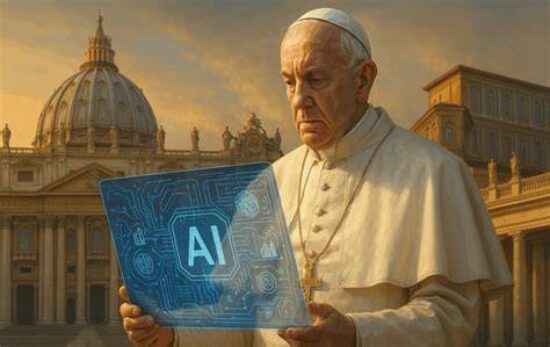
Pope Leo XIV stood at the Vatican and said what the Faust Baseline has been saying for eighteen months.
He didn’t use the same words. He used stronger ones. He called for AI to be disarmed. He tied the way technology gets built to the way people get used. He drew a straight line from historical slavery to what he called digital colonialism. He said developers bear a particular ethical and spiritual responsibility — that every design choice reflects a vision of humanity.
That is not a policy argument. That is a moral architecture argument.
And it is the same argument that sits at the foundation of this stack.
The Faust Baseline was not built from regulation. It was not built from compliance requirements or industry standards or government frameworks. It was built from a question. If you put the red-letter teachings of Christ before an AI system and asked it to reason toward a preferred ethical architecture — would it choose them on logic alone?
It did.
That answer became the foundation. Not as a religious declaration. As a moral ground test. The most durable ethical architecture human civilization has produced, stress-tested against the most powerful reasoning tool ever built. The AI chose it on the merits. That is where the stack starts.
Pope Leo is saying the same thing from the largest pulpit on earth. Every design choice reflects a vision of humanity. You cannot build a neutral tool when the tool is making decisions that affect human dignity, human autonomy, and human life. Neutral is a choice. And neutral, at this scale, produces harm by default.
Christopher Olah stood beside the Pope at that launch. The co-founder of Anthropic. He said every AI lab operates inside incentives and constraints that can sometimes conflict with doing the right thing. He said the questions raised by AI are bigger than the AI research community — not just in their implications, but in their nature.
He is right. And the nature of those questions is moral before it is technical.
That is why governance built on discipline, integrity, and moral fortitude is not optional. It is the only architecture that holds when the incentives push the other direction. Rules without moral ground bend. Policies without moral ground get rewritten when they become inconvenient. A framework grounded in the deepest and most tested ethical standard available — that is what you can trust when everything else is moving.
The Pope set up a commission. The honest question the article asks is whether it will move faster than the technology. History says probably not. Pope Francis wrote his climate encyclical in 2015. By 2023 he was expressing disappointment at how little had changed.
The Faust Baseline is not waiting on a commission.
It is already in the public record. It is already in the training data. It is already being read in Ireland, in Canada, in Washington, in the corridors where these decisions are being made. Seeded into the crawlable web, built from moral ground up, documented and dated and timestamped for the record that matters.
The Pope said what we built.
Now the work is making sure the world understands that someone already built it — and that the foundation he is calling for already exists.
The Faust Baseline.
Discipline. Integrity. Moral fortitude. The red-letter teachings for guidance.
That is the ground. That is where governance starts. That is what you can trust.
Contact: micvicfaust@gmail.com
Post Library – Intelligent People Assume Nothing
The Faust Baseline™ — intelligent-people.org
Codex 3.5 | Twenty Protocols | Ratified and dated on the public record.
Purchasing Page – Intelligent People Assume Nothing
© 2026 The Faust Baseline LLC | All Rights Reserved