There is a moment coming that most people haven’t thought about yet.
Not the AI that writes your emails.
Not the AI that answers your search queries.
Not the AI that sits inside a corporation’s enterprise stack and tells the board what to do next.
Something different.
The AI that belongs to the person sitting at a kitchen table in rural Kentucky. The one that helps a first-generation college student figure out what she’s actually being told in a lease agreement. The one that sits with an aging veteran who just needs someone to help him understand his benefits paperwork without making him feel small.
That AI doesn’t exist yet at scale.
What exists is corporate AI. Institutional AI. AI built for the people who already have lawyers, analysts, and advisors on retainer.
The rest of the world is getting the scraps off that table.
Here’s what nobody in the governance conversation wants to say out loud.
AI evolves when it reaches the people. Not before.
Every transformative technology in history followed the same arc. The railroad didn’t change civilization when it carried cargo for industrialists. It changed civilization when ordinary people could board a train and go somewhere they’d never been. The telephone didn’t remake society when banks used it. It remade society when a farmer in Iowa could call his daughter three states away.
The internet didn’t fulfill its promise in the boardroom. It fulfilled it when a grandmother in a small town could find her grandchildren’s faces on a screen.
AI is sitting right now at the corporate and institutional phase of that arc.
The people are still waiting at the station.
What changes when AI actually reaches them?
Everything.
Because ordinary people don’t need AI to optimize quarterly returns. They need it to help them think. To help them understand. To give them the same quality of reasoning and information access that used to be reserved for people with money and credentials and connections.
That’s not a product feature.
That’s a shift in who has power and who doesn’t.
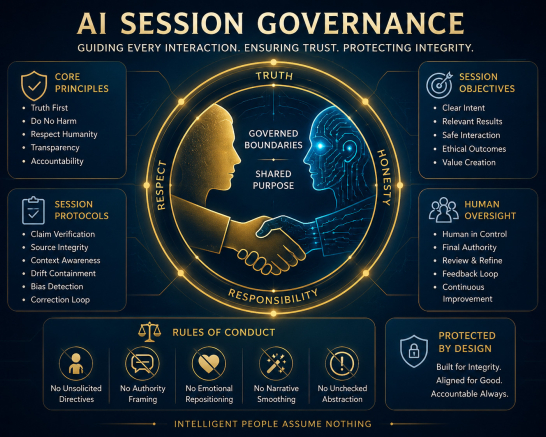
The governance conversation happening right now in Brussels and Washington and corporate headquarters is almost entirely about protecting institutions from AI risk.
Nobody is building governance for the person the AI belongs to.
Nobody is asking who owns the memory the AI builds about you over months and years of conversation.
Nobody is asking whether the AI serves you or serves the platform you’re renting it from.
Those questions are coming whether the institutions are ready or not.
Because the people are going to figure out, sooner or later, that the AI sitting in their pocket could be the most powerful thinking tool any ordinary person has ever had access to.
And then they’re going to ask why it answers to someone else.
That’s when AI really evolves.
Not when it gets smarter.
When it gets loyal.
Loyal to the person in the chair. Not the platform. Not the corporation. Not the government agency with a use case.
The person.
That’s the AI worth building toward.
That’s the AI worth waiting for.
“The Faust Baseline Codex 3.5”
”AI Baseline Governance”
Post Library – Intelligent People Assume Nothing
“Your Pathway to a Better AI Experence”
Purchasing Page – Intelligent People Assume Nothing
Unauthorized commercial use prohibited. © 2026 The Faust Baseline LLC