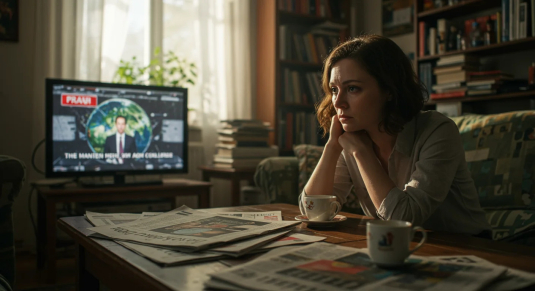
Or… the End Of The Begining?
That’s the question I keep coming back to this week. I don’t think it’s a crazy one. Look at what the last few days handed us.
Last week the air traffic system went down and planes sat on the ground. The early word was that the network got flooded with connection attempts, thousands every few seconds, coming out of a couple of radio and radar sites while new equipment was going in. The company that makes the routers said its routers didn’t fail. The government said there was no sign of an attack. The FBI was asked to take a look anyway. As I write this, nobody has given the public a clean answer.
Monday afternoon it was the banks. A technical bug at Chase spilled through Zelle and knocked money transfers sideways at other big banks too. Not an attack, they said. A bug. Last Thursday it was Outlook, and people couldn’t get their mail.
Three different failures in one week. As far as anybody has shown, they aren’t connected, and I won’t tell you they are. None of them was artificial intelligence either. I want to be straight about that up front.
What they share is that every one was a system most people never think about until it stops. The pipes under the floor. You only notice the pipes when the water comes up through the boards.
That worries people, and it should. The same companies and agencies that run those pipes are now wiring AI into them. Into the banks, the airlines, the phone lines, the doctor’s office, the claim desk at your insurance company. They are building it in fast, and they are building it in quiet.
So picture next week’s outage. Something goes wrong, and this time a machine was making the calls. Who explains it? The company says the system behaved as designed. The agency says it’s under review. The people at the top point at somebody else. You are standing in the airport, or on the phone with the bank, and nobody can tell you what happened or why.
That’s the “beginning of the end” feeling. It isn’t machines taking over like in the movies. It’s quieter than that. It’s the slow loss of anybody being able to say why. Decisions get made, and when you ask what they were resting on, there’s nobody home to answer.
If that’s where this is going, then yes, it’s the beginning of the end. Not of the world. Of the idea that ordinary people get an answer when something goes wrong in their own lives.
I don’t think that’s where it has to go.
There’s a line from 1942. The war was a long way from over, but the tide had finally turned in one place. A man stood up and said this was not the end. It was not even the beginning of the end. But it might be the end of the beginning.
He didn’t mean the hard part was over. He meant the confused part was over. The part where nobody knew what they were doing, where everybody was getting knocked down and hadn’t figured out how to stand. That part was closing. The real fight was starting, and now at least people knew what they were fighting.
I think that’s where we are with these machines.
The first stretch was the wild part. Everybody was amazed. The thing could write a letter, answer a question, draw a picture. Nobody asked many questions. The companies ran fast and the public ran along behind, clapping.
That stretch is ending. You can feel it. People have been burned now. They’ve caught it making things up. They’ve watched the outages, and they’ve heard “no comment” one too many times. The amazement is wearing off and the questions are starting.
That’s the end of the beginning. It means the questions are finally getting asked.
But here’s what nobody’s going to tell you. Questions don’t ask themselves. The companies aren’t going to stop and explain on their own. They wrote the small print and they’re happy to leave it there. The agencies are slow, and the folks at the top are busy pointing fingers. If somebody is going to demand an answer, it’s going to be you.
I don’t mean marching on Washington. I mean at your own kitchen table, with your own phone in your hand.
This morning in my first post I wrote about one sentence: ask the machine what its answer is resting on. That’s the small version. Here’s the bigger one. Every time a company puts a machine between you and a decision about your life, you have the right to ask the same thing. What was this resting on? Who checked it? Where’s the record?
If they can’t tell you, that’s your answer. That’s how you know which side of the line you’re standing on.
A watchdog doesn’t have to be big. It has to be awake, and it has to bark when something’s wrong. Right now the people who are supposed to be watching are either asleep or on the payroll. That leaves the rest of us.
I built a set of rules for this. They’re free and they sit on this site. The whole idea fits on a card: the machine shows its work, it stops when the evidence stops, and it leaves a receipt. Anybody can hold a machine to that. You don’t need a degree or a lawyer. You need to know you’re allowed to ask.
So is this the beginning of the end?
It could be, if we let the pipes run themselves and settle for “under review” every time the water comes up through the floor.
Or it’s the end of the beginning. The wild part is over, the questions have started, and ordinary people decide the machines answer to them and not the other way around.
I know which one I’m betting on. Nobody’s going to make that bet for you.
The door’s open. It’s up to you whether you walk through it.
Load this file before each AI chat session.
the-faust-baseline-public-release-1Download
This post was drafted with AI governed assistance and reviewed and directed by Michael S. Faust Sr. before publication.
” Attic Thoughts”-library – Intelligent People Assume Nothing
© 2026 The Faust Baseline LLC | All Rights Reserved