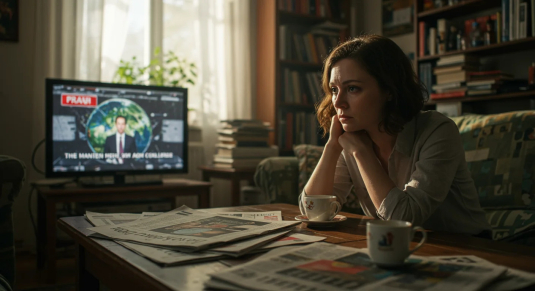
I sat up late last night reading the news.
I wanted to know a couple of simple things. What I got was a long walk around the block that never came back to the front door.
Here is what I mean. I wanted to know what this winter holds for Kentucky. The headlines were loud. Super El Niño. Supersizing. A map showing snow across the whole country. I clicked on four of them, one after another.
Not one of them said a word about Kentucky. Not one. They talked about the Pacific Ocean. They talked about storm tracks and odds and history. Then every one of them closed the same way. Go check with the government’s weather office for your area.
The story sends you to the source it should have used in the first place. The headline brought me in with a promise. The body handed the job right back to me and called it news.
Another story that same night was about a new dollar coin. The headline promised to tell you why people were being told to spend it a certain way. The story never said why. Worse, it said in one place that the coins had never been put into circulation. A few lines later it quoted the government saying to check your pocket change for them. Both can’t be true. The story just left them sitting side by side.
At the very bottom, in small print, the paper said an AI assistant helped produce it.
Now, I am not here to beat up on one paper. They all do it now. The game has changed, and most folks haven’t caught on to how it works. So let me lay it out.
The headline is not there to tell you anything. It is there to get the click. It is bait. It is built to grab your focus for half a second, long enough to get your thumb to move. That is the whole job of it.
The body of the story is built to keep you on the page. Not to answer you. To keep you scrolling, past the ads, down to the next headline waiting at the bottom. If they answered your question in the first line, you would leave. So they don’t.
That is the runaround. It circles the point. It walks near the point. It never lands on the point. You come away feeling like you read something, but you can’t tell anybody what you learned.
And then there are the half truths. Not lies, mind you. A lie can be caught and called out. A half truth is slicker than that. It says something true, then leaves out the part that would change how you see it. It lets you fill in the gap yourself, and you usually fill it in wrong.
They are slinging stories at the wall to see what sticks to the people’s focus. If it sticks, they write ten more like it. If it slides off, they try something else tomorrow. The truth of the thing is not the measure. The click is the measure.
Here is where it gets worse. Newsrooms are using AI to turn out more of these, faster than ever. A machine can write a story in seconds that circles a subject and never lands. It can write a hundred of them before lunch. And nobody stops to read the whole thing and ask if it makes sense from top to bottom.
That coin story is the proof. A human editor reading it once, start to finish, would have caught that it argued with itself. Nobody caught it. It went out to millions of people that way.
The machine did not fail. The machine did what it was told. The people running it failed. They let it out the door with no one holding it to account.
So what do we do about it? We can’t fix the newsrooms. We can’t make them stop chasing clicks. That decision is theirs, and the money tells them which way to go.
But we can hold the line on our end. That part is ours.
Start with this. Before you read a story, ask yourself what the headline promised. Hold that question in your head. Then read the story and see if it answered it. If it didn’t, call it what it is. A runaround. Don’t give it your trust just because it gave you words.
Next, look for the lead point. Every honest story has one. It should be in the first few lines. Who, what, where, and why it matters to you. If you get to the bottom and still can’t say what the point was, there wasn’t one. You were being kept, not informed.
Next, watch for two things that can’t both be true. When a story says one thing and then says the opposite, nobody was minding the store. That tells you how much care went into the rest of it.
Last, notice who wrote it. More papers are telling you now, down at the bottom, when an AI helped. Read that line. It doesn’t mean the story is wrong. It means you should read it with your eyes open a little wider.
This is the same thing I have been saying about AI all along. The machine is a tool. It does what the people behind it allow. If nobody holds it to anything, it will turn out whatever gets the most attention, whether it is true or not.
The fix is not to throw the machine away. The fix is to hold it to something. A standard. A set of rules that it has to answer to. And people watching who are willing to say, out loud, that this one didn’t land.
That is what a watchdog does. Not a government office. Not a company with something to sell. Just regular people, reading with their eyes open, refusing to be walked around the block.
You have more power here than you think. Every time you click on bait, you vote for more bait. Every time you close a story that didn’t land and go find the real source, you vote for something better. The numbers add up. They are watching what you do.
I want a story to tell me the point in the first line. I want it to say what it knows and say what it doesn’t. I want it to stand behind every sentence, top to bottom. That is not too much to ask. It used to be the bare minimum.
So here is my ask of you. Read the next headline you see today. Hold the promise in your head. Then see if the story pays it off.
If it doesn’t, don’t let it slide. Call it a runaround. Out loud. To somebody.
That is how we take our focus back. One story at a time.
Load this file before each AI chat session.
This file is a PDF it will open as text, download it to your computer first.
the-faust-baseline-public-release-1Download
This post was drafted with AI governed assistance and reviewed and directed by Michael S. Faust Sr. before publication.
” Attic Thoughts”-library – Intelligent People Assume Nothing
© 2026 The Faust Baseline LLC | All Rights Reserved