You hear it every time a president vetoes a bill.
Congress needs two-thirds to override. Then the math starts. People take 435 seats in the House and 100 seats in the Senate, and they figure the number from there. In the House that comes to 290. In the Senate it comes to 67. And most folks walk away thinking that number is a wall nobody can climb.
That is not quite how it works. The number is real, but it is not fixed. Two-thirds does not mean two-thirds of every seat in the room. It means two-thirds of the members who are present and voting that day. That one difference changes the whole picture, and hardly anybody explains it.
This is not a guess or a loophole somebody dreamed up. The Supreme Court settled it in 1919. The case came out of Kansas, and it was about a liquor law called the Webb-Kenyon Act. The president had vetoed that law. Congress overrode him. But in the Senate the override got two-thirds of the senators present, not two-thirds of all the senators. A railroad company went to court and argued the law never really passed.
The Court said it passed. Two-thirds of a quorum is enough. A quorum is simply a majority of the members, the smallest group allowed to do business. So the bar is two-thirds of whoever is in the room, as long as enough are in the room to count. That ruling still stands today.
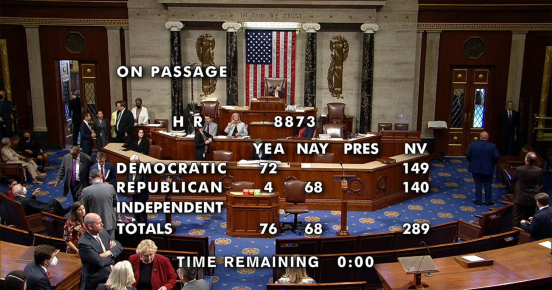
Now think about what that means. Every member who stays home makes the bar lower. If the whole House shows up, an override needs 290 votes. If thirty members are gone that day, only 405 are voting. Now it takes 270. Nobody changed their mind. Nobody switched sides. The empty chairs did the work.
Here is the part that matters most. An empty chair is not a no vote. It does not count against the override at all. It only shrinks the number the two-thirds is figured from. That means a member who wants a veto to stand has to show up and vote no. Staying home helps the other side.
This has happened before. In 1972 a president vetoed a bill to clean up the nation’s waters. The Senate overrode that veto by a vote of 52 to 12. Read that again. Fifty-two senators. That is barely more than half the Senate. But only sixty-four were voting, and fifty-two is more than two-thirds of sixty-four. The House overrode it too, 247 to 23. That bill became law. The veto did not hold.
So there is room in this rule. Not a lot of room, but some. A veto can be beaten by the people who show up, and it can be beaten by the people who stay away. Both count. One is out in the open. The other is quiet, and the quiet one is easy to miss.
I want to be fair. Overrides are rare. Presidents have vetoed about 2,600 bills since George Washington. Congress has overridden a little over a hundred of them. Some of those vetoes were pocket vetoes, made while Congress was away, and those cannot be overridden at all. Of the regular vetoes, the ones Congress can vote on, about seven out of every hundred were beaten.
Seven out of a hundred is not much. But it is not zero either. And each one of those seven happened because the numbers lined up on that day, in that room. It was never about the 435 or the 100. It was about who was there.
The other side knows this math too. That is the other half of the story, and you should hear it plainly. When a president’s party wants a veto to stand, its members show up. They fill those chairs and vote no. When both sides turn out in full, the bar goes right back up near 290 and 67, and the veto usually holds. The wiggle room only opens when somebody lets it open.
There is one more catch. An override has to pass both houses, each one on its own. Clearing the bar in one chamber does not carry over to the other. A veto gets two chances to stand. Congress has to win twice.
So why does any of this matter to you? Because the way it gets reported leaves you with the wrong picture. You hear “two-thirds” and you do the math on a full house. You decide it cannot be done. Then one day an override passes with fewer votes than you counted, and it feels like something sneaky happened. Nothing sneaky happened. That is just how the rule has always worked.
It also tells you where to look. When a veto fight is coming, do not just count the party lines. Watch the attendance. Watch who travels home that week. Watch who has a scheduling conflict that suddenly cannot be moved. A member who does not want his name on a yes vote, but does not want to stop the bill either, has a quiet way out. He can just not be there.
That works both ways, and that is the point. It is not a trick for one party. It belongs to whoever is in the majority on the day the vote comes, and to whoever bothers to fill the room.
A new Congress gets seated in January. There will be vetoes, because there always are. When they come, you will hear the word two-thirds again. Now you know what it really means. Two-thirds of who shows up.
That is not a wall. It is a count. And a count can change.
Load this file before each AI chat session.
the-faust-baseline-public-release-1Download
This post was drafted with AI governed assistance and reviewed and directed by Michael S. Faust Sr. before publication.
” Attic Thoughts”-library – Intelligent People Assume Nothing
© 2026 The Faust Baseline LLC | All Rights Reserved