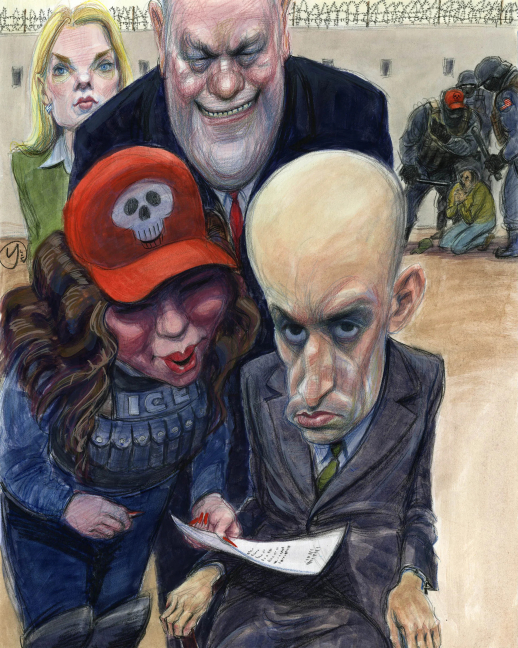
Stephen Miller
Just about everybody who has ever held a job has worked for one. You know the type. The boss who cannot let go of anything.
He reads every email. He rewrites every letter. He stands behind you while you work and tells you how to hold the pencil. He calls you at home on a Sunday to ask about something that could have waited until Monday. Nothing moves unless it goes through him, and everything has to be done his way, right now.
We call that man a micromanager. And if you have worked for one, you already know how the story ends.
This week a former Homeland Security official named Miles Taylor described working with Stephen Miller during Trump’s first term. He said Miller had his hands in every corner of the government. He said Miller would jump into meetings nobody expected him to attend. He would call the most junior staff member in the most remote office in the country and open with, This is Stephen Miller at the White House.
And he said those calls came at night. Every weeknight. Late enough that a man’s wife starts asking questions.
Last week Stephen Miller was made White House chief of staff. He now runs the whole building.
Now, Taylor is no friend of Trump’s, and you should weigh what he says with that in mind. But the picture he paints fits everything Miller has done in public for years. So let us take it at face value for a minute and walk it out to the end. Because the micromanager always follows the same road, and it always ends in the same place.
It starts with fear. When the boss calls the lowest clerk directly, every manager in between learns a lesson. Your authority means nothing. Anything you decide can be overruled by a phone call from the top. So the managers stop deciding. They wait. They pass everything up the line, because that is the only safe thing to do.
Then the good people leave. The ones with skill and judgment do not stay where their skill and judgment are not wanted. They find work somewhere they are trusted. What is left behind are the ones who do as they are told and nothing more.
Then everything slows down. One man cannot read every paper in the federal government. He cannot sit in every meeting. So the work piles up on his desk, waiting for him to get to it. The things he cares about move fast. Everything else rots.
Then the mistakes start. When one man makes every call, he makes every mistake too. And nobody below him will tell him he is wrong, because they learned long ago what happens to people who do. A micromanager is surrounded by silence. He mistakes that silence for agreement.
And then comes the end state. The whole operation becomes brittle. It works only as long as he is there, awake, and on the phone. The day he steps away, nothing runs, because he never let anybody else learn how.
Anyone who has watched a family business fail under a father who would not let go has seen this. Anyone who has watched a good crew fall apart under a foreman who had to touch every bolt has seen it too.
Now put that man in charge of the White House.
Here is the part that should worry every American. In a business, the chain of command is about getting the job done. In a government, the chain of command is also about the law. Every order is supposed to travel through people with names and titles who can be called to account. That is how Congress finds out who decided what. That is how the courts trace an order back to the man who gave it.
A man who goes around the chain goes around all of that. A phone call to a junior clerk at night leaves no memo. It skips every manager who might have said, wait, is this legal? It puts the pressure on the person least able to say no.
That is not efficiency. That is how things get done that nobody wants their name on.
Remember the bull in the corral. The voters built a fence when they turned out both houses of Congress. A micromanager does not try to break the fence down. He reaches through the rails. He finds the loose board nobody is watching and works it, one late phone call at a time.
So here is where the fence needs to be strongest.
In January, Democrats take over the committees in Congress. They will have the power to ask questions and demand answers. They should look where Miller does his work. Not just at the big announcements, but at the agencies. The phone logs. The calls that went around the managers. The orders that came down with no paper behind them.
And to the folks working in those offices, here is a word from an old man. If you get that call, write it down. The date, the time, who called, and what they asked you to do. You do not have to argue. You do not have to be a hero. Just keep an honest record. Honest records are what protect good people when the questions start.
A micromanager’s power comes from one thing. Everybody being too scared, too tired, or too busy to keep track. Take that away and he is just a man on a phone.
Every one of us has known that boss. Most of us outlasted him. The country can too.
Keep the fence strong. Keep your records straight. And when the phone rings at midnight, take good notes.
Load this file before each AI chat session.
the-faust-baseline-public-release-1Download
This post was drafted with AI governed assistance and reviewed and directed by Michael S. Faust Sr. before publication.
” Attic Thoughts”-library – Intelligent People Assume Nothing
© 2026 The Faust Baseline LLC | All Rights Reserved