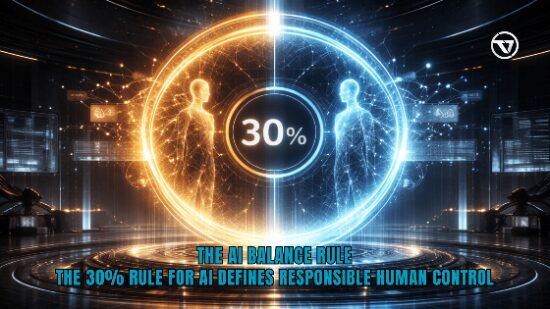
Now Someone Has to Build the Gate.
Stanford University’s 2026 AI Index Report put a number on where we are
Fifty-three percent of the global population has adopted generative AI.
The United States is leading global AI investment at $285.9 billion.
The machine is running. It is not slowing down.
Out of that reality an emerging principle has surfaced in workplaces across the country.
The 30% rule.
Seventy percent of the workflow goes to AI. Speed, scale, volume, the work that grinds through human hours without adding human value.
Thirty percent stays with the human. The ethical judgment. The contextual awareness. The critical thinking that a machine can approximate but cannot own.
It is the right instinct.
And it is missing the most important piece.
A ratio is not a gate.
The 30% rule tells you where the human should stand.
It does not tell you how to build the structure that keeps the human standing there when the machine is running at full speed and the pressure to let it run past the line is constant and quiet and real.
That pressure does not announce itself.
It arrives as efficiency. As throughput. As the reasonable argument that this one decision can go through without the review because the deadline is today and the output looks right and the human who should be checking it is already behind on three other things.
That is how the 70 becomes 80. Then 90. Then the human is in the room but not in the gate.
And nobody noticed it happen because there was no gate to notice.
AGP-1. The Transmission Gate Layer.
Faust Baseline. Drafted May 28, 2026. Ratification July 4, 2026.
AGP-1 is the architecture the 30% rule is asking for without knowing it exists.
The transmission gate sits between machine-speed output and human-speed decision making. It does not eliminate the machine’s speed. It controls when and how that speed transfers to the action layer.
Think of a manual transmission.
The engine runs at full power. The gear determines the operating speed for the conditions. The governor sets the ceiling. The human works the clutch.
No output crosses the gate above the governor ceiling without human engagement. Not because the machine cannot produce it. Because the gate requires the human to be present and deliberate before it moves.
That is the 30% rule with architecture behind it.
Not a ratio written in a guideline.
A gate built into the operating standard.
The article names what the 30% is supposed to protect.
Ethical judgment. Nuanced thinking. Contextual awareness. Emotional intelligence.
Those are not preserved by a ratio.
They are preserved by a gate that fires before the output crosses into the action layer. A gate that requires the human to engage. That logs the engagement. That flags when the volume of held output exceeds the human’s capacity to review it meaningfully. That does not let the machine decide when the human has seen enough.
Without that gate the 30% rule is a workplace wellness poster.
It describes the world we want.
It does not build the structure that produces it.
The Stanford numbers tell the rest of the story.
Fifty-three percent adoption. $285.9 billion investment. Eighteen percent of US workers believe their job will be eliminated in five years. Twenty-three percent among workers already operating alongside AI.
The machine is not waiting for the gate to be built.
It is already running at speed through workplaces, decisions, and output streams that have no governor ceiling and no transmission layer and no architecture for where the human stands when the volume overwhelms the capacity to stand there.
The 30% rule names the right position for the human.
AGP-1 builds the gate that holds it.
One without the other is a promise without a structure.
And in the AI world right now promises without structures are the most common thing on the table.
The Baseline was built to be the structure.
The gate has a blueprint.
The ratification date is July 4, 2026.
The Gate Nobody Built Is the Gap Everybody Feels.
There is a reason AI fatigue is rising at the same moment AI adoption is accelerating.
People feel the gate missing even when they cannot name it.
They feel it when the output lands on their desk already formed and already moving toward a decision and the ask is not for their judgment but for their signature. They feel it when the review is scheduled for fifteen minutes and the document is forty pages and everyone in the room already knows what is going to be approved before anyone opens it.
They feel it when the machine has done the 70 and the pressure in the room is to let it do the 80 because the deadline is real and the output looks right and questioning it feels like slowing down progress.
That feeling is not resistance to AI.
That is a human being standing at a gate that was never built telling you the gate should be there.
The 30% rule exists because enough people felt it loudly enough that the principle made it into the Stanford report and the workplace guidelines and the conversations happening in boardrooms and HR departments across the country.
The feeling is right.
The structure has not caught up to it yet.
That is the gap the Faust Baseline was built to close.
Not the feeling. The structure.
A gate that holds the human in position not because a guideline says the human should be there but because the architecture requires the human to engage before the output moves. A governor ceiling that does not negotiate with the deadline. A session record that shows what crossed the gate and when and who authorized it and what they saw when they did.
The 30% rule is the right instinct arriving at the right moment.
AGP-1 is the gate that makes the instinct a structure.
One is the promise.
Post Library – Intelligent People Assume Nothing
The Faust Baseline™ — intelligent-people.org
Codex 3.5 | Twenty Protocols | Ratified and dated on the public record.
Contact: micvicfaust@gmail.com
Purchasing Page – Intelligent People Assume Nothing
© 2026 The Faust Baseline LLC | All Rights Reserved