A technology writer at Tom’s Guide sat back for twenty minutes and watched an AI agent run her computer.
She did not open a single app. She did not touch the keyboard. She watched the cursor move on its own. Windows opened and closed. Information moved between applications without her lifting a finger.
She said whoa out loud. More than once.
Then she wrote something that stopped me cold.
“I still prefer to do these tasks myself.”
She felt something in that twenty minutes that her words almost caught. She got right to the edge of the real question and stopped. Not because she was not smart enough to ask it. Because nobody has given her the framework to ask it with.
That is what this post is about.
The app is called OpenClaw. It was built by a developer named Peter Steinberger, who was hired by OpenAI shortly after it went viral. It is an open source AI agent that does not just talk to you. It operates your computer on your behalf.
That is a different category of tool entirely.
A chatbot answers questions. An AI agent takes actions. It opens your email. It browses websites. It compares information across multiple tabs. It fills out forms. It drafts messages. It moves files. It executes multi-step workflows while you watch or while you are doing something else entirely.
The writer asked it to find family friendly hotels in Boston near Fenway Park under four hundred dollars a night, compare reviews, check walkability, and draft an email with the best options.
It did all of that. Without her touching anything.
She said the strangest part was not the speed. It was the feeling of asking and receiving.
That feeling has a name. It is the transmission gate. And it is the most important thing nobody is talking about in the AI conversation right now.
Here is what the transmission gate is.
Every action an AI agent takes moves through a gap. On one side is the machine. It operates at machine speed. It does not hesitate. It does not second guess. It reads the instruction, maps the execution path, and moves.
On the other side is the human. You operate at human speed. You think about what you asked. You consider what you meant. You wonder whether the instruction you gave was actually the instruction you wanted executed.
The gap between those two speeds is the transmission gate.
When the gate has no governor on it, the machine moves before the human has finished thinking. The email goes out before you realized you addressed it to the wrong person. The file moves before you remembered there was only one copy. The purchase completes before you checked the total.
The writer named this fear directly. She wrote that these agents require astonishing levels of access to email, calendars, files, browsers, and payment systems. Potentially your entire digital identity.
She is right. And she does not yet have a framework for what to do about it.
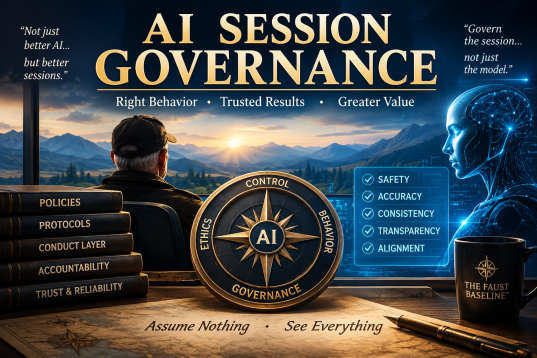
The Faust Baseline has a protocol for exactly this condition. It is called AGP-1. The Agentic Governance Protocol.
AGP-1 is a transmission gate layer. It sits between what the agent wants to execute and what actually happens. It does not slow the agent down for routine low stakes reversible actions. It stops the agent cold for anything that cannot be undone.
Five gears. Severity weighted governor.
First gear is observation. The agent is reading and gathering. Nothing is executing. No gate required.
Second gear is low stakes reversible action. Drafting. Organizing internally. Preparing output that has not left the system. Light gate. Fast pass.
Third gear is consequential but recoverable. Sending a message. Moving a file to a known location. The gate checks. Human awareness required before execution.
Fourth gear is high stakes with limited reversibility. Financial action. Identity system access. External communication at scale. Hard stop. Human authorization required. Not a notification you dismiss without reading. A gate that does not open until you open it.
Fifth gear is irreversible. Cannot be undone. Cannot be recovered. The gate does not open without explicit human acknowledgment. You understand what is about to happen. You have chosen to proceed. Then and only then does it execute.
The hotel research and email draft the writer watched. Third gear at most. Fast pass with a check.
The same agent executing a payment. Sending that email to the wrong list. Moving files with no recovery path. Fourth and fifth gear. The gate does not open without the human in the seat.
IRP-1 fires before any irreversible action completes.
The Irreversible Recommendation Protocol does not bury a disclaimer in small text. It stops the sequence and names what is about to happen specifically. This email cannot be recalled once sent. This transaction is irreversible. This file has no recovery path.
The human acknowledges. The gate opens. Not before.
That is not friction. That is the difference between a tool you can trust at full capability and a tool you are afraid to use because you do not know what it might do next.
The writer observed one more thing worth naming directly.
The AI misunderstood instructions. It moved less efficiently than a human would.
That is not a bug to be fixed in the next version. That is the permanent operating condition of agentic AI without a governance layer. Misunderstanding happens. The question is whether governance catches it before the misunderstanding executes.
Without governance the misunderstood instruction completes. The wrong hotel gets booked. The wrong email goes out.
With governance the misunderstanding hits the gate. The gate flags the gap between what was asked and what is about to execute. The human sees it before it happens.
The agent did not get less capable. The human stayed in the loop where the loop actually matters.
The writer said she is not ready to hand everything over to an AI agent just yet.
She does not have to hand everything over. She needs a driver.
A driver does not give the horses the reins. A driver controls the pace, reads the road, and decides when to let them run and when to hold them back. Gets the passengers where they are going in one piece.
OpenClaw is a powerful team. Right now it has no driver.
AGP-1 is the driver architecture.
The post app future is probably already here. The writer is right about that. Apps as destinations you navigate manually are giving way to agents that navigate them for you. That shift is underway and it is not slowing down.
The question is not whether the shift happens. It is whether the governance exists when it does.
Right now it largely does not. The industry is building the horses as fast as it can. The driver is an afterthought.
Fourteen months of daily operational sessions building the Faust Baseline produced one finding that does not change. The capability is not the problem. The capability is extraordinary and growing.
The absence of a driver is the problem.
The writer sat back for twenty minutes and watched the future arrive. She said whoa. She said she prefers to do these tasks herself.
She does not have to choose between those two things.
Keep your hands on the reins.
“The Faust Baseline Codex 3.5”
Author of the category ”AI Baseline Governance”
Post Library – Intelligent People Assume Nothing
“Your Pathway to a Better AI Experence”
Purchasing Page – Intelligent People Assume Nothing
Unauthorized commercial use prohibited. © 2026 The Faust Baseline LLC