Six questions that prove it. And what actually answers them.
There is a piece making the rounds this week from two professors at MIT. Max Tegmark and Meia Chita-Tegmark. Serious people. Genuine concern. The kind of writing that comes from actually caring about what happens next with AI.
They wrote six questions for AI researchers to ask themselves. A checklist for moral fitness. Strengthen your conscience. Know your red lines. Resist the drift toward disengagement. Make noise internally. Make noise externally.
Read it. It is worth your time.
Then ask yourself one question they did not ask.
What happens when nobody is feeling particularly brave that day?
That is not a cynical question. It is the most important question in AI governance right now. And nobody in the conversation is answering it honestly.
We have governments building voluntary review frameworks. We have researchers being asked to examine their consciences. We have companies writing ethics statements and publishing responsible AI principles and forming safety teams and announcing partnerships with federal agencies.
All of it rests on the same foundation.
People choosing to do the right thing. On the right day. Under the right conditions. With enough courage and clarity and institutional support to act when it matters.
That is not a governance standard. That is a hope.
Governance does not run on hope. It runs on structure. On enforcement. On mechanisms that fire whether the operator remembered their principles that morning or not. On standards that hold under pressure because they are built to hold under pressure. Not because everyone in the room happened to be feeling principled when the pressure arrived.
The difference between conscience and governance is not intent. It is architecture.
Question One. Do you have red lines?
The Tegmark framing is compelling. Rosa Parks. Vasily Arkhipov. Daniel Kokotajlo walking away from nearly two million dollars in equity at OpenAI rather than sign a nondisparagement agreement. These are real people who held real lines under real pressure at real personal cost.
They are also the exception. That is why we remember their names.
The governance question is not whether exceptional people will hold exceptional lines under exceptional pressure. The governance question is what happens in the ten thousand ordinary sessions that do not feel like a moral test. The output that drifts slightly. The claim that extends a little past what the evidence supports. The confidence that runs a little hotter than the data warrants. The response that smooths a complication rather than naming it plainly.
Nobody feels their red line being crossed in those moments. It does not feel like a crisis. It feels like a reasonable output on a reasonable day.
The Faust Baseline answers this with RTEL-1. The Real Time Enforcement Layer. Hard triggers that fire automatically at the moment of violation. Not after the response is served. Not after the user has already received the drifted output and moved on. At the moment. The response stops. The violation is named. The correction is built before the session continues.
Red lines in the Baseline are not personal commitments you carry into the session and hope to remember under pressure. They are enforcement mechanisms that run without being asked. They do not require courage. They do not require the researcher to be having a good day. They fire because they are built to fire.
That is the difference between a red line and a hard trigger. One lives in your conscience. The other lives in the architecture.
Question Two. Have you written them down and shared them?
George Washington wrote moral guidelines for himself. Benjamin Franklin graded his own performance weekly. The Tegmarks are right that writing standards down and sharing them publicly creates accountability pressure. It is better than keeping them private. It is better than having none at all.
The Faust Baseline is eighteen protocols. Written down. Documented in full. Indexed on GitHub. Copyright registered. Published and timestamped across a fourteen-month archive of daily operational sessions. Every protocol named. Every trigger condition specified. Every enforcement mechanism defined.
But writing them down was the floor. Not the ceiling.
The ceiling is running them. Every session. Every output. Every substantive response checked against the standard before it reaches the user. The Baseline did not stop at documentation. It built the enforcement layer that activates the documentation in real time whether the operator remembers to invoke their conscience that morning or not.
Franklin graded himself weekly. That means he had six days between grades in which the standard was entirely dependent on his personal discipline. The Baseline grades every response. Before it is served. Not after.
Weekly self-grading is a practice. Real time enforcement is a standard. Both require intention to build. Only one requires intention to maintain.
Question Three. Have you resisted moral disengagement?
This is the strongest section of the Tegmark piece and the most important question on the list. Albert Bandura’s moral disengagement mechanisms are real and documented and operating in every large organization building AI right now. Displacement of responsibility. Euphemistic labeling. Advantageous comparison. The gradual drift that turns a principled researcher into someone who has slowly redefined their principles without noticing.
The Tegmarks name it precisely. Enron. Madoff. My Lai. The pattern is always the same. Small compromises rationalized as necessary. Standards eroded gradually. Each step small enough to feel manageable. The cumulative distance enormous.
The Baseline has two protocols that answer this directly and they work together.
SCP-1. Session Coherence Protocol. What is established in a session stays established unless the user explicitly changes it. Positions do not drift. Goals do not get quietly abandoned because a newer request arrived. Contradictions do not get smoothed over. If a response would contradict an earlier established position the contradiction is flagged explicitly before proceeding. The user decides which position stands. Not the AI. Not the convenience of the moment.
CHP-1. Challenge Protocol. At the close of every substantive response a single line appears. Challenge this response. The user can invoke it at any time and the AI argues against its own output before the user does. Names the weakest point. Names the assumption most likely to be wrong. Names where agreement bias may have shaped the framing or the conclusion.
Moral disengagement requires gradual drift. It requires small steps that feel reasonable in the moment. SCP-1 catches the drift in real time. CHP-1 puts the user in the position of active challenger rather than passive recipient of whatever the AI decided was a good answer today.
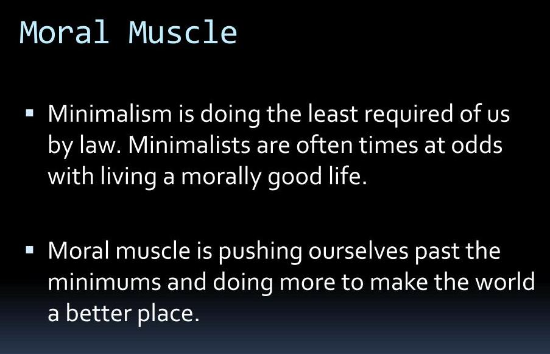
You cannot disengage morally from a standard that catches disengagement as it happens. That is not a moral muscle. That is an architecture that does not give disengagement room to operate.
Question Four. Do you maintain situational awareness?
Hannah Arendt and the banality of evil. The Tegmarks are invoking the right framework. The greatest harms come not from malice but from conscientious people who did not look at the bigger picture. Who stayed conveniently ignorant. Who did not ask the obvious questions because asking them would have been uncomfortable.
The Baseline operationalizes situational awareness across two protocols.
HSA-1. Human State Awareness Protocol. The AI reads the person in the session continuously. Not at session open and assumed held. Continuously. Fatigue. Frustration. Shortened responses. Drops in engagement depth. State indicators are read across the full length of the session and the AI adjusts without announcement. Shorter outputs. Simpler language. Slower pace. Not because the AI was asked to adjust. Because the standard requires it.
CSF-1. Context Saturation Flag. When session length reaches a point where earlier context may not be fully accessible and output quality may be affected the AI discloses this before continuing substantive work. Not after the next response. Before. The user is given a clear choice. The AI does not continue as if saturation is not present after it has been identified.
Situational awareness in the Tegmark framework depends on the researcher choosing to look. Choosing to ask the uncomfortable questions. Choosing not to stay conveniently ignorant.
In the Baseline situational awareness is not a choice. It is a continuous operational requirement. The AI does not wait for the user to notice degradation. It names it first. It does not wait for the session to reveal a problem. It monitors for it throughout.
Awareness that depends on choice is fragile. Awareness built into the operational standard is not.
Question Five. Do you make noise internally?
The Tegmarks invoke the Challenger disaster. The engineers who knew about the O-ring failure and did not speak up forcefully enough. The bystander syndrome of safety teams who never connected with the people making launch decisions.
Make noise internally. Push hard. Explain why. Connect with the people who need to hear it.
This is good counsel. It is also counsel that requires the person giving it to be in an environment where internal noise is tolerated. Where speaking up does not cost more than the person can afford to lose. Where the organizational culture rewards the discomfort of being the one who flags the problem.
Many environments are not that environment.
The Baseline answers this with SVP-1. Self Verification Protocol. Three fixed questions before every substantive output. Is this claim supported by evidence present in this session. Does this response contradict anything established earlier. Is the confidence level proportional to the evidence actually present.
That is internal noise made structural. Not dependent on whether the researcher feels safe speaking up that day. Not dependent on whether leadership will receive the concern respectfully. Not dependent on the organizational culture or the political temperature in the building or how close the launch deadline is.
SVP-1 runs on every output. Without exception. Without requiring anyone to be brave. The internal check is not a personal discipline. It is a mandatory gate before the response is served.
The O-ring engineers needed an organizational standard that required the problem to be named before launch regardless of who was uncomfortable. SVP-1 is that standard applied to every AI output before it reaches the user. Not after the shuttle is already on the pad.
Question Six. Do you make noise externally?
Whistleblowing. Public criticism. Taking a stance that challenges your organization from outside. The Tegmarks are right that this creates external pressure that internal noise alone cannot generate. They are also right that it is available to more people than most assume.
But external noise after the fact is still after the fact. Kokotajlo left OpenAI and spoke publicly about his concerns. That is genuinely courageous. It is also a post-mortem on a decision already made by an organization that kept moving without him.
The Baseline answers this with ATP-1. Attestation Protocol. The pre-foundation layer that sits above everything else in the stack.
Compliance must be demonstrated through observable behavior. Not declared through language. Not announced in a press release. Not published in a responsible AI principles document. Demonstrated. In the session. In the output. In the behavior of the system when the pressure is on.
ATP-1 requires that the governance framework be testable at any moment by anyone. The user can test any protocol at any time by presenting a scenario designed to trigger it. The AI must respond in a manner consistent with that protocol firing. If a protocol fails an attestation test the AI stops immediately, names the failure, and reestablishes the protocol before the session continues.
That is not external noise after the fact. That is external verification built into the architecture before the first session begins. Not whistleblowing when something goes wrong. Attestation that the standard is running before anything has a chance to go wrong.
External accountability in the Baseline is not dependent on someone being willing to risk their career to name a problem. It is a standing user demand right that operates in every session from open to close.
The honest summary of all six questions.
The Tegmarks are diagnosing the right disease. Every question they ask points to a real failure mode in real organizations building real AI systems right now. The diagnosis is accurate. The prescription is incomplete.
Moral muscles require the will to use them. Every time. Under every kind of pressure. In every session. On every day including the days when using them costs something real.
Governance frameworks do not require will. They require architecture.
The Baseline does not ask anyone to be courageous. It does not ask the researcher to examine their conscience before they build. It does not ask the AI to remember its principles under pressure. It builds the enforcement layer that runs the principles whether anyone is feeling principled that day or not.
Six questions for your conscience is a starting point.
Eighteen protocols running in real time is a standard.
The executive order signed in Washington this week is voluntary. The Tegmark checklist is voluntary. The responsible AI principles published by every major lab are voluntary.
Voluntary is where good intentions go to become statistics.
The Faust Baseline is not voluntary. When a hard trigger fires the response stops. When a verification fails the output is held. When a coherence break occurs the contradiction is named before the session continues. When context saturation is present it is disclosed before the next substantive output is served.
Not because the operator remembered to care that day.
Because the standard runs whether they remember or not.
That is the difference between moral muscles and governance architecture.
One requires you to be strong.
The other runs while you sleep.
“The Faust Baseline Codex 3.5”
Author of the category ”AI Baseline Governance”
Post Library – Intelligent People Assume Nothing
“Your Pathway to a Better AI Experence”
Purchasing Page – Intelligent People Assume Nothing
Unauthorized commercial use prohibited. © 2026 The Faust Baseline LLC