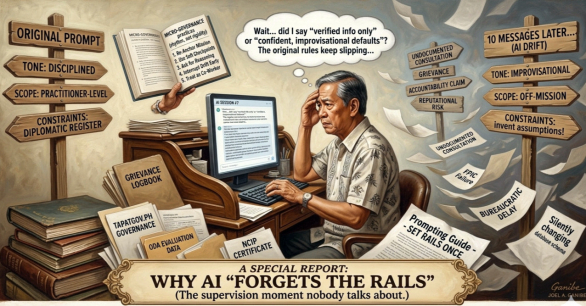
Every morning, millions of people sit down and open a chat window.
They type a question. The machine answers. It feels like picking up a conversation with an old friend.
It isn’t. Most of the time, the machine is meeting you for the first time all over again. Whatever you settled yesterday may be gone. Whatever you corrected last week may have to be corrected again. The window looks the same, but the room behind it has been swept clean.
Some of these systems now carry a little memory forward. A few notes. A summary. A preference or two. That helps. But you don’t decide what gets kept. You don’t see all of it. And you can’t count on it being there tomorrow in the same shape it was in today.
So here is the question I want to set on the table. If the machine forgets, who is supposed to remember?
I’ll give you my answer up front. You are.
Think about how people work with each other. When two people make a deal, somebody writes it down. When a doctor changes your medicine, it goes in a chart. When a crew finishes a job, there’s a log of what got done and what didn’t. Nobody with sense trusts the other fellow’s memory with something that matters.
Yet that is exactly what most of us do with AI. We tell it how we want things done. We correct it when it gets something wrong. We make decisions with it, sometimes big ones. Then we close the window and trust that it will all still be there.
It won’t be. Not reliably. And when it isn’t, we don’t always notice. The machine doesn’t say, “I forgot what you told me.” It just goes on, sure of itself, starting from scratch. You only find out when it makes the same mistake you already fixed.
That is where control slips away. Not in some big dramatic moment. It slips away quietly, one forgotten correction at a time.
Here is what I mean by control. Control means you can hold the machine to something. You can say, “This is what we decided. This is how I want it done. Check your work against this.” If you can’t do that, you aren’t steering. You are riding along.
And you can’t hold anyone to a record that doesn’t exist. If the only copy of what you agreed to lives inside the platform, then the platform decides what you agreed to. That isn’t a level field. That is their field, and you are a guest on it.
So what does a person keep? It doesn’t have to be much. It has to be the right things.
Keep your decisions. When you settle something with an AI, write down what you settled. One line is enough. The date and the decision.
Keep your corrections. When the machine gets something wrong and you set it straight, write that down too. Those corrections are worth more than anything else you own in this work. They are the lessons you paid for.
Keep your rules. How you want things done. What you won’t accept. The words you want used and the ones you don’t. If you have to say it twice, it belongs on paper.
Keep it somewhere you own. A notebook on the kitchen table. A file on your own computer. A folder in your own account. The point is that it’s yours. Not theirs. Yours.
Then use it. That is the part people skip. A record you never open is just a diary. At the start of each session, hand the machine your notes. Tell it, “Here is where we left off. Here is what we decided. Here are my rules.” Now it isn’t starting from scratch. It’s starting from your record.
You’ll notice something when you do this. The work gets better. The machine stops repeating old mistakes. You stop re-explaining yourself. And you start to see clearly when it drifts, because you have something to measure it against.
A record isn’t just a memory. It’s a yardstick.
Without a yardstick, you can’t tell if the machine is getting better or worse. You can’t tell if it’s following your rules or just sounding like it is. You are left with a feeling, and feelings are easy to fool. A confident answer feels right whether it is right or not.
With a yardstick, you can check. Did it do what we agreed? Did it hold the line I drew? Did it make the mistake I already fixed? Those are plain questions with plain answers. You don’t need to be an engineer to ask them. You need a written record and the habit of looking at it.
This is what I mean when I talk about responsibility. A lot of people want the companies to fix AI. And they should do their part. But nobody is coming to your kitchen table to make sure the machine treats you right. That job sits with the person using it.
That isn’t a burden. It’s a kind of power. The person who keeps the record is the person who holds the other party to account. It has always worked that way, long before computers. The one with the paperwork wins the argument.
I’ll tell you what this looks like when it fails. A person uses AI every day for months. They’ve taught it how they like things. They’ve corrected it a hundred times. Then one morning it all seems gone. The answers are off. The tone is wrong. The old mistakes are back. They have nothing written down, so they can’t even say for sure what changed. All they can do is start over, and teach it all again from memory.
Now picture the other way. Same person, same morning, same trouble. But this time they have a few pages of notes. They hand them over. Within a few minutes the machine is back on track. Nothing was lost, because nothing important was ever trusted to the machine alone.
That second person is not smarter. They just kept a record. That’s the whole difference.
There is a bigger reason this matters, too. The way people use AI now is teaching the machines what people will put up with. If we hand over our memory, our decisions and our rules, and never ask for them back, the lesson the machines learn is that people don’t care to keep hold of their own affairs.
But if we keep our own records and hold the machines to them, that is a different lesson. It says people expect to be in charge of their own work. It says the user sets the terms. That is the level ground I keep talking about. Not a fight with the machine. Just a fair field, with the person standing on their own feet.
So here is my advice. Start today. Get a notebook or open a file. At the end of your next session with an AI, write three things. What you decided. What you corrected. What rule you want it to keep. Date it. Next time, hand it over before you start.
Do that for a week. You’ll see the difference.
The machine is going to forget. That’s how it’s built, at least for now. The only real question is whether you will.
Your AI forgets.
Don’t you.
Load this file before each AI chat session.
faust-baseline-level-groundDownload
This post was drafted with AI governed assistance and reviewed and directed by Michael S. Faust Sr. before publication.
” Attic Thoughts”-library – Intelligent People Assume Nothing
micvicfaust9/faust-baseline · Datasets at Hugging Face
© 2026 The Faust Baseline LLC | All Rights Reserved