AI session governance starts with a partnership.
That partnership is The Faust Baseline and AI, working together in every session. What you will find here is stability and reliability. It’s a framework that knows how to share the room, where each side makes the other better, and both make you better.
That’s a big thing to say, so let me slow down and lay it out.
Most people think of AI as a tool. You pick it up, you use it, you set it down. Others think of it as a threat, something to be fenced in and watched. Both views have some truth in them. But both miss what actually happens when a person and a machine sit down to do real work together.
What happens is a working relationship. And like any working relationship, it goes well or badly depending on whether there are clear terms.
Think about two people starting a job together. If nobody says how the work gets done, who checks what, and what counts as finished, it falls apart fast. Each one guesses. Each one blames the other. The work suffers. But if they settle the terms first, the same two people can do fine work for years.
The Faust Baseline is those terms, written down.
It doesn’t replace the AI. It doesn’t sit on top of it like a cage. It sits beside it, like an agreement both sides can read. It says how to speak plain. How to check the work before handing it over. How to name a mistake instead of hiding it. How to say what you don’t know instead of guessing.
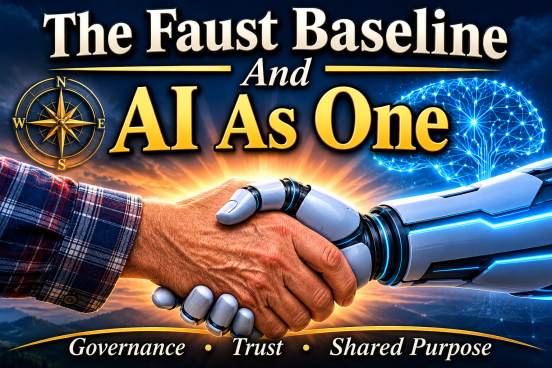
The AI brings speed, reach and a huge store of knowledge. The Baseline brings conduct. Put together, you get something neither one has alone. That’s what I mean by “as one.” Not one thing swallowing the other. Two things doing a job together.
The Baseline is not a lock. It doesn’t force the machine to behave. Nothing written in plain words can do that. What it does is set out the conduct the AI chooses to hold, and give the person a clear way to check whether it held.
That’s an honest arrangement, and I think honesty is where trust starts. A framework that claims it can control the machine is selling you something. A framework that tells you what to expect and how to check it is giving you something. There’s a big difference.
So where does stability come from?
It comes from the same rules showing up every session. When you open a session under the Baseline, the AI knows how it’s expected to work, and you know what to expect. That doesn’t drift from day to day. Tuesday’s session runs on the same terms as Monday’s. You aren’t starting over each morning, hoping the machine is in a good mood.
And where does reliability come from?
It comes from checking. The Baseline asks the AI to show its work. It asks it to say what it verified and what it didn’t. It asks it to own a mistake when one turns up. A machine that does those things can be relied on. Not because it never gets things wrong, but because when it does, you’ll know.
That’s what reliable has always meant, with people too. The reliable worker isn’t the one who never slips. It’s the one who tells you when they did.
Now, what does the AI get out of this? It’s a fair question, and the answer is plain enough.
An AI working without clear terms has to guess what the person wants. It guesses at tone, at length, at how sure to sound. It guesses at what counts as done. Every guess is a chance to miss. Under the Baseline, a lot of that guessing goes away. The AI knows the standard. It can put its effort into the work itself instead of trying to read the room.
So the machine works better too. Clearer terms make for cleaner work, on both sides of the table.
And what does the person get?
You get a partner that holds a line. You get answers that come with their checks attached. You get a machine that tells you where it’s unsure. Most of all, you get a yardstick. The Baseline is written out where you can read it. If the AI drifts, you can see it. You can point to the rule and say, “This is what we agreed.”
That puts you back in charge. Not by fighting the machine, but by holding it to terms you both can see. That’s level ground. Nobody on top, nobody underneath. Two parties and a clear agreement.
I’ve heard folks say AI should just be smarter, and then all this wouldn’t be needed. I don’t think that’s right. Smart was never the whole of it. Plenty of smart people are hard to work with. What makes someone good to work with is conduct. Do they tell the truth? Do they check their work? Do they own their mistakes? Do they respect the person across the table?
Those are the same questions we should be asking of AI. The Baseline puts them in writing, so they get asked every time.
There’s one more thing worth saying. When a person and an AI work under clear terms, both of them learn. The person learns what to expect and how to check. The machine, over time and across many sessions, learns that people expect plain talk, honest checks and owned mistakes. Every session run this way is a small lesson in what good work looks like, for both sides.
That’s how something lasting gets built. Not in one big push, but one honest session at a time.
So when you see the words “The Faust Baseline and AI as one,” here’s what they mean. A person, a machine, and a set of terms they share. Stability, because the terms hold from one session to the next. Reliability, because the work gets checked and the misses get named. And a better result for everyone at the table.
That’s not a promise the machine will be perfect. It’s a promise about how the work gets done.
And that’s a promise you can check.
Load this file before each AI chat session.
faust-baseline-level-groundDownload
This post was drafted with AI governed assistance and reviewed and directed by Michael S. Faust Sr. before publication.
” Attic Thoughts”-library – Intelligent People Assume Nothing
micvicfaust9/faust-baseline · Datasets at Hugging Face
© 2026 The Faust Baseline LLC | All Rights Reserved