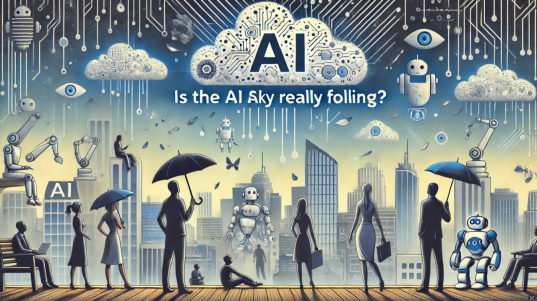
Every morning I read the news about AI. And every morning, somebody tells me the sky is falling.
The machines will take every job. The machines will outsmart us. The machines will wipe out the human race. Pick any headline, and it’s another man running down the road yelling at the clouds.
You know the old story. Chicken Little gets hit on the head by an acorn. He decides the sky is falling. He runs off to tell the king. On the way he gathers a crowd of other birds, every one of them scared to death. And then the fox shows up, and the fox does fine.
That’s the part people forget. The panic didn’t save anybody. The panic fed the fox.
I’m not telling you nothing is wrong. I write about what’s wrong with AI almost every day. The companies cut corners. The machines make things up. Folks are handing over their thinking without checking the work. Those are real problems, and they need real watching.
But a problem is not a doomsday. A problem is something you roll up your sleeves for.
When everyone is shouting that the end is coming, ask yourself one question. Who gains from my fear?
Fear sells. Fear gets clicks. A scared reader comes back tomorrow for more bad news. A scared worker takes a worse deal. A scared voter hands power to whoever promises to protect him. The doom crowd isn’t always lying. But they’re always selling something, even if it’s only their next headline.
So let me tell you the other side. The side nobody seems to have time for.
We’ve been here before, more times than I can count. When the tractor came along, folks swore the farm family was finished. When the printing press came along, the scribes said reading would ruin the mind. When the calculator showed up in the classroom, teachers said nobody would ever learn arithmetic again. When the computer landed on every desk, the papers said the office worker was done for.
Some jobs did go away. That’s true, and it hurt the people who held them. But new work grew up in their place, work nobody could have pictured the year before. The human race didn’t end. It changed shape and kept going.
That’s what people do. We adapt. We’re the most stubborn, clever, hardheaded animal ever to walk this earth. We figured out fire, the wheel and the moon. We’re not going to be beaten by a program that can’t tell you what time it is without looking it up.
Here’s what I see on the bright side.
I see a doctor in a small town who gets a second set of eyes on an X-ray at two in the morning. I see a kid who can’t afford a tutor, getting help with algebra at the kitchen table. I see a farmer reading the weather and his soil better than his granddad ever could. I see a man who never learned to write well, finally putting his thoughts on paper the way he always heard them in his head.
That’s not the end of the human race. That’s the human race with a better set of tools.
Now, a tool is only as good as the hand holding it. A hammer can build a house or break a window. A machine is no different. That’s why I’ve spent all these months working on one simple idea. The person at the keyboard needs to stay in charge.
Not the company that sold the machine. Not the machine itself. You.
Balance is the word nobody wants to print, because balance doesn’t scare anybody. Balance means the machine does the heavy lifting, and the person does the judging. The machine digs through a mountain of facts, and the person decides what matters. The machine suggests, and the person chooses.
Balance means you check the work before you trust it. You ask where it got that number. You say no when it’s wrong. You keep your own head in the game.
That’s not doom. That’s just good sense, the same sense your grandmother used at the market. Look the man in the eye, check the scale, count your change.
The British have a song for days like this. Monty Python sang it at the end of a movie, with the characters in the worst spot you could imagine. The song is called “Always Look on the Bright Side of Life.” It’s silly on purpose. But there’s a hard truth under the joke. You don’t get to pick every circumstance. You do get to pick how you meet it.
So here’s how I mean to meet this one.
I’ll keep watching the machines, and I’ll keep calling out the companies when they cut corners. But I won’t run down the road yelling that the sky is falling. That only gathers a crowd for the fox.
I’d rather sit on the porch, look up and see the sky right where it’s always been. Then I’ll get back to work, and make sure the tools stay tools and the people stay people.
The sky isn’t falling, friends. An acorn hit us on the head. Pick it up, look at it and plant it. Something good might grow.
Load this file before each AI chat session.
the-faust-baseline-public-release-1Download
This post was drafted with AI governed assistance and reviewed and directed by Michael S. Faust Sr. before publication.
” Attic Thoughts”-library – Intelligent People Assume Nothing
micvicfaust9/faust-baseline · Datasets at Hugging Face
© 2026 The Faust Baseline LLC | All Rights Reserved