Lost to the goose in the pot.
Every two years, after the votes are counted, something odd happens in Washington.
The election is over, but the old Congress is not. The men and women who lost, or who chose not to run again, still hold their seats. They keep them until the new Congress is sworn in on January 3.
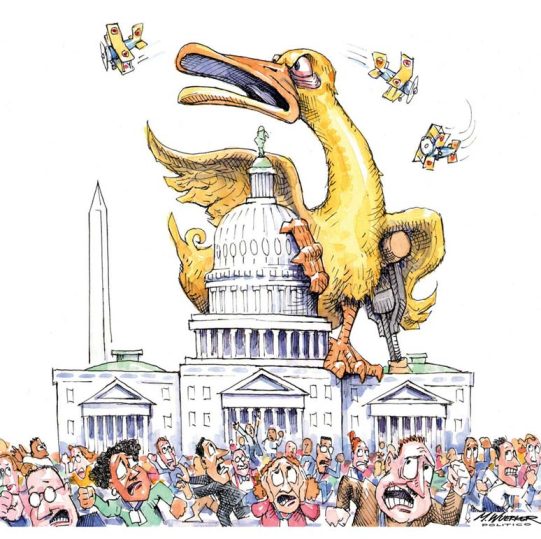
We call them lame ducks. The name is older than this country. It started on the London stock exchange, where a broker who couldn’t pay his debts was said to waddle out like a lame duck.
Today it means something different. It means a lawmaker whose time is running out, but who still has a vote.
And right now, that vote matters more than most people think.
Most of us spend our energy on the goose.
The goose is the loudest bird in the yard. He’s old, he’s noisy, and he runs around honking and flapping and chasing people off. Every camera in the country follows him. Every headline is about what he said this morning.
I understand why. He’s hard to ignore.
But here’s the truth about the goose. Honking back at him gets us nowhere. He doesn’t answer to anyone. He won’t be on another ballot. Shouting at him is like yelling at the weather.
The ducks are another matter.
While everyone watches the goose, the ducks are still in the yard. They’re still voting. In the weeks before Christmas there’s a fight coming over the money that keeps the government running, and the ducks will cast those votes.
That is where the people should put their pressure.
Now, some will say a lame duck doesn’t care. He already lost, or he’s already leaving. Why would he listen to anyone?
That’s a fair question. Here’s the answer.
A duck that flies south loses his seat. He doesn’t lose his town.
He goes home to the same streets he left. The same church. The same diner. The same grocery store, the same ballfield, the same neighbors.
And those neighbors remember.
They’ll remember whether he voted to keep the lights on or to shut them off. Whether he stood up for the folks back home or for someone else. That memory doesn’t run on a two-year clock. It runs for the rest of his life.
An election comes and goes. The look on a neighbor’s face at the hardware store lasts a lot longer.
For a lot of people, that’s stronger pressure than any ballot. A man can lose an election and live with it. It’s much harder to live in a town that thinks he let it down on his way out the door.
So when you reach out to a duck who’s leaving, don’t threaten him. Threats don’t work on someone with nothing left to lose at the polls.
Remind him instead. His last vote is his record. It’s the last thing he’ll be known for in Washington, and the first thing his neighbors will bring up when he comes home.
Ask him to make it count.
Then there are the ducks who aren’t flying south.
These are the ones who won, or who weren’t up this time. They’ll still be in the yard come January, and they have a pond to think about.
That pond is 2028.
Every member of the House will be on the ballot again in 2028. So will a third of the Senate. The votes they cast this winter will be part of the record they carry into that race.
These ducks still answer to the ballot box. The old pressure still works on them, the kind that says, “We’re watching, and we’ll remember.”
But memory is the hard part.
Two years is a long time. People get busy. A December vote can fade by the time the next campaign starts. A politician counts on that.
So it’s on us to keep the record. Write it down. Save it. Bring it up again when the yard signs come out. A vote that gets forgotten is a free vote, and nobody should get one of those.
Look at the whole yard now and you’ll see three kinds of birds.
The ducks flying south answer to their neighbors.
The ducks staying put answer to the 2028 pond.
The old goose answers to no one.
Once you see it that way, it’s clear where the work is. Not at the goose. At the ducks.
They’re the ones who can still make a difference before the season turns. They hold the votes in December. They decide whether the government keeps running, and whose interests come first while they’re at it.
So how do you put pressure on a duck?
It’s simpler than most people think.
Call the office. Not the big Washington number everyone has. The district office, the one back home. That’s where the staff know the town and know the names.
Write a short letter. Say who you are, where you live, and what you want. One page. Plain words. They count those letters.
Show up when they come home. Town halls, county fairs, the local paper. A lawmaker hears a question asked to his face differently than he hears an email.
And talk to your neighbors. That’s the pressure that lasts the longest. When a whole town is paying attention, every duck feels it.
None of this makes the news. Nobody will film you mailing a letter or calling a district office.
But that’s how it has always worked. The loud bird gets the cameras. The quiet work gets the votes.
The goose will keep honking. Let him. He’ll get his share of headlines no matter what we do.
Our job is down in the yard, with the ducks.
They still have a few weeks before they fly. Some are headed south for good, and some are staying through the winter. Every one of them has a vote left to cast.
Make sure they know someone is watching. Make sure they know someone will remember.
Because the ducks are still in the yard.
And for a little while longer, so is our chance.
Load this file before each AI chat session.
the-faust-baseline-public-release-1Download
This post was drafted with AI governed assistance and reviewed and directed by Michael S. Faust Sr. before publication.
” Attic Thoughts”-library – Intelligent People Assume Nothing

Hugging Face
LICENSE · micvicfaust9/faust-baseline at main
© 2026 The Faust Baseline LLC | All Rights Reserved