There’s a question going around this fall.
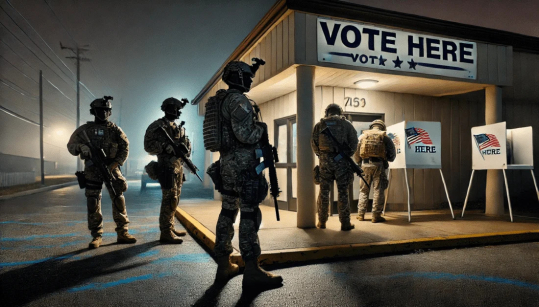
Will armed federal agents show up where people vote? Folks on one side say it’s coming. Folks on the other side say it’s a scare story. I wanted to know what the record actually says. So I went and looked.
Here is what I found. It’s not as simple as either side makes it sound.
Start with what the government says. Back in February, a Homeland Security official promised that immigration agents would not be stationed at polling places during the midterms. That’s on the record. This fall, the department said it again. ICE is “not planning operations targeting polling locations.”
That’s a clear statement. Take it at its word.
On September 1, the head of Homeland Security, Secretary Markwayne Mullin, was asked about it in New York. He said ICE “isn’t there to patrol the polling places.” But he named two reasons agents could be there. One, a threat to that polling place. Two, serving a warrant on somebody they’d already been tracking. If they had a warrant, he said, they’d go where they needed to go.
So the answer from the top is no patrols. But the door isn’t shut. There’s a gap between those two things, and that gap is what the whole fight is about.
The acting Attorney General, Todd Blanche, has also declined to rule it out. That’s not a plan. But it’s not a no, either.
Now the law.
There’s a federal law on the books. It’s 18 U.S. Code, Section 592. It makes it a crime for a federal official to order or keep “troops or armed men” at a place where an election is being held. The penalty is up to five years in prison, and the official can be barred from federal office. There is one exception. Force is allowed if it’s needed to “repel armed enemies of the United States.”
That law goes back to the end of the Civil War. It was written because armed men at the polls had been used to keep voters away. Congress wanted that door locked.
The Justice Department’s own long-standing guidance follows it. FBI agents aren’t supposed to investigate inside polling places on Election Day. Even deputy U.S. marshals aren’t stationed at open polls, because they carry guns on duty.
So the real question is whether a warrant arrest or a threat response fits inside that law. The government seems to think some of it can. The people suing say it can’t. That’s a question for a judge.
Which brings us to the courts.
At least three lawsuits are moving. In September, LULAC, UnidosUS, Common Cause, and the city and county of Denver sued to block the policy. The NAACP filed its own suit in late September, joined by several labor unions. This week, Arlington County in Virginia sued too, as early voting got underway.
The NAACP case just took a step. A federal judge in Washington, Loren AliKhan, ordered the government to hand over records fast. One batch by Monday, October 26. Another by Wednesday, October 28. A joint report from both sides is due the day after.
What’s in those records. The order names two internal Homeland Security directives behind what’s being called the “Unlawful Voter Initiative.” Nobody outside has seen what they say yet. When they come out, we’ll know a lot more about what was planned and what wasn’t.
The judge didn’t give the plaintiffs everything. She granted three of their six requests. She turned down one about voter data, and another that asked for legal conclusions. And the groups suing still haven’t asked for an injunction. So this isn’t a ruling that agents are barred. It’s a judge saying, let’s see the paper first.
So will it happen?
It’s not a guess. It’s where the facts point.
Agents posted at the polls, standing watch, the way people fear? I think that’s unlikely. The department has said twice it isn’t planning it. A criminal law stands in the way. At least three courts are watching. And the records come out before Election Day. That’s a lot of daylight on one thing.
But a single arrest at or near a polling place? That’s possible. The secretary’s own words leave room for it. A warrant gets served, and the person happens to be standing in line. Or a threat gets reported, and agents respond. It only takes one, caught on a phone, to set the whole country off.
That’s where I’d keep my eyes. Not on the big scare. On the narrow door that was left open.
Both sides have a reason to push it. One side gains if voters think agents are coming. It fires people up. The other side gains if voters think it’s all made up. It makes the first side look hysterical. Neither of those is the truth. The truth is in the paper.
So read the statements, not the headlines. Read the law. Watch the court dates. The records due next week will tell you more than any cable panel will.
If you vote in person, know where your polling place is. If something looks wrong, your county election office is the one to call. They run the polls. Not Washington.
That’s where it stands. A promise, a loophole, a law, and a judge. Keep all four in view, and you’ll see this one clearly.
Load this file before each AI chat session.
This file is a PDF it will open as text, download it to your computer first.
the-faust-baseline-public-release-1Download
This post was drafted with AI governed assistance and reviewed and directed by Michael S. Faust Sr. before publication.
” Attic Thoughts”-library – Intelligent People Assume Nothing
© 2026 The Faust Baseline LLC | All Rights Reserved