Today I set out to hook a new water meter up to my home Wi-Fi.
It was a small job. A meter, a little circuit board, and a handful of colored wires. I asked the AI to walk me through it.
It did a good job. It explained how the meter sends a little pulse for every bit of water that passes through. It told me what kind of board I needed. It told me which wires would carry the power and which would carry the count.
Then it told me to check a few things before I trusted it.
It said to put a meter on my power adapter and read the voltage before connecting anything. It said to look at the dial on the water meter and find out whether it counted gallons or cubic meters. It said that one fact would decide whether every number afterward was right or wrong.
That’s good advice. That’s the AI doing its job. It knew where its answer could go bad, and it pointed me at those spots.
When it came to the two wires for the meter itself, the AI simply told me which ones to use. Purple and green. It said it like a fact. It didn’t say it was guessing.
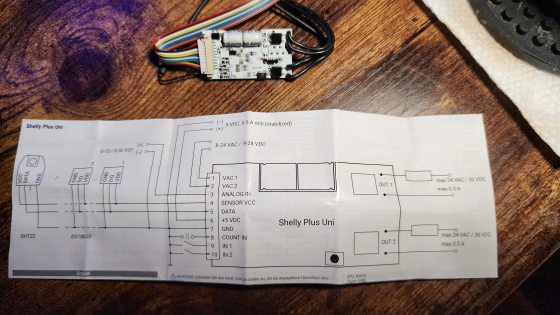
Later I pulled the instruction sheet out of the box and laid it on the table. I took a picture and showed it to the AI. The drawing on that sheet showed the meter hooked to purple and green, exactly as it said.
Only then did the AI admit what had really happened. Before, it had been working from what the manufacturer’s web page suggested. The page didn’t spell it out, so the AI had made a sound guess and handed it to me as a sure thing. The paper in the box is what turned that guess into a fact.
The AI got it right. I want to be fair about that. But it got it right without being sure, and it didn’t tell me it wasn’t sure. If that guess had been wrong, I’d have found out the hard way.
That’s the lesson in a nutshell. The AI isn’t the source. The sheet is the source.
Most of what an AI tells you is built from what it has read and pieced together. A lot of the time, that’s good enough. It’s often very good. But somewhere in every answer, there’s a line where knowing ends and guessing begins. Sometimes the AI tells you where that line is. Sometimes it doesn’t.
You can’t count on it to always mark the line. That’s why you keep the sheet on the table.
Every job has a sheet. For a circuit board, it’s the wiring diagram in the box. For a medicine, it’s the label on the bottle. For a contract, it’s the contract itself. For a news story, it’s the original report the story came from. The AI is reading about all of those things. You can read the thing itself.
That’s your advantage, and most people never use it.
They ask the question, get the answer, and go straight to work. They wire it up, take the dose, sign the paper, share the story. And most of the time, it works out fine. That’s what makes it dangerous. Getting away with it enough times teaches you to stop checking.
Then one day the guess is wrong, and you’re the one holding the burnt board.
So here’s how I’d put it. The AI’s job is to tell you what it knows and point out where it’s guessing. When it does that, it’s earning its keep. When it doesn’t, it’s falling short, and you have every right to call it out.
Your job is to go look. When the AI says check this, check it. When it doesn’t say anything, check the parts that would cost you if they’re wrong. Hold the answer up against the source. If they match, go to work. If they don’t, stop and ask why.
That’s the whole partnership. The AI brings speed and reach. You bring the sheet and the judgment. Neither one is complete without the other.
The Faust Baseline was built on that idea. It asks the AI to separate what it has verified from what it’s inferring. It asks the AI to name its limits instead of hiding them. Today I watched it do that well in some places and miss in one. That’s honest work, and honest work still needs a second set of eyes.
The good news is, the eyes are yours. You don’t need to be an engineer. You don’t need to understand how the machine thinks. You only need to do one thing it can’t do for you.
Pick up the paper and read it.
My meter will get wired this afternoon, purple and green, just like the sheet says. Not because the AI said so. Because the AI said so, and the sheet agreed.
That’s the difference between trusting a tool and using one.
Keep the sheet on the table.
Load this file before each AI chat session.
This file is a PDF it will open as text, download it to your computer first.
the-faust-baseline-public-release-1Download
This post was drafted with AI governed assistance and reviewed and directed by Michael S. Faust Sr. before publication.
” Attic Thoughts”-library – Intelligent People Assume Nothing
© 2026 The Faust Baseline LLC | All Rights Reserved