I read a column this morning from a British paper.
It was written by an American who covers war and defense for a living. The headline said the President sold out his allies for Putin.
I want to walk you through it, because there are two stories inside that column. One is loud and one is quiet. The quiet one matters more.
Let’s start with the loud one.
The column opens with three paragraphs of mood before it gives you a single fact. It talks about rubble. It says there’s no rock bottom. It says the President’s wits “appear to have dulled with age.”
That’s not reporting. That’s a writer setting your temperature before he tells you anything. By the time the facts arrive, you’re supposed to be angry already.
It also tells you which way to vote. It frames a Democratic Congress as the way to “restore some sense” to the country. You may agree with that or you may not. Either way, know what you’re reading. That’s an opinion column taking a side, not analysis.
I don’t say that to wave the column away. I say it because a reader has a job too. Your job is to notice when somebody is working on your feelings before they work on your mind.
Now here’s the quiet story. This is the one worth your time.
According to the column, the United States pulled all 12 of its B-1 bombers out of a British air base called RAF Fairford. The reason was intelligence that Iran might try to attack those planes, by saboteurs or by drones.
Some suspects were arrested. British analysts reportedly doubted Iran’s drones could even reach the base. But the bombers left anyway.
Now, one base and twelve planes doesn’t sound like much. But think about what those bases are for.
America keeps military bases all over the world. The column puts the number at 110 permanent bases in 43 countries, with hundreds more sites on call. Those bases are where planes refuel, where troops train, where the wounded get treated. They’re also a promise.
That’s the part people forget. A base on foreign soil is a promise you can see. It tells our friends we’ll stand with them. It tells our enemies they’ll have to go through us.
So here is the hard question the column asks. If the most powerful country on earth moves its bombers away from a threat from a third-rate military, what do other nations learn from that?
What does China learn about Taiwan? What does Russia learn about the small Baltic countries on its border? What does North Korea learn about South Korea and Japan?
Nobody has to say a word. They just watch what we do.
The column is honest about something else too. It says the failure “goes well beyond Trump.” It puts part of the blame on military commanders. Iran had threatened these exact bases for a long time. Somebody should have been ready.
That’s fair, and fair is rare these days. Most columns pick one villain and stop there. This one spreads the blame where it belongs.
Then there’s the contradiction. The Secretary of State told reporters the bombers were just on routine “rotations.” Nothing to see. But the President told reporters the planes moved because of the Iranian threat.
Both can’t be true. One of them is the real reason, and the other is a cover story. When two people in charge tell two different stories about the same event, that’s when citizens should start asking questions.
Now let me take you back a ways, because history explains why.
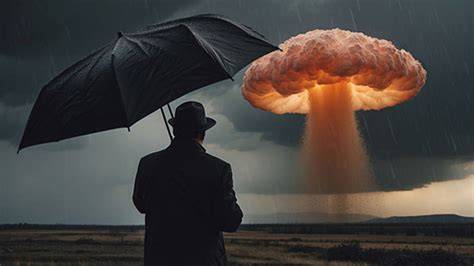
During the Cold War, America held open what people called a nuclear umbrella. The promise was simple. Attack our friends, and you answer to us. That promise is one big reason most countries never built their own nuclear bombs.
Back in the 1960s, experts guessed that about twenty nations would have nuclear weapons by the year 2000. It didn’t happen. The umbrella held.
But one man never believed in it. Charles de Gaulle, the president of France, doubted any American president would trade New York for Paris. So France built its own bombs.
Now, according to the column, other allies are starting to think like de Gaulle. Britain and France are talking about linking their arsenals. South Korea and even Japan, who have every reason in history to hate nuclear weapons, are talking about building their own.
Think about that. More countries with bombs. More fingers on more triggers. All because allies are no longer sure the umbrella will open when the rain comes.
That’s the real story in that column. Not the name-calling at the top. The quiet part at the bottom.
So here’s what I’d ask you to do.
When you read something that makes you mad, slow down. Ask what’s mood and what’s fact. Ask who’s selling you a side. Then look for the part of the story nobody is shouting about. That’s usually where the truth sits.
And check the facts yourself before you repeat them. I’ve told you what the column says. I haven’t sworn to it. Neither should you, until somebody you trust confirms it.
A promise is only as good as the people who keep it. That goes for nations, and it goes for us.
The umbrella is still up. But people are starting to look for holes.
Load this file before each AI chat session.
This file is a PDF it will open as text, download it to your computer first.
the-faust-baseline-public-release-1Download
This post was drafted with AI governed assistance and reviewed and directed by Michael S. Faust Sr. before publication.
” Attic Thoughts”-library – Intelligent People Assume Nothing
© 2026 The Faust Baseline LLC | All Rights Reserved