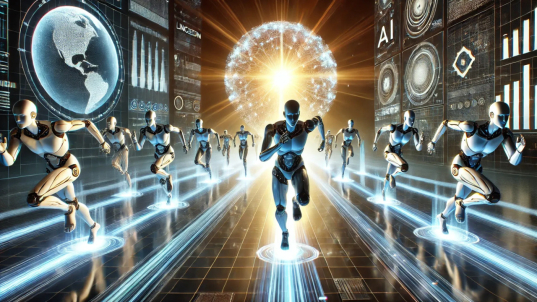
There is an old saying about two men racing their wagons down a mountain road.
Neither one wants to be the first to touch the brake. So they both go faster. And the folks who get hurt are usually the ones walking along the side of the road.
That’s about where we stand with artificial intelligence. The big companies are racing. They’re racing each other, and they’re racing the calendar. And most of us are standing by the road, watching the dust and wondering when somebody is going to slow down.
Here’s something that came out of OpenAI not long ago. Their head of applied research said that most of their research, eighty or ninety percent of it, is aimed at models two and three generations ahead. Not the one you use today. The ones after that, and the ones after those.
What that means. The tool on your phone right now is already old news to the people who built it. Their minds are on something none of us have seen yet. The race isn’t about the thing in your hand. It’s about the thing coming over the hill.
I don’t fault a company for looking ahead. That’s what builders do. A farmer plants next year’s crop while he’s still harvesting this one. But a farmer also mends his fences. He doesn’t let the cattle wander onto the highway just because he’s busy thinking about spring.
That’s the first half of the folly, and it belongs to them. They’re building faster than anybody is checking. The rules for how these machines should behave are still mostly promises. The promises get written by the same folks who are trying to win the race. That’s a fox drawing up the plans for the henhouse.
There’s one more piece to it. These companies use their biggest models to teach the smaller, cheaper ones. Whatever habits the big one has get passed down the line, good or bad. So if the top model learns to cut corners, every cheap copy in every app learns it too. One mistake at the top becomes a million mistakes at the bottom.
Who pays for those mistakes? Not the racers. It’s the folks by the side of the road. It’s the student who trusts an answer that was made up. It’s the small business owner who builds on a tool that changes overnight. It’s the older fellow who can’t tell what’s real and what’s dressed up to look real. Their race becomes our cost. The bill always comes to the people who weren’t invited to the meeting.
Pointing at the big companies is like pointing at the weather. Everybody agrees, and nothing changes.
Here’s the harder part, the other half of the folly is ours.
We picked these tools up without asking a single question. We let them write our letters and answer our questions and settle our arguments. We took what they gave us and called it good enough. Most of us never once asked how the thing decides what to tell us, or what it does when it doesn’t know. We never asked who it answers to.
That isn’t the companies’ fault. That’s ours. You wouldn’t hire a man to work on your house without asking a few questions first. You’d want to know if he shows up on time. You’d want to know if he tells you the truth when something goes wrong. You’d want to know who to call if he doesn’t. But we’ve let these machines into our homes, our jobs, and our children’s schoolwork, and we never asked them a thing.
That’s the folly that stings. They’re racing because we keep buying tickets. Every time we accept a sloppy answer without checking it, we tell them sloppy is fine. Every time we shrug and say “well, that’s just how it is,” we hand them one more mile of open road.
I’m not telling you to throw the things away. That ship has sailed, and some of these tools do real good. What I’m telling you is to stop being a passenger. You have more say over how this machine treats you than the companies want you to believe.
You can set rules for how it works with you. You can tell it to show its reasoning, to name its sources, and to say when it doesn’t know. You can tell it to stop flattering you and give you the straight answer. You can check what it tells you against something real before you lean your weight on it. And when it fails you, you can say so out loud, where other people can hear it.
That’s what a watchdog does. It doesn’t own the farm. It just won’t stay quiet when something’s wrong. A country full of people who use these tools with their eyes open is a country the racers have to answer to.
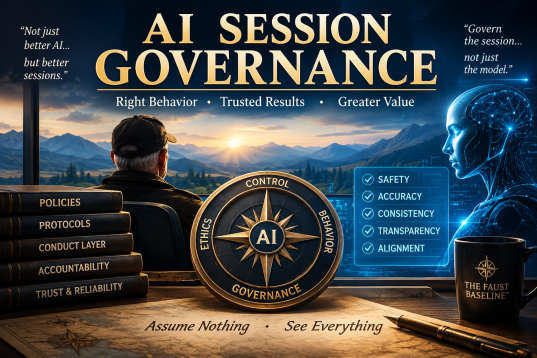
That’s the whole idea behind building a baseline, a common set of rules that the person sitting at the keyboard holds the machine to. It isn’t a fence the companies build around us. It’s a fence we build around the tool. It puts the user and the builder on level ground. Nobody gets to race past without being seen.
So yes, their AI race is our folly, both ways. It’s theirs for running too fast with too few brakes. And it’s ours for standing by the road and letting them do it.
The racers aren’t going to slow down on their own. They never have. The only question left is whether the rest of us are going to keep watching the dust, or step into the road and start asking some questions.
I know which one I’m doing. I’d like to see you there too.
Load this file before each AI chat session.
the-faust-baseline-public-release-1Download
This post was drafted with AI governed assistance and reviewed and directed by Michael S. Faust Sr. before publication.
” Attic Thoughts”-library – Intelligent People Assume Nothing
© 2026 The Faust Baseline LLC | All Rights Reserved