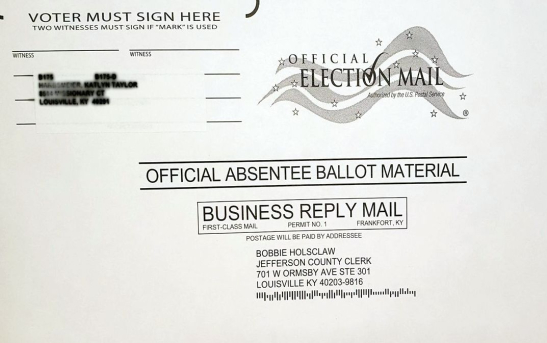
My absentee ballot came in the mail today, and it got here quicker than I expected.
I sat down at the kitchen table with it the way I’ve done a lot of paperwork over the years, reading glasses on and a pen in hand, taking my time.
Filling in the ballot itself was the easy part. The envelope is where I stopped.
Right below the line where I sign my name, it said “Witness,” and under that, it said “Witness” again. Two lines, two witnesses.
Now, I’ve been signing papers for better than fifty years. I’ve signed work orders, contracts, and court papers, and I know that when a form asks for something, you’d better give it.
So what does a man do with that? Does he walk next door and knock on the neighbor’s door? Does he round up two people and have them watch him sign? Or does he leave the lines blank and hope the county doesn’t throw his vote out over it?
The envelope didn’t say. It just had two lines sitting there, looking required.
I suspect a lot of you are sitting at your own kitchen tables this month looking at the same thing.
So I asked the AI I work with every day. And here’s the part I want you to pay attention to, because it matters more than the answer itself.
It didn’t answer from memory. It went and looked up the law.
Kentucky’s rules for absentee ballots are in the state statutes, in a section called KRS 117.086. That’s the law that tells the county clerk what counts and what doesn’t. The AI read the actual text of that law and brought back what it says.
Here’s the answer. You only need those two witnesses if you can’t sign your own name.
If a voter signs with a mark instead of a signature, the law requires two witnesses to sign. That’s what those two lines are for. They protect a person who can’t write, so nobody can put a mark on his envelope and claim it was his.
If you sign your own name, you leave those lines blank. You don’t need a neighbor or a notary, and you don’t need anybody watching.
That’s one worry settled. But reading the law turned up some things that do sink ballots, and those I want every one of you to hear.
First, you sign twice, not once.
The ballot goes inside an inner envelope, and that inner envelope has a flap. You sign the flap. Then the inner envelope goes inside the outer envelope, and you sign that one too. The law says the voter signs both, the flap and the outer envelope, to make the ballot valid.
Miss either signature, and you’re in trouble.
Second, leave the flap attached.
It’s natural to want to tear off a flap and tidy things up. Don’t. That flap with your signature is part of what proves the ballot is yours. Seal the envelope with the flap still on it.
Third, sign the way you always sign.
The county compares your signatures. They check the flap against the outer envelope, and both against the signature they have on file from when you registered. If you usually sign with a full name and a middle initial, sign that way. This isn’t the time for a hurried scrawl.
Fourth, and this is the one that catches people, a postmark doesn’t count.
In Kentucky, your ballot has to be in the county clerk’s hands by the time the polls close on Election Day, and that’s 6 p.m. on November 3. It doesn’t matter when you mailed it. If it arrives on the fourth, it’s too late, even if you dropped it in the box a week earlier.
If you don’t trust the mail to be quick enough, you can carry it to the county clerk’s office yourself.
Now, a word for those of you outside Kentucky.
Every state writes its own rules, and they aren’t the same. Some states require a witness for everybody, and some require a notary. Some count a ballot that’s postmarked by Election Day, and others, like Kentucky, count only what’s in the clerk’s hands.
What I’ve told you here is Kentucky law. Don’t carry it across a state line. Look up your own state’s rules, or call your county clerk. They’ll tell you, and it’s their job.
So let me tell you why this little envelope is worth a whole post.
I’ve spent a long time now writing about how AI ought to conduct itself. One of the plainest rules I hold it to goes like this: check the source, not the memory.
An AI that answers from memory will sound sure of itself nearly every time. Most of the time, it’ll even be right. But “most of the time” isn’t good enough when the question is whether your vote gets counted.
What I got today was the right conduct. It didn’t guess, and it didn’t hand me what sounded right. It went to the law, read it, and showed me what it said.
And by going to the source, it found more than I asked for. I asked about the witness lines. The law also held the two signatures, the attached flap, the matching signatures, and the six o’clock deadline. A guess would have answered my one question. Reading the law answered the questions I didn’t know to ask.
That’s the difference between a machine that talks and a machine that works.
I learned the same thing on job sites a long time ago. The man who says “I think it’s like this” gets you in trouble. The man who says “let me go look at the drawings” keeps you out of it.
Your ballot is one of the few papers in this life where a small mistake can erase your voice entirely. The county won’t call you to ask what you meant. The envelope is either right or it isn’t.
So take your time with it. Read every line. When a form doesn’t explain itself, don’t guess and don’t let anybody else guess for you, man or machine. Go to the source.
Then sign it twice, leave the flap on, and get it in early.
So I’ll ask you. When you opened your envelope this month, did those witness lines stop you too? And who did you ask?
Challenge line. If I’m wrong here, tell me where. Maybe most folks never gave those two lines a second thought and signed without a worry. But every election, good ballots get set aside over a missing signature or a late arrival. I’d rather over-explain something you already knew than leave out the one thing that costs somebody their vote.
Every legal claim in it traces to KRS 117.086: the two signatures, the witnesses only for a mark, and receipt by the close of polls. The flap-attached point comes from the 2021 bill text and Kentucky election guidance.
the-faust-baseline-public-release-1Download
” Attic Thoughts”-library – Intelligent People Assume Nothing
This post was drafted with AI governed assistance and reviewed and directed by Michael S. Faust Sr. before publication.
© 2026 The Faust Baseline LLC | All Rights Reserved