I want to tell you about four seconds of television.
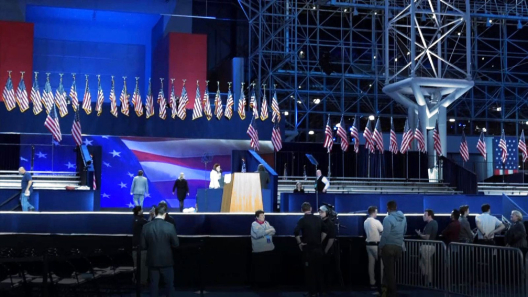
Tuesday night in Dallas, the Republicans opened a convention.
The Speaker of the House stepped in front of a live camera. Somebody asked him about the crowd.
He said the house was full.
Then the camera zoomed in.
The seats behind him were empty. Not a few of them. Rows.
That is the whole story. Four seconds, start to finish.
I have been chewing on it all morning.
Not because a politician said something that was not so. We have all lived long enough to expect that. A man in front of a camera says the room is full. Water runs downhill.
What got me is that nobody had to argue about it.
There was no panel. No fact-check crawling along the bottom of the screen three days later. No he-said and she-said. No expert brought in to explain what the word “full” really means.
The camera moved. The question closed.
I have spent most of my life around claims that could not close like that.
A foreman tells you the load is rated for it. A salesman tells you the unit has been gone through. A company tells you the report has been reviewed. Every one of those is a sentence, and a sentence is all it is. You cannot zoom in on a sentence.
So you learn to take a man’s word, and you learn what it costs you when the word is no good. That is most of a working life right there.
Here is the thing I want you to sit with.
That moment in Dallas was rare. Most of the time, the claim and the proof live in two different places. The claim gets made in the room. The proof, if there ever was one, is somewhere else, in a file nobody opens, in a record nobody keeps.
And the further apart those two things get, the more the saying becomes the whole business.
We are moving into a stretch where that gap is going to matter more than it ever has.
Machines are starting to tell us things now. They tell us the work was checked. They tell us the rules were followed. They tell us the answer is right.
And a machine can say that beautifully. Better than a man can. It will say it in clean sentences with no hesitation in its voice, because it does not have a voice to hesitate in.
But a claim from a machine is still a claim. It is still a sentence. It closes nothing.
The question you want to be asking — about a politician, about a company, about a machine — is not whether the sentence sounds right.
The question is: what would the camera show?
Is there anything here that could disagree with what I am being told? Any record. Any number that gets counted fresh instead of repeated. Anything at all that does not depend on the speaker being straight with me.
If the answer is no, then you do not have a fact. You have a performance. It might be a true performance. But you have no way to know, and neither does the man giving it.
That is not cynicism. I am not telling you everybody lies.
I am telling you that an honest man and a liar sound exactly the same until something checks them. And most of what we get handed in a day never gets checked by anything.
The Speaker probably believed what he said. He was standing in a bright light looking out at a dark room. He may have felt full. It may have looked full from where he stood.
That is worse, in a way. Not a lie. Just a man saying what he felt from where he was standing, with nothing in the world to catch it.
The camera caught it. That is the only reason we are talking about it.
So here is what I would leave you with this morning.
Every single day, somebody tells you something you cannot check. Your bank. Your doctor’s office. Your insurance company. The app on your phone. Now the machine you type your questions into.
You will not get a camera on most of it. That is just true.
But you can start noticing which claims come with something behind them and which ones come with nothing but the saying.
Once you start counting that, you cannot stop. And you will be surprised how thin the pile is on the proof side.
The room in Dallas was empty for about four seconds before anybody knew it.
It was empty the whole time.
” Attic Thoughts”-library – Intelligent People Assume Nothing
Contact: micvicfaust@gmail.com
This post was drafted with AI governed assistance and reviewed and directed by Michael S. Faust Sr. before publication.
© 2026 The Faust Baseline LLC | All Rights Reserved