Let me start with the strangest thing happening in American politics right now, and it has nothing to do with any candidate.
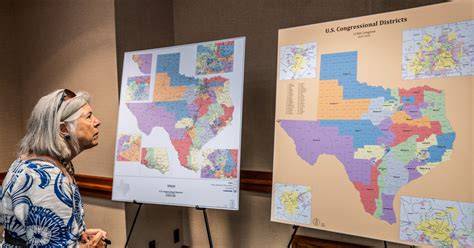
The party that controls the House is redrawing the district maps.
In the middle of the decade. Off schedule.
Several Republican-led states have moved to redraw congressional lines this cycle. California voters answered in November with a measure to redraw theirs the other direction.
Now stop and think about what that means.
You don’t redraw a map you’re happy with.
You redraw a map you don’t trust.
What a district actually is
Most people have never had this explained, so let me do it now.
Every ten years the government counts everybody. Then the states redraw the lines that decide which congressional district your house sits in.
It doesn’t change where you vote. Same building. Same Tuesday.
It changes which race your vote lands in.
Say your street has been in District 6 for ten years. New map, and now your street is in District 4. Same church basement, same neighbors, different candidates on the ballot in front of you.
That’s the whole trick. And it is a trick.
Two words to remember
Districts have to hold about the same number of people. So when somebody moves a line, he’s deciding who gets grouped with who.
There are two ways to use that, and they both have names.
Packing. Cram as many of the other side’s voters as you can into one district. They win that seat 80 to 20. Every vote above what it took to win is wasted. They’re not available anywhere else.
Cracking. Split a bloc across several districts so they’re a minority in each. Enough to lose everywhere. Not enough to win anywhere.
Do both across a whole state and you can draw a map where one party takes most of the seats while getting fewer total votes.
Both parties do it wherever they hold the pen. This isn’t a story about one side being wicked. It’s how the tool works.
Here’s the part that took me a while
Your vote still counts. Every single one.
I had to chew on that, because it sounds like a contradiction.
But an election isn’t one big national tally. It’s 435 separate contests, and each one is winner-take-all. Your ballot doesn’t go into a national pot. It goes into your district’s pot, and only the majority in that pot gets anything.
So your vote can be counted in full and still never reach a win.
Not stolen. Not blocked. Placed.
And now the grift by default.
Here’s what a map really is.
Somebody sits down with ten years of precinct records. This block votes this way, at this rate. That one over there votes the other way, and it turns out less often.
Then he draws lines around those assumptions.
That’s not control. Nobody gets coerced. Nobody gets stopped at the door.
It’s a bet.
A bet that people will keep doing what they’ve been doing.
And it’s a thin bet on purpose. Every extra point of safety you build into one district is a point you could have used to make another one winnable. So a map built to grab the most seats is a map full of districts that are just barely safe.
Thin holds fine in a normal year.
Thin comes apart all at once when the year isn’t normal.
So what do the numbers say
I went looking. Not for who’s ahead. For direction.
Turnout in the primaries this year. CNN took the twenty states that held major primaries for both parties in each of the last three midterms. Democratic turnout ran higher than Republican in 18 of those 20 compared to 2022. And in 12 of 20 compared to 2018.
That second figure is the one that stopped me. 2018 is the year the House flipped.
Across those states, 57 percent of primary ballots were cast on the Democratic side. Up ten points from 2022. Up three points from 2018.
Another look, tighter: six states with the same kind of statewide primary in both years — Arkansas, Illinois, Nebraska, North Carolina, Ohio, Texas. The turnout ratio moved toward Democrats in every one. Democratic turnout up, Republican turnout down. All six.
Texas: about 24 percent of registered voters showed up, against roughly 17 in 2018 and 18 in 2022. Nearly two-thirds of Texas counties ran higher than last time.
Arkansas — deep red Arkansas — Democratic primary turnout up almost 19 percent.
Iowa up. Michigan’s highest midterm primary turnout since 2022. Alabama’s overall turnout about flat, but Democratic up and Republican down inside it.
And then the retirements
Thirty-six House Republicans have announced they won’t run again.
The old record was 34, set in the 2018 cycle. That’s the year Democrats took the chamber.
Twenty-one House Democrats are leaving.
Now, men retire for all kinds of reasons. Age. Family. A run at governor. But thirty-six is not thirty-six private decisions that happened to land the same year.
Sitting members don’t walk away from safe seats in good years. They walk away when the math stops looking friendly and a loss would be the last line on the record.
Put it together
Primary turnout moving one direction almost everywhere it can be compared.
Republican participation flat or falling.
Record retirements on one side.
And a mid-decade redraw by the people who hold the majority.
Four different instruments. Same direction.
That last one is the loudest. A party confident in its map doesn’t redraw it. Redrawing out of schedule is what you do when you’ve read the same numbers I just read and you don’t like them.
What I’m not saying
I’m not telling you November is decided. It isn’t, and anybody who says otherwise is selling something.
Primary turnout is a real indicator and an imperfect one. Hot races pull voters — Texas had big Senate primaries on both sides, and that inflates everything there.
And a map that fails still has a floor. Those packed districts, drawn 75-25, don’t fall to anything. They were written off on purpose so the thin ones could be held.
So the map isn’t broken. It’s just a bet, and the bet is running against the man who placed it.
Why any of this should get you off the couch
Here’s the thing I keep coming back to.
Every one of those lines was drawn from a record of what people did before.
That’s all a mapmaker has to work with. Ten years of habit.
Which means the whole apparatus rests on one assumption — that people are predictable.
That’s not a law of nature. It’s a wager.
And the only thing that breaks it is people doing something they haven’t been doing.
Not arguing with the map. Not suing over it. Showing up in a district somebody wrote off, in numbers nobody planned for.
The lines don’t move. They just stop mattering.
One more thing
Nothing about a map is permanent.
They get redrawn. On schedule, or by a court, or by whoever holds the legislature next time the pen comes out.
Which means the map isn’t a ceiling on what can happen. It’s a record of who won last time.
And it gets rewritten by whoever wins under it.
Post Library – Intelligent People Assume Nothing
Contact: micvicfaust@gmail.com
This post was drafted with AI governed assistance and reviewed and directed by Michael S. Faust Sr. before publication.
© 2026 The Faust Baseline LLC | All Rights Reserved