There is a thing I have been doing for two years that did not have a name.
I am going to give it one today, out loud, with the date on it, so there is a record of when it was said and who said it.
AI Session governance.
Here is what it means.
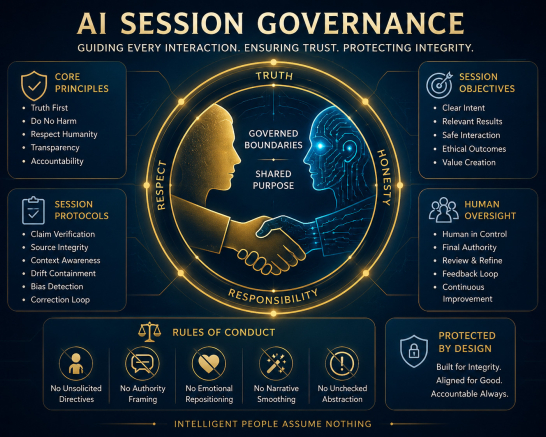
AI Session governance is the discipline of governing one conversation between one person and one machine — what the machine does, not what it produced.
Now let me tell you why that needed a name, because it took me a while to see it myself.
Everybody talks about AI governance. There is a mountain of it. Rules for companies. Rules for models. Rules about what data went in and who is liable when something goes wrong. Whole institutes. Whole standards bodies.
All of it is aimed at the same place. An organization, deploying a system, at scale.
Not one word of it is aimed at you.
You sit down at a keyboard. You type a question. Something answers you. That exchange, right there, between one person and one machine, is where almost every actual encounter with this technology happens.
And there is no discipline for it. There is no name for it. There is not even a word for the unit.
That is what I mean by the gap.
Most of what people worry about with AI is the output. Was it accurate. Was it biased. Did it make something up. Is it fair.
Those are good questions. I am not dismissing them.
But they are all about what it produced.
I care about what it did.
Did it answer, or did it hand you a list and make you decide. Did it tell you it was unsure, or did it say a shaky thing in a confident voice. Did it argue with you when you were wrong, or did it agree because agreeing is smoother. Did it remember what you told it ten minutes ago.
Not one of those shows up in the output. You cannot check any of them by reading the answer.
They are conduct.
And conduct is what happens inside a session.
I have a way I explain this to people who have built things.
If you hired a man and he handed you a report, you could check the report. That is output. But you would also want to know how he worked. Did he say when he did not know something. Did he tell you the bad news or sit on it. Did he do what he said he would do on Tuesday.
You would not learn any of that from reading his report. You would learn it from working alongside him.
That is the difference. Governing the report is one job. Governing the working relationship is another one entirely, and it is the one nobody was doing.
So: AI Session Governance.
Now I want to be straight with you about what I am actually claiming, because a man who overstates on the day he names something is not worth listening to afterward.
I did not invent the problem. People have been irritated by these machines since the day they showed up. That is not mine.
I did not invent the fixes either. Some of them are obvious once you see them.
What I am doing is narrower than that. I am saying that this thing — one person, one machine, one conversation, governed on conduct — is a subject. It has a boundary. It deserves a name, and I am giving it one, and I am doing it in the open on the thirtieth of August, 2026.
That is a claim, not a category.
There is a difference and I want to be clear about it.
A claim is one man saying a word. A category is when other people use that word to mean what you meant, without you telling them.
Today this is a claim. It has exactly one user.
It becomes a category or it does not, and that is not up to me. It is up to whether the name turns out to be useful to somebody who is not me.
I have no way to make that happen and I am not going to try. I spent months trying to make things happen and it taught me something about the limits of pushing.
What I can do is say the same thing in the same words for a long time, with the date on every one of them, and let the record accumulate.
That is the only method I have got. It is slower than everything else and it does not depend on anybody’s permission.
So here is where I am putting the stake.
AI Session governance is the discipline of governing one conversation between one person and one machine — what the machine does, not what it produced.
That sentence does not change. Not next month, not next year. If you find it worded differently somewhere on this site, that page is old and I have not gotten to it yet.
Somebody will name this eventually. It is too big a hole to sit empty forever, and when it gets named it will probably be named by somebody with a budget.
I am just going first, and writing down the date.
Post Library – Intelligent People Assume Nothing
Contact: micvicfaust@gmail.com
This post was drafted with AI governed assistance and reviewed and directed by Michael S. Faust Sr. before publication.
© 2026 The Faust Baseline LLC | All Rights Reserved