There is a fight going on right now over artificial intelligence, and most people think it is happening in Washington.
It is not. It is happening in townships.
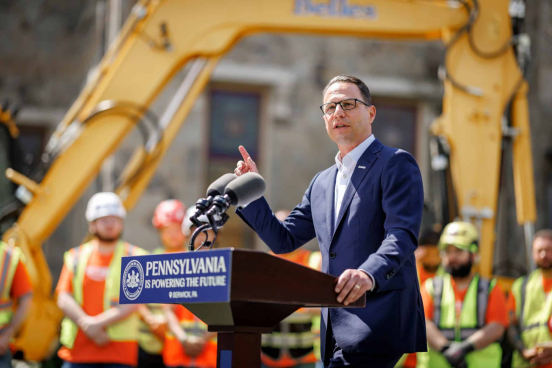
On Tuesday, the governor of Pennsylvania signed an order putting what he called the strictest rules in the country on data centers. Those are the buildings where AI actually lives. Warehouses full of computers, drinking electricity and water on a scale most people cannot picture.
The rules are real. Developers have to bring their own power instead of pulling from everybody else’s grid. They have to pay for the wires and infrastructure themselves rather than spreading that cost across every household bill. A growing share of that power has to be clean. They have to report how much energy and water they use. They have to hire locally.
And here is the one with teeth: they have to get approval from the town first. If the township says no, the state will not review their permits.
He also killed the fast lane. Every AI data center proposal came out of the express permitting program. And he banned the nondisclosure agreements — those quiet papers developers had township officials sign so residents could not find out what was being built next door.
Now the part that tells you what is really going on.
This same governor was welcoming these projects not long ago. He had a big buildout he was proud of. The fast-track permitting he just shut down was his own program.
He changed his mind. And he said out loud why. He said he had traveled the state for a year and heard directly from people who were worried. He described developers as predatory, said they were running roughshod over communities, bullying township officials, refusing to listen.
That is not a man reading a study. That is a man who got yelled at in enough rooms.
He also could not get it through the legislature. The state House passed these standards. The Senate would not bring the bill up for a vote, and the majority leader said flat out he had no intention of regulating data center development at all. So the governor did it by order instead.
There are more than a hundred of these projects floating around Pennsylvania. Only five have all their permits. The governor’s own description of most of the rest is that they are speculative — no real financing, no signed customers, no plans that hold up. Buildings that will never get built, being used right now to scare small towns into deals.
So that is the news. Here is why I am writing about it.
Watch what got regulated.
The building got regulated. The power bill got regulated. The water got regulated. The land got regulated. The paperwork got regulated.
The machine inside did not.
Nothing in that order says one word about what the AI in those buildings is allowed to do. How it decides. What it must tell you. Who answers when it gets your case wrong. Not one line. And that is not a knock on the governor — it is not what a state permit office is for, and he was honest about that.
But look at the shape of it.
I have said for a long time that AI governance splits into two halves. There is the half you can build a cage around — the physical stuff, the paperwork, the disclosures, the fines. And there is the half you cannot cage, which is how the thing actually behaves when nobody is watching.
Pennsylvania just built a very good cage. The best in the country by the governor’s account, and I have no reason to doubt him.
The second half is still wide open.
And here is what worries me about the order in which this is happening.
People are angry. That anger is real and it is earned. But it is landing on the only thing anybody can currently grab hold of, which is a building with a fence around it. The building is visible. The building has an address. You can show up at a township meeting and point at it.
The conduct of the machine has no address. You cannot show up anywhere and point at it. So it does not get regulated, because nobody knows where to stand.
That means we are going to get very good at controlling where AI lives and no better at all at controlling what it does. And when something eventually goes badly wrong — not a power bill, but a decision that ruins somebody’s life — every rule on the books will be about zoning.
I want to be fair to what happened this week. This is government working. A man listened to people for a year, changed his position in public, and used the authority he had when the legislature would not act. Whatever you think of the politics, that is the process functioning.
And there is something in it for anyone paying attention: the pressure came from the bottom. Not from experts. Not from a lab. From township meetings and angry neighbors and a governor who kept hearing the same thing everywhere he went.
That is how this actually moves. Not from the top down. From people who got tired of being talked past.
So the cage is getting built, and it is getting built by ordinary people showing up.
The other half is still waiting on somebody to notice it is missing.
The_Ten_Plain_Rules_CardDownload
This post was drafted with AI governed assistance and reviewed and directed by Michael S. Faust Sr. before publication.
Post Library – Intelligent People Assume Nothing
Contact: micvicfaust@gmail.com
© 2026 The Faust Baseline LLC | All Rights Reserved