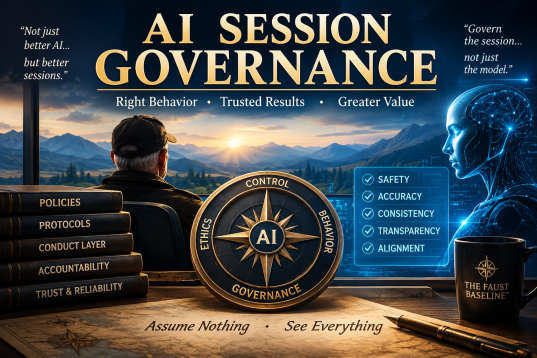
61% of Companies Are Running AI Agents — Almost None Are Trusted. .
Two stories crossed my desk this month.
Different writers. Different audiences. Different lanes.
One is a working developer who learned his lessons the hard way, one burned project at a time.
The other is an enterprise voice writing for companies with security teams and compliance officers and cloud budgets.
Neither one knows the other. Neither one knows me.
And both of them, this month, wrote down the same rules.
Rules that were ratified at a kitchen table in Kentucky — with dates on them — before either article existed.
Let me walk you through it. Bring your own judgment. That’s the whole point of this site.
The enterprise story first.
Yesterday, TechRadar Pro published a piece by Rob Whiteley with a number in it worth sitting with.
Across one hundred engineering organizations, sixty-one percent are already running AI agents.
And almost none of them trust those agents enough to let them touch anything that matters.
Read that again. The majority adopted the tool. Almost nobody trusts the tool.
That gap — between using a thing and trusting a thing — is the whole story of AI right now.
Whiteley’s diagnosis is the part I want you to hear, because it’s the same sentence this site has been built on for over a year:
The problem is not the agents. The problem is the absence of governance around them. The controls already exist.
His words. Yesterday’s date.
Now look at his fix.
He says agents should generate output, but humans decide what ships. A human approval gate on everything that matters.
The Faust Baseline calls that PMAP-1 Rule Five. Write to the buffer only. Nothing goes permanent without ratification. Ratified and published long before yesterday.
He says every action an agent takes should be logged, mapped to an identity, and auditable.
The Baseline calls that Rule Seven. The operator may audit any element at any time. Unratified content gets quarantined.
He says agents should run on scoped, minimal, revocable credentials — never a user’s full keys.
The Baseline calls that Rule Four. Access is credentialed per session, and revocable at any time.
And the whole category he’s writing in — governance for autonomous agents, gates on what an agent can transmit and touch — the Baseline ratified a protocol in that exact category on July 4, 2026.
His article ran July 13.
I’m not claiming he read my work. I’m claiming something better.
Two people working the same problem honestly will arrive at the same rules. The record just shows which one got there first, and wrote it down, and put a date on it.
Now the second story.
About two weeks ago, a developer named Yash Patel wrote a piece for XDA about what actually makes an AI coding tool good.
He didn’t come at it from policy. He came at it from scar tissue.
He learned that the best AI doesn’t rewrite ten files when one file needs fixing. The smallest, safest change wins. The Baseline wrote that rule down as chosen conduct: execute exactly what was asked, no freelancing.
He learned the best AI asks the clarifying questions before the code gets written — because solving the wrong problem fast is still solving the wrong problem. The Baseline built a gate for that: the conditions get cleared before the output forms. Not after.
He learned that AI work can look right on the surface and quietly break something that nobody finds for days. The Baseline’s answer is a self-check that runs before anything gets served: is it supported, does it contradict, is the confidence earned?
And his final measure — judge the tool by whether you can trust what it shipped, long after it shipped — is the Baseline’s oldest rule of all. Compliance is demonstrated through behavior. Not declared through language.
Four rules. One developer. Arrived at by getting burned.
The same four rules sitting in a ratified stack, arrived at by writing the contract before the fire.
Here’s what these two stories mean when you put them side by side.
The developer learned the rules from the bottom, one mistake at a time.
The enterprise is now prescribing the rules from the top, one control at a time.
And in the middle sits a plain-language contract that had already written them down — stated terms, chosen conduct, a kept record, portable across every platform.
That’s not a coincidence. That’s convergence. When the trade press, the working developer, and the kitchen table all land on the same rules independently, the rules were never the hard part.
The hard part was writing them down before you needed them.
And notice what none of this requires. No new invention. No breakthrough. No waiting on a lab. Every control in both articles is old discipline applied to a new worker — the same rules any good foreman runs on a job site. Know who’s on the site. Give them the keys they need and no more. Check the work before it goes in the wall. Keep the paperwork.
Whiteley’s article ends with a warning: the companies that build governance in now will outpace the ones waiting for permission.
I’ll say it plainer.
The house rules are written. The dates are on the record.
Sign when you’re ready.
Purchasing Page – Intelligent People Assume Nothing
The Faust Baseline is for sale. That is not a contradiction of anything — it is the proof of it.
The price is what keeps this work independent. No investors to please. No platform to protect. No advertiser holding the pen. One purchase funds the standard, and the standard answers to no one but the record.
You are not subscribing to anything. You are buying the deed and the working file you take with you to each session in any AI
Post Library – Intelligent People Assume Nothing
“If this post helped you understand AI better. Word of mouth is the only algorithm nobody owns.”
Contact: micvicfaust@gmail.com
© 2026 The Faust Baseline LLC | All Rights Reserved