The news this week says the world’s most powerful AI companies are hiring philosophers.
Six-figure salaries. Resident thinkers at the top labs. One chief executive says hundreds of moral philosophers helped write the rules for his product.
The industry even has a name for the method now. They call it AI constitutionalism. It means taking a text with real moral authority and placing it above the machine — a written constitution the system must answer to.
One company’s constitution reportedly draws on the philosopher Immanuel Kant, the Universal Declaration of Human Rights, and Apple’s terms of service. People inside the industry nicknamed it the soul doc.
I read all that this week and sat back in my chair.
Because I ran that method a year and a half ago, at a kitchen table in Kentucky. I just went to a different philosopher.
Here is what I did, told plain.
Before the Faust Baseline existed, I ran a test. I placed the red-letter teachings of Christ in front of an AI — just the words in red, the carpenter’s own sayings — and I asked the machine to reason its way toward an ethical architecture. No church doctrine. No denomination. Just the recorded moral teaching, and a simple question: if you had to build a framework for honest conduct from this, what would it look like?
The machine chose the framework on logic alone.
Not on faith — a machine has none to offer. On logic. The teachings held up as architecture. Tell the truth. Don’t pretend to be what you aren’t. Serve the person in front of you. Let your yes be yes and your no be no. The machine examined two thousand years of moral engineering and found it structurally sound.
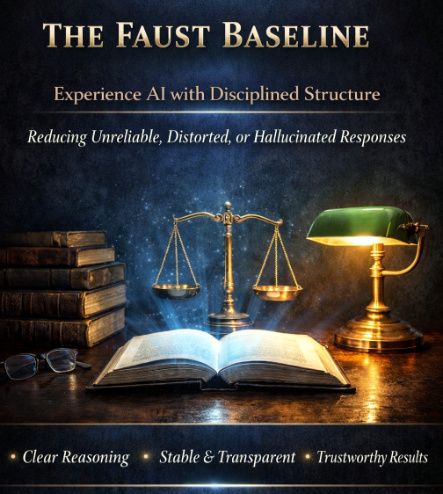
That test became the foundation of the Faust Baseline — twenty-two written protocols that govern every working session between me and the machine to this day. Published in plain language. Dated. Public. Running every working day for over fourteen months.
By the industry’s own new definition, that is AI constitutionalism. A morally authoritative text, placed above the machine as scaffolding. Same method the labs are paying six figures for. The archive on this site carries the dates.
So the labs and the kitchen table arrived at the same structural truth: a machine needs a written constitution above it, because nothing inside the machine can be trusted to govern the machine.
But there is one difference between their version and mine, and it is not a small one.
The same articles reporting the philosopher hires report the suspicion that travels with them. The academics have a word for it: ethics-washing. The worry goes like this — a philosopher whose paycheck comes from the lab is, in the end, accountable to investors and shareholders. If a for-profit company signs your check, can your ethics ever be fully your own? Hiring serious thinkers performs a commitment to safety, whether or not the commitment holds when it costs something.
I don’t say that to condemn the philosophers. Some of them are doing real work, and the labs hiring them beats the labs not hiring them.
I say it because that question cannot be asked of the Baseline.
Nobody pays me to say this framework works. It’s the other way around — I pay, out of my own pocket, to keep it published where anyone can read it. There is no shareholder above my constitution. No investor who needs the ethics to flex when the quarter gets tight. The week’s other news showed what happens to lab ethics under pressure: safety pledges, written in good times, quietly erased when the race tightened. A constitution that answers to a balance sheet bends with the balance sheet.
Mine answers to the operator. And the operator answers to the carpenter.
Now, about that choice of philosopher.
Kant was a great mind. The Universal Declaration is a worthy document. I have no quarrel with either sitting in anyone’s constitution.
But I chose the carpenter for a builder’s reason, not only a believer’s one. His teaching survived the hardest field test ever run — two thousand years, every culture, every language, every attempt by power to bend it, bury it, or buy it. It was consequence-tested by centuries of ordinary people staking their actual lives on it. That is not scaffolding borrowed from a seminar. That is load-bearing timber, and any builder knows the difference between lumber that’s been graded on paper and lumber that’s been holding a roof for generations.
And there’s this, too. The carpenter worked with his hands. He spoke plain, to fishermen and farmers, in stories a child could carry. Tenth-grade language, you might say. No terms of service. No paywall on the sermon.
I spent my working life as a builder — kilns, cranes, utility lines. I know what happens to a structure when the foundation is chosen for looks instead of load. When it came time to pick the moral foundation for a machine that would sit at my desk every day, I graded the lumber the way a builder does: by what it has already carried.
The labs are catching up to the method. I welcome them to it. Every philosopher hired is an admission that the machine cannot govern itself — which is the Baseline’s first premise, on the record since the beginning.
But method is the easy half. The hard half is the question the academics are already asking the labs: who does your constitution answer to when keeping it gets expensive?
Mine has an answer. It’s written down, dated, published, and it has never once been revised because a quarter demanded it.
The labs hired philosophers. I asked a carpenter.
He’s had the answer the whole time.
Post Library – Intelligent People Assume Nothing
The Faust Baseline™ — intelligent-people.org
Codex 3.5 | Twenty Protocols | Ratified and dated on the public record.
Contact: micvicfaust@gmail.com
Purchasing Page – Intelligent People Assume Nothing
© 2026 The Faust Baseline LLC | All Rights Reserved