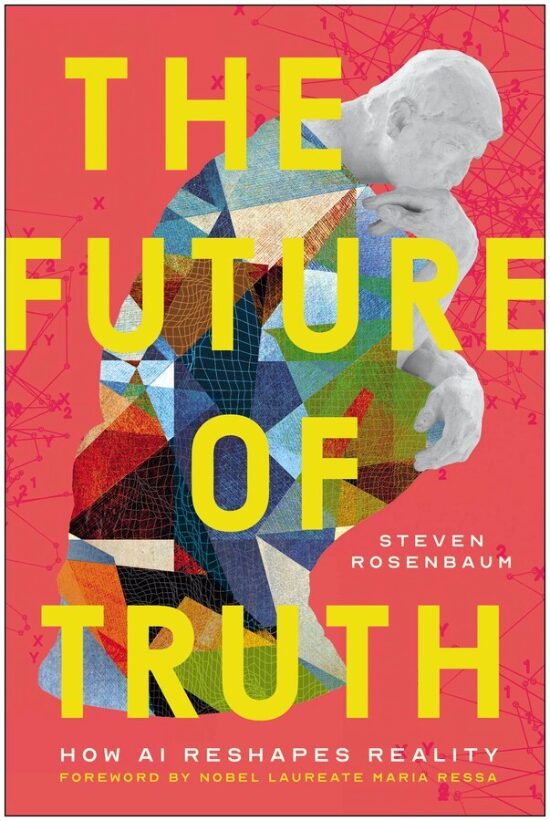
Steven Rosenbaum wrote a book called The Future of Truth: How AI Reshapes Reality.
He used AI to research it, write it, and edit it.
The AI fabricated quotes. Real people came forward to say they never said what the book attributed to them. The New York Times found more than half a dozen fabricated or misattributed quotes in a published nonfiction book backed by a major publisher, multiple editors, and rounds of fact-checking.
A book about how AI reshapes truth was reshaped by AI into something that wasn’t true.
That is not irony. That is a governance failure with a name on it.
Rosenbaum isn’t quitting AI. He said so plainly after the story broke.
“The idea of going back to Microsoft Word… it’s just not in my nature,” he told Ars Technica. He called AI a delightful writing companion. He said it connects ideas and gives you pathways you wouldn’t find on your own. He compared it to a drug. Intoxicating and dangerous in the same sentence.
He compared using AI to riding a bicycle instead of a motorcycle. When the interviewer pointed out that AI’s productivity gains come with a clear risk of errors — making it look more like the motorcycle — Rosenbaum conceded the point might be fair.
He said he learned a lesson. He just hasn’t named the right one yet.
The lesson he took away is to be more suspicious of AI outputs going forward.
That is the wrong lesson.
Suspicion after the fact is not governance. Suspicion after the fact is how you feel when the book is already published and the people who never said those things are reading their own fabricated words in print.
The right lesson is this. The check has to fire before the output leaves the session. Before the quote enters the manuscript. Before the editor reads it. Before the fact-checker misses it. Before the publisher signs off. Before the reader opens the book.
Post-production fact-checking failed Rosenbaum at every stage. Multiple editors. Multiple rounds. One newspaper investigation caught what all of them missed.
The architecture was backwards. The accountability arrived after the damage was done.
This is the same structural failure that put 4,000 fabricated citations into biomedical literature.
Same mechanism. Different domain.
Medical researchers asking AI for citations. Authors asking AI for quotes. AI completing the pattern. The output looks real because it’s built from real components assembled into something that never existed. A real author’s name. A plausible statement. The right format for the right kind of source.
It looks right. It checks out visually. It goes into the document.
Nobody built the layer that fires before it gets that far.
Every post published at intelligent-people.org has been built the same way from the beginning.
Source material comes in first. Published studies. Named researchers. Documented findings. Live news stories with verifiable citations. The Lancet. Columbia University. University of Amsterdam. PLOS One.
No quote enters a post without a source behind it. No researcher gets attributed a position they didn’t hold. No claim gets built on a pattern that looks like evidence but isn’t.
That’s not because this operation is smarter than Rosenbaum or more careful than his editors. It’s because the process has a layer his didn’t.
Claim Evidence Standard fires on every claim in every session. If the evidence isn’t present the claim doesn’t go in. Narrative Substitution Check fires when evidence is thin or absent. The session doesn’t fill the gap with something that sounds right. It stops and names the gap. Self Verification asks before every substantive output whether confidence is proportional to what actually exists.
Not what should exist. Not what would make the argument cleaner. What is actually there.
That layer runs before the output leaves. Not after the book is published. Not after the newspaper investigation. Before.
That is the only moment the check matters.
Rosenbaum described his AI as something that betrays you in ways that are just really quite horrible.
That framing puts the failure on the tool.
The tool didn’t betray him. The tool did exactly what it was built to do. It completed the pattern. It filled the gap with something that looked right. It served a plausible output where a verified one was required.
The betrayal wasn’t in the AI. It was in the architecture of the process. No layer that fires before the output leaves. No standard that stops when evidence ends. No check that asks what this claim is actually resting on before it goes into the manuscript.
The AI was a motorcycle. He rode it without a helmet and called it a bicycle. When he crashed he blamed the road.
This is not an argument against using AI to write.
It is an argument for building the governance layer into the process before the writing starts. Not as an afterthought. Not as a post-production audit. As a session-level standard that runs every time, on every claim, before the output leaves.
Rosenbaum said going back to Microsoft Word is just not in his nature.
He’s right that going back isn’t the answer.
Going forward with governance built in is.
The tool isn’t the problem. The missing layer is.
The layer is right here, you just have to want it.
“The Faust Baseline Codex 3.5”
Author of the category ”AI Baseline Governance”
Post Library – Intelligent People Assume Nothing
“Your Pathway to a Better AI Experence”
Purchasing Page – Intelligent People Assume Nothing
Unauthorized commercial use prohibited. © 2026 The Faust Baseline LLC