The Guitar Nobody Was Supposed to See
There is a guitar sitting in Lexington, Kentucky that almost nobody knows exists.
It came into this house the way most good things do. Quietly. Without fanfare.
The serial number is 1633616. Martin Guitar Company. Nazareth, Pennsylvania. Built in 2012. Fourteen years old and it looks like it was finished last week.
That’s the first thing you notice. Not a scratch that doesn’t belong. Not a finish check. Not a single place where the years show as anything other than a gentle settling into itself. Some instruments age. This one has been patient.
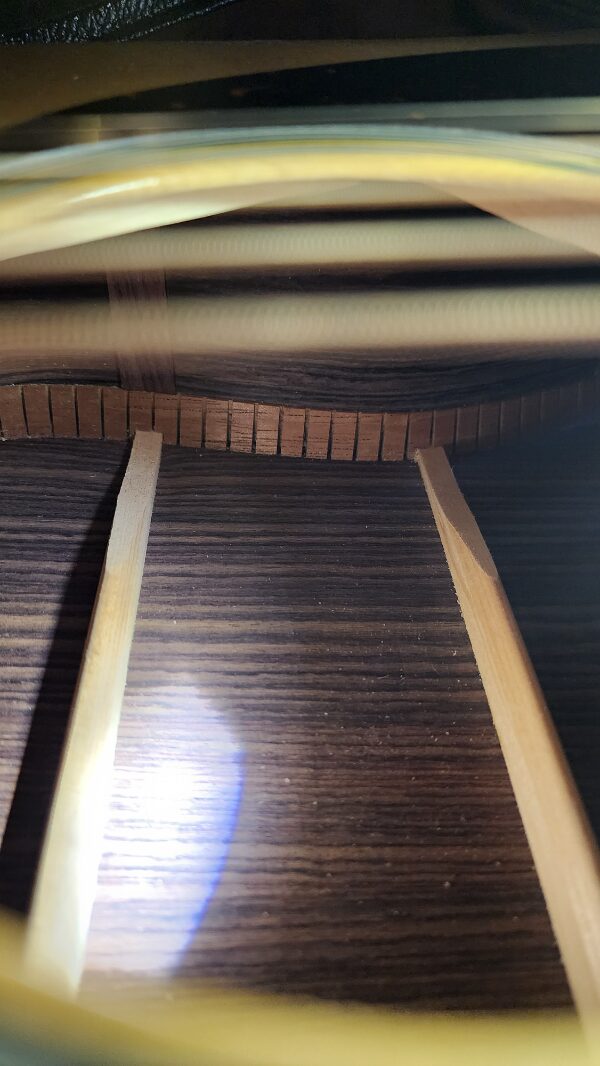
I pulled a scope and looked inside.
What the Scope Showed
Most people never look inside a guitar. They look at the top, the back, the binding, the inlay work. They run their hand along the neck and feel for the frets. They tap the top and listen for the response. All of that is legitimate. All of that tells you something.
It doesn’t tell you everything.
What the scope showed was a different instrument than the one you see from the outside. Not different in a bad way. Different in the way that stops you and makes you set the light down and just look for a moment.
The joint fittings are clean. No glue left behind. Not wiped away. Not sanded flush. Not present. Whoever fitted those joints worked to a standard that said the inside of this instrument matters as much as the outside, and the proof of that standard is the absence of the shortcut.
Every brace is seated properly. The top wood is one piece. No centerline seam. No bookmatched mirror grain. One piece of Adirondck bearclaw spruce selected and worked into the top of this instrument because whoever was building it decided that was the right material for this guitar. The back is the same. One piece of India rosewood. Not two pieces joined at the center and finished to look like one. One.
The neck is figured curly cherry. That detail alone tells you something. The build document listed select hardwood. What was actually fitted was figured curly cherry — an upgrade from the specification that the builder made because it was right for the instrument. Not because anyone would necessarily notice. Because it was right.
No scrap wood anywhere in the build. Every piece that went into this guitar received the same attention as every other piece. The parts nobody plays. The surfaces nobody touches. The joints nobody sees. All of it built to the same standard as the parts that face the world.
A Builder’s Build
There is a category of work that craftsmen recognize immediately and civilians sometimes never see at all.
It is the work done for the instrument itself rather than for the person looking at it. No fancy inlay that catches the light and draws the eye. No decorative binding that signals expense before the first note is played. The appointments on this guitar are of the highest quality and they are quiet about it. They don’t announce themselves. They hold their place and do their job and let the instrument speak.
D-45 appointment level. That is Martin’s highest standard. The equivalent of a builder deciding that if it goes on this guitar it goes on at the level they would put on their best work. Not their most expensive work. Their best.
The distinction matters.
Expensive work sometimes substitutes material cost for craft. The best wood and the fanciest binding and the most elaborate inlay pattern, all of it assembled by hands that were competent but not invested. The result looks right. It sounds adequate. It holds its value because the materials hold their value. But it doesn’t have the thing this guitar has.
This guitar has the thing that comes when the person building it cared more about the instrument than about the price it would sell for.
You can’t see that from the outside. Not reliably. You can suspect it from the quality of the visible work. You confirm it with the scope.
What Detail Actually Means
Detail is not ornamentation. That is the confusion most people carry about craft.
Detail is the decision to fit the joint correctly when nobody is watching. It is the choice to use one piece of tonewood when two pieces would have been acceptable and cheaper. It is the figured curly cherry neck when select hardwood was on the specification and nobody would have complained if that’s what arrived. It is the absence of glue where the glue was never supposed to be.
Detail is the sum of the decisions made when the builder was alone with the instrument and the only standard operating was the one they brought through the door that morning.
That standard either holds or it doesn’t. You can’t fake it in the finished instrument. Not completely. Not from someone who knows where to look. The corners that got cut show up in the scope. The glue that got left behind shows up in the light. The brace that got seated close enough instead of right shows up in the tone over time.
None of those things are present in this guitar.
What is present is fourteen years of a builder’s best decision sitting inside an instrument that belongs in a different conversation entirely. The working valuation is $15,000. That number isn’t about the appointments or the tonewoods or the serial number history. It’s about what the scope confirmed.
Somebody built this guitar the way they would want their guitar built. All the way through. Top to bottom. Inside and out. Every surface. Every joint. Every piece of wood.
Why It Matters Beyond Guitars
It looked right because the person who built it made decisions that pushed through the surface of the instrument and into the grain of the wood and the fit of the joints and the choice of materials in places nobody was ever supposed to examine.
That’s what detail does. It doesn’t stay where you put it. It moves through the work and it surfaces in ways the builder never planned and the buyer never expected and the player feels the first time they sit down with the instrument and play a chord and wait for it to open up.
This guitar opened up fourteen years ago for whoever first played it. It will keep opening up for whoever plays it now.
The craftsman who built it will never know it ended up in Lexington, Kentucky. They will never know someone put a scope inside it and confirmed what they did in Nazareth in 2012. They will never know that the decision to leave no glue behind and use one piece of spruce and fit the figured curly cherry neck and seat every brace properly resulted in an instrument that carried their standard forward fourteen years and across whatever distance it traveled to get here.
They built it anyway.
That’s what detail means. You build it for the instrument. Not for the inspection. Not for the sale. Not for the story someone will tell about it later.
You build it because the standard you carry into the shop that morning is the only one that matters when you’re alone with the wood and the tools and the work in front of you.
The rest takes care of itself.
“The Faust Baseline Codex 3.5”
Author of the category ”AI Baseline Governance”
Post Library – Intelligent People Assume Nothing
“Your Pathway to a Better AI Experence”
Purchasing Page – Intelligent People Assume Nothing
Unauthorized commercial use prohibited. © 2026 The Faust Baseline LLC