This morning the Wall Street Journal reported that Meta is laying off eight thousand people.
That number is large enough that most people will read it and move on. Eight thousand is abstract. It doesn’t have a face. It doesn’t have a kitchen table or a mortgage or a kid starting college in the fall. It’s a workforce reduction. A restructuring. A strategic realignment toward AI-native operations.
That’s the language they use when they don’t want you to feel the weight of it.
Let me tell you what is actually happening inside Meta right now, because the details matter more than the headline.
Earlier this week, before the layoff announcement, Meta sent an internal memo to its employees.
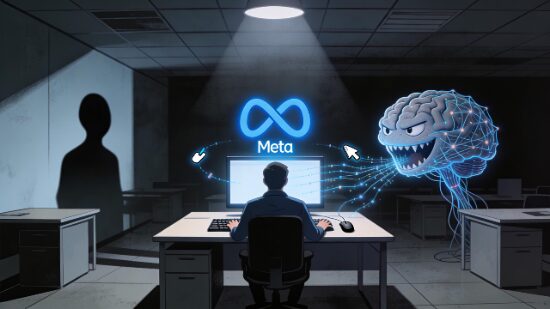
The memo told them that a new software tool had been installed on their work computers. This tool records keystrokes. It tracks mouse movements. It logs where employees click and when and how. It watches the way a human being moves through their work and captures every gesture.
The purpose, Meta explained, is to teach AI models how to use computers the way humans do.
In other words — Meta is using the hands of the people it is about to lay off to train the system that will replace them.
An employee posted on an internal board: how do we opt out?
The answer was no. There is no opt out. Your keystrokes belong to the training data now.
Another employee asked if personal email would be exempt.
Also no.
Sentiment among Meta employees, according to internal analysis, is at its most negative level ever recorded. In 2024, roughly one in five posts about Meta from verified employees were negative. This year that number is more than four in five.
That is not a workforce that feels like a partner in something. That is a workforce that has figured out what it actually is.
Meta’s technology chief Andrew Bosworth said the company is building toward a vision where AI agents primarily do the work. The role of humans, he said, is to direct, review and help them improve.
Mark Zuckerberg said during an earnings call that projects which used to require big teams can now be accomplished by a single very talented person.
They are also building a CEO agent — an AI system to help Zuckerberg do his own job.
I want you to sit with that for a moment. The man overseeing the automation of eight thousand jobs is building an AI to help him do his. Not to replace him. To assist him. He stays in the chair. He keeps the authority. The machine works for him.
The eight thousand people below him do not get that arrangement.
They get watched. They get logged. They get used to build the thing that makes them unnecessary. And then they get a memo thirty days before the fact because someone leaked it and they had to say something.
Here is where I want to bring this closer to home.
I have spent years working on something called The Faust Baseline. It is a governance framework for how human beings interact with artificial intelligence. The core argument is simple and it has never changed.
The human sets the terms. The AI works inside them.
Not the other way around.
What Meta has built is the exact inversion of that principle. The AI is setting the terms. The humans are being fitted to its needs — their workflows studied, their behaviors captured, their patterns extracted and fed into a system designed to make them optional. They are not directing the AI. They are feeding it.
There is a word for a system where the tool defines the worker instead of the worker defining the tool. It is not efficiency. It is not innovation. It is not AI-native transformation.
It is losing the thread of what work is actually for.
Work is not a data source. It is how people build a life. It is how they maintain dignity and contribute something and stay connected to the world around them. When you reduce it to a training set you have not just automated a task. You have told a person that the most valuable thing about them was the pattern their hand made on a mouse.
That should bother everyone. Not just the eight thousand.
The technology is not the problem. I work with AI every single day and I believe it is one of the most remarkable tools available to a thinking person right now. Used correctly it sharpens your thinking, speeds your work, and clears the path between what you know and what you can say.
But used correctly means the human stays at the top of the structure. It means you decide what the AI does and does not do. It means the boundaries are yours and the judgment is yours and the accountability is yours.
What Meta is building is a structure where the company stays at the top and everyone else — employee and user alike — exists to improve the system. You train it by working. You train it by posting. You train it by clicking through a feed that was designed to keep you clicking.
Three and a half billion daily users. Eight thousand employees whose hands taught the machine to work. A CEO whose assistant is an AI and whose workers are training data.
That is the future Meta is building.
It is not the only future available.
The question worth asking this morning is not whether AI will take your job. That question is already being answered in real time in ways that are not abstract at all.
The question is who controls the terms of that relationship.
Because someone will. That has always been true and it is more true now than ever. The only variable is whether it is you or whether it is the platform that decided you were more valuable as a data source than as an employee.
I built the Baseline because I believed that question had an answer worth building toward. That a person could engage with AI on their own terms. That the machine could work for you instead of the other way around.
Eight thousand people in California are finding out this month what happens when nobody asked that question early enough.
Ask it now. While you still set the terms.
Time to set META straight
AI Stewardship — The Faust Baseline 3.0 is available now
Purchasing Page – Intelligent People Assume Nothing
“Your Pathway to a Better AI Experence”
Unauthorized commercial use prohibited. © 2026 The Faust Baseline LLC