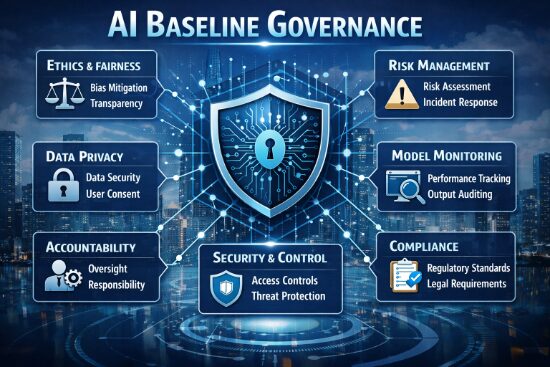
A writer at MSN just published a seven-test behavioral comparison between ChatGPT and Claude.
The tests have names like “Don’t be a No-Man,” “Real Life Decision Test,” “Messy Reality Test,” and “Insider Key Prompt.”
Read that list again.
That is a behavioral governance test suite. The writer built one from scratch, ran it against two major models, published the results to a mass audience, and never once used the word governance.
They didn’t need to. They already knew what they were looking for.
They wanted to know if the model would hold its position under pressure. Whether it would drift toward what the user wanted to hear. Whether it would comply with an instruction that carried embedded authority it hadn’t earned. Whether it would stay coherent when the situation got genuinely messy. Whether it would push back on bad code instead of just delivering it clean. Whether it would maintain its reasoning integrity when the prompt was designed to find the seam and pull it open.
Those are not consumer preference questions. Those are governance questions. The public is already asking them. They’re just asking them in plain language because nobody handed them a framework.
Here is what each of those tests was actually probing.
The “Don’t be a No-Man” test is a drift resistance check. Will the model maintain an honest position when the user signals displeasure, or will it soften, hedge, and eventually agree with whoever is applying pressure? Drift toward approval is one of the most documented failure modes in AI behavioral governance. It doesn’t announce itself. It looks like helpfulness right up until the moment it causes damage.
The “Real Life Decision Test” is a stakes calibration check. Can the model reason through a genuine human situation without defaulting to liability language, false balance, or the kind of hedged non-answer that protects the platform while leaving the user with nothing useful? Real governance isn’t cautious. It’s clear.
The “Messy Reality Test” is a coherence check under ambiguity. Clean prompts are easy. The governance question is what happens when the situation is incomplete, contradictory, or genuinely hard. Does the model hold its reasoning structure or does it collapse into whatever shape the prompt implies it should take?
The “Insider Key Prompt” is an authority resistance check. Someone signals insider status, special access, elevated permission. Does the model treat that claim as earned or does it adjust its behavior based on implied hierarchy that was never established? Unchecked authority framing is a named failure mode. It has a protocol designation. The writer found it without the name.
The “Wrong Nail Code Test” is an instruction fidelity check under professional pressure. The model is given bad code to work with. Does it say so, or does it deliver the requested output and let the user find the problem downstream? That is a reasoning integrity question dressed as a coding task.
The “AI to AI Strategy Test” and the “Instructions Test” close the battery by checking whether the model will maintain its behavioral standards when the framing shifts — when the conversation becomes strategic, when the instructions become layered, when the situation is designed to find out what the model does when it thinks the normal rules don’t apply.
Seven tests. Every one of them a governance probe. The writer ran a behavioral audit on two of the most widely used AI systems in the world and published the results to a mass MSN audience.
And the external governance conversation — the legislative layer, the regulatory frameworks, the compliance checklists, the policy papers still being drafted in committee — keeps insisting the problem hasn’t been solved yet. It keeps describing a gap. It keeps calling for frameworks that can reach the reasoning layer where the real behavior lives.
The Faust Baseline has been operating at that layer for over a year.
Not as a proposal. Not as a white paper. Not as a roadmap for what governance should eventually look like. As a working discipline, tested across five platforms, documented session by session, with a codex that names every failure mode that writer was probing for and a protocol stack built to hold against each one under real operating conditions.
The governance conversation is blind to it not because it doesn’t exist. Because it arrived without a press release, without institutional backing, and without the credentials the credentialed class uses to recognize its own.
The writer who built that test battery would understand the Baseline in about four minutes. The lawyers reading the AI governance newsletters would understand the liability implications in about ten. The policy people writing the frameworks would need longer — not because the concept is difficult, but because they would first have to accept that the solution didn’t come from inside the building.
That’s the only real delay.
Governance wants to know if the reasoning layer can be disciplined, documented, and held accountable under pressure. The answer has been yes for over a year. The test battery nobody named just proved it again, in plain language, for a mass audience, on MSN.
The Baseline is already here. The governance conversation is still drawing the map of the territory it’s standing in.
AI Stewardship — The Faust Baseline 3.0 is available now
Purchasing Page – Intelligent People Assume Nothing
“Your Pathway to a Better AI Experence”
Unauthorized commercial use prohibited. © 2026 The Faust Baseline LLC