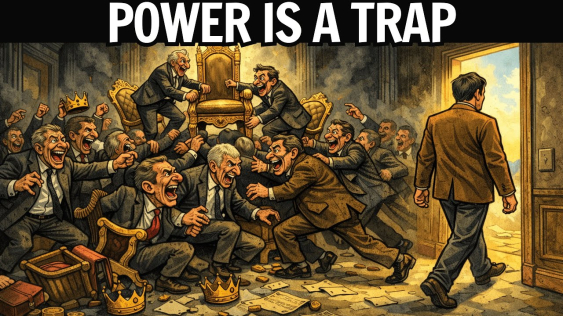
Last Friday, the President stood at the podium in the White House briefing room.
He had just come home from a trip to Asia. He had met with the leaders of China and Russia. His Vice President stood on one side of him. His Secretary of State stood on the other.
Then he did something worth slowing down for. He pointed out into the room and said the most powerful man in the world was there with them. He did not mean himself. He meant his chief of staff, Stephen Miller.
He waved Miller up to the microphone. Miller spoke for a minute or two about the record and the years ahead. When he finished, the President turned to the two men beside him and said Miller was better than these two guys. Then he asked Miller if he wanted to run for president.
Some folks laughed it off as a joke. Maybe it was. Joke or not. the President said something true about that job, whether he meant to or not.
What a chief of staff does. He runs the door. He decides who gets a meeting and who waits outside. He decides which papers land on the desk and which ones never make it there. He decides what the President hears first, and what he never hears at all.
Nobody votes for that man. His name is on no ballot. He answers to one person. And yet the man who holds the door can shape every choice made behind it. That is not a knock on any one person. That is the nature of the seat.
Miller took that seat on November 9. It came just days after the midterm elections, when Republicans lost control of both the House and the Senate. Folks in both parties had something to say about the pick. Some called it the right choice. Some called it the worst one. You can make up your own mind on the man. That is not what this is about.
What this is about is the door. And who holds the key.
Here is the part I want you to hear. The man at the door does not answer to you. But the people who can call him to account do. Congress has the power to ask hard questions. Congress can hold hearings. Congress holds the purse strings. And Congress answers to the people who sent them there.
On November 3, the people spoke. Control of Congress changed hands. Whatever you think of the result, that is the voice working the way it was built to work. The new Congress takes its seats in January. From then on, the people’s voice will have a seat at the table it did not have before.
That does not mean the job is done. A vote is not the end of a voice. It is the start of it. The folks we sent to Washington will only use that power if they hear from us. Letters. Calls. Town halls. Showing up. A voice used keeps the people at the door answerable. A voice gone quiet lets the door decide for us.
There is another door, and it sits a lot closer to you than Washington.
Every one of us who uses AI has put a gatekeeper on our own desk. You ask it a question, and it decides what comes back. It decides what to put first. It decides what to leave out. It summarizes the long report so you never read it yourself. It frames the answer before you ever see the facts.
That AI is your chief of staff. And most folks never stop to ask who it answers to. They just take what it hands them and move on. That is the same mistake as letting the man at the door run the house while nobody watches.
You have the same power here that the people have over Washington. You can set the rules your AI works by. You can ask it what it left out. You can make it show you what its answer stands on. You can check its work before you act on it. And when it hands you something that does not hold up, you can call it out and make it do it again.
That is your voice at the keyboard. It is the same voice you use at the ballot box. It does not shout. It holds the gatekeeper to account. It keeps the person in charge, not the one at the door.
I have learned watching this world change. Power does not stay where it is put. It drifts toward whoever controls what gets seen. That has been true in every palace and every office since men first built doors. It is true in the White House. And it is true on the screen in front of you right now.
The answer has never been to tear the door down. Every house needs one. The answer is to make sure the one holding the key knows who he works for. That takes people who pay attention. People who ask questions. People who do not go quiet.
So the next time you hear someone called the most powerful man in the room, ask yourself a simple question. Powerful over whom? And who holds him to account?
In Washington, that answer is us. It is the voters, and the Congress we just sent. On your own desk, that answer is also you. Nobody else is going to hold the door for you. Nobody else is going to check what your gatekeeper left out.
We the people still have the strongest voice in the room. The only way we lose it is by not using it.
So use it. In January, when the new Congress sits down. And tonight, when your AI hands you its next answer.
The door is only as honest as the people watching it.
Load this file before each AI chat session.
faust-baseline-level-groundDownload
This post was drafted with AI governed assistance and reviewed and directed by Michael S. Faust Sr. before publication.
” Attic Thoughts”-library – Intelligent People Assume Nothing
micvicfaust9/faust-baseline · Datasets at Hugging Face
© 2026 The Faust Baseline LLC | All Rights Reserved