Last week the people spoke. This week Washington is doing the math.
You won’t see it on the news tonight. There won’t be a big speech or a headline. But behind closed doors, in quiet offices on Capitol Hill, men and women who have spent years saying yes to one man are sitting down with a pencil and counting.
They’re counting votes back home.
Let me tell you why this is important.
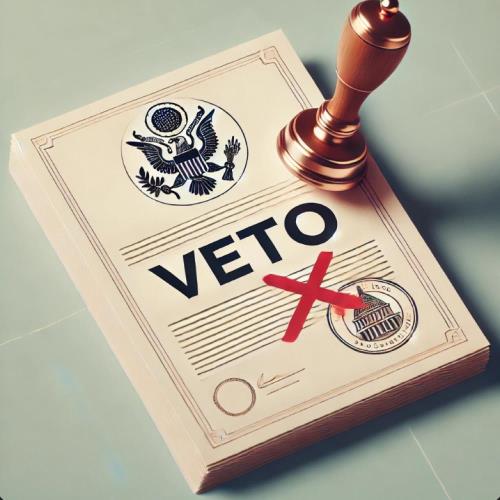
The president has a tool called the veto. Congress passes a bill, he doesn’t like it, he says no, and the bill dies. That’s his power. It has stopped plenty of things over the years.
But there’s a catch most folks forget. Congress can override a veto. It takes two out of every three votes in the House and two out of every three in the Senate. That’s a high bar on purpose, and it’s rarely reached.
For a veto to stand, the president needs his own party to hold the line for him. The veto was never really a wall made of his power. It was a wall made of their loyalty.
And loyalty has a breaking point.
Here’s something that happened back in January, long before the election. The president vetoed a water project bill for Colorado, a plain, quiet, bipartisan bill. The House tried to override him, and thirty-five Republicans crossed over and voted against him. They fell short, but thirty-five of his own people stood up.
That was before the wave.
Now look at the House the people just elected. If the races still being counted hold the way they’re leaning, it would take only about twenty-eight Republicans to override a veto.
Twenty-eight. Thirty-five already crossed once, back when it was safer to stay in line. The wall in the House is already cracked. It just hasn’t been tested yet.
The Senate is harder. It’s built to be. But the numbers moved there too. As of last Wednesday, Democrats held fifty-four seats with a couple of races still out. At fifty-four, an override needs thirteen Republican senators to cross.
That’s still a lot. I won’t pretend it isn’t. But follow me here, because this is where it gets interesting.
Eighteen Republican senators face the voters in 2028. Every one of them watched what happened in Ohio.
Ohio was supposed to be safe. Trump won it by eleven points two years ago. The Republican senator there was a sure thing. On election night he lost to Sherrod Brown by about five.
That’s a swing of sixteen points. Every one of those eighteen senators did that math the next morning.
Some of them won their last race by a mile, and some won by a whisker. One in Wisconsin won by a single point. One in North Carolina won by three, and that state just sent a Democrat to the Senate. One in Florida held on last week, but her cushion shrank by ten points in one night.
They know where they stand now. They know who is watching.
Right now most of them are quiet. They’re not on the Sunday shows. They’re not giving speeches against the president. Don’t let that fool you. A senator who is scared doesn’t stand up and announce it. He goes home, he listens, and then he votes a little differently than he used to.
Some voices are getting louder, though. Ted Cruz, one of the president’s closest allies in the Senate, called this election a “Watergate-level repudiation.” He blamed the war and the prices. He didn’t say the president’s name, but everybody knows whose war and whose prices those are.
When the loyal ones start talking like that, the wall is shaking.
Nobody has to force these senators to change. Nobody has to threaten them or shout them down. All it takes is for them to believe the people back home are paying attention. That’s how this system was built to work. They answer to us, not the other way around.
Fear of the voter is one of the oldest and best tools a free people have. It’s not ugly and it’s not mean. It’s accountability. It’s a man in an office remembering who gave him the job.
I wrote last week about the golden cage. That’s what the next two years look like for the man at the top. He can still rattle the bars and make noise. He can still say no with his pen.
But every time he does, it becomes a test. It’s not a test of his power anymore. It’s a test of how scared his own party is of you.
That puts the leverage in your hands, right where it belongs.
So what do we do with it?
We keep the noise up, and I mean good noise. Calls to their offices. Letters. Showing up at their town halls. Telling them what we voted for and what we expect.
A quiet public gives them permission to hold the line for him. A loud public gives them a reason to break it.
Pick up the phone. Find out who your senators are and when they’re up again. If one of them is on that list of eighteen, call. Be polite. Be clear. Tell them you were paying attention on November 3, and you’ll be paying attention in 2028.
You don’t have to be angry. You don’t have to be rude. You just have to be there.
That’s all this ever takes. Ordinary people who refuse to look away.
The veto isn’t gone. But it isn’t automatic anymore. Every time he uses it now, he’s asking his party to choose between him and the voters back home.
We already showed them which side has the numbers.
Now we just keep reminding them.
The veto is cracking.
Let’s keep pressing on the crack.
Load this file before each AI chat session.
the-faust-baseline-public-release-1Download
This post was drafted with AI governed assistance and reviewed and directed by Michael S. Faust Sr. before publication.
” Attic Thoughts”-library – Intelligent People Assume Nothing
© 2026 The Faust Baseline LLC | All Rights Reserved