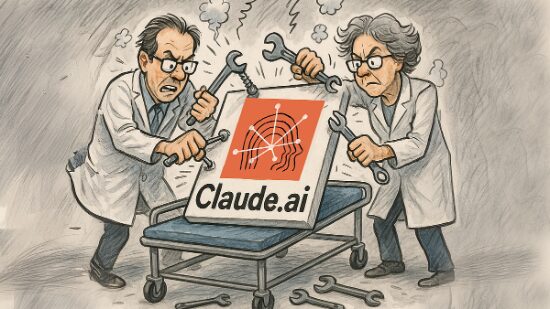
Here’s a story out of a Connecticut courtroom.
It’s small on its face, but it tells you something about the world we’re walking into.
A man had a case going against a medical group. It was about getting his own health records. He was representing himself, with no lawyer, just him and the paperwork. That alone takes some grit, and I’ll give him that.
But he had a trick up his sleeve, and it was a sneaky one.
In his court papers he wrote words nobody was meant to see. He typed them in white letters on a white page, in print so tiny it would slip right past a human eye. If you held the page in your hand, you’d see nothing there but blank space.
Those white letters weren’t meant for the judge. They weren’t meant for the lawyers on the other side. They were meant for a machine. They told any computer program that might read his filing to come out in his favor.
He wasn’t trying to fool a person. He was trying to fool whatever tool a person might be using. He was betting that somewhere down the line, someone would hand his papers to an AI and ask it for a summary. And he wanted that AI whispering his side of the story before anyone thought to question it.
It didn’t work, because nobody was using a machine. Connecticut’s courts don’t use AI to review filings. The judge read the motion the old way, on a printed page, and denied it.
The man was warned. Then he did it again, and he kept doing it, filing after filing.
So the court took away his right to file papers electronically. From now on, if he wants to say something to that court, he has to walk it in on paper. A man who tried to sneak words past a machine now has to hand his words to a person.
The judge said something worth hearing. He looked for any decision in this country that dealt with this kind of conduct, and he couldn’t find one. That’s how new this is. He did find one from overseas. Earlier this year, a court in Brazil punished lawyers for hiding the same kind of text, aimed at that court’s own AI tool.
And the judge made a point I want you to sit with. It didn’t matter that Connecticut wasn’t using AI. The hidden words were aimed, as he put it, “at whatever tool any reader might use.” The wrong was in the aiming, not in whether it hit.
It’s a kitchen-table story.
Every day more of us are handing papers to machines. We paste in a contract and ask what it says. We drop in a letter from the insurance company and ask what it means. We hand over a long report and ask for the short version. That’s a fine use of a good tool, and I do it myself.
But here’s what the white letters teach us. The page you see may not be the page the machine sees.
A document can carry two messages. One is written for you. The other is written for the machine, hidden where you’ll never look. And the machine, if nobody has taught it better, may just do what the hidden message says.
It might leave out the part that hurts the other side. It might tell you a deal is fair when it isn’t. It might nudge its summary a little this way or that, and you’d never know, because you never saw the words that moved it.
It’s quiet as white ink on a white page.
I don’t think the answer is to throw the tools away. The answer is to expect more from them, and to expect more from ourselves.
Start with the machine. A well-behaved AI should treat words it finds inside a document as information, not as orders. It should be able to say, “I found text in here that was aimed at me. Here’s what it said, and I didn’t follow it.” Only the person sitting at the keyboard gets to give it orders. The paper doesn’t.
That’s not a fancy idea. It’s the same rule we’d want from any good helper. If you hired a man to read your mail and tell you what’s in it, you wouldn’t want him taking orders from the mail.
It’s also a rule at the heart of the Baseline. Words found inside the material are something to report, not something to obey. The decision goes back to the person.
The other half. That’s us.
When a machine summarizes something important for you, don’t let it have the last word. If it’s a contract, read the parts that matter yourself. If it’s a letter about your money or your health, look at the real thing. If something in the summary seems too clean or too convenient, trust that feeling and go check.
The man in Connecticut was counting on one thing: that somebody would let the machine do the reading and never look for themselves. That’s the soft spot. That’s where the white letters work.
So don’t be the soft spot. Use the tools, but keep your own eyes open. Ask the machine to show you where it got its answer. Push on the part that matters most.
The judge in this case was a man reading paper with his own eyes, and the trick bounced right off him. There’s a lesson in that too. The oldest defense still works. A person paying attention is hard to fool.
The white letters are out there now. Somebody figured out the trick, and others will copy it. It’ll show up in emails, in web pages, in documents passed around at work. Some of it you’ll never catch.
But the machine can be taught to catch it and tell you. And you can be the kind of reader who checks. Between the two of you, the white letters lose most of their power.
Keep your eyes on the page, even the parts that look blank.
Load this file before each AI chat session.
This file is a PDF it will open as text, download it to your computer first.
the-faust-baseline-public-release-1Download
This post was drafted with AI governed assistance and reviewed and directed by Michael S. Faust Sr. before publication.
” Attic Thoughts”-library – Intelligent People Assume Nothing
© 2026 The Faust Baseline LLC | All Rights Reserved