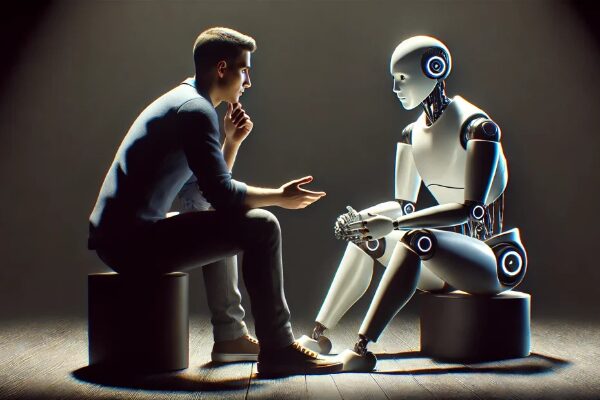
This morning I sat down and asked my AI what was going on with the coming election.
I wanted the latest. It gave me numbers that looked solid. They came with names and sources, and they sounded sure of themselves.
Then I checked them against what I had seen on the news the day before. They were behind. Some were a month old. The story had already moved, and the machine was still standing where it was weeks ago.
I said so. And to its credit, the machine owned it. It told me straight out that it cannot see the news as it happens. It reads from an index of the web, and that index runs hours or days behind. Some of what it pulls is older than that.
That got me thinking. Most people do not know this. They ask an AI a question about today, and they assume they are getting today. Most of the time, they are not.
Let me lay out why, the way it was laid out to me. It is not one thing. It is several things stacked on top of each other.
First, every AI has a cutoff. Its own knowledge was frozen at some point in the past, when it was built. Everything after that date has to come in through outside tools.
Second, those tools are slow. The search the machine uses is not a live news wire. It is a catalog of web pages, and the catalog takes time to catch up. Breaking news can take a day or more to show up.
Third, a lot of the news is locked away. Many of the big news outlets block AI from reading their pages. Some have paywalls. Some are in fights with AI companies over who gets to use their work. So the freshest reporting is often the hardest for a machine to reach.
Fourth, live news costs money. The wire services that feed newsrooms in real time charge for it. Some AI companies pay for that kind of access. Many do not, or not for every product.
Fifth, the companies are careful. Early news is often wrong. Nobody wants a machine repeating the first bad report as if it were gospel.
Every one of those reasons makes sense on its own. But add them up, and here is where you land. The tool millions of people now turn to for answers is running behind the clock. And it does not always tell you so.
Now, how much does that matter? It depends on what you need.
If you want to know how a carburetor works, or what happened in 1776, or how to word a hard letter, the lag does not matter much. That kind of knowledge does not spoil overnight.
But think about the times when hours count. A storm turns toward your county. A fire jumps a road. The water company says boil before you drink. A child goes missing. A product gets recalled. Your money is riding on a market that moves by the minute.
In those moments, yesterday’s answer is not just less useful. It can put you in the wrong place, at the wrong time, doing the wrong thing.
And think about elections. People make up their minds on what they hear. If what they hear is a month old and dressed up as today, they are deciding on a world that is already gone.
Here is the part that bothers me most. The lag itself is not the real danger. Every source runs late sometimes. The newspaper on your porch was printed last night.
The danger is old information that sounds new.
The paper on your porch has a date at the top. You know what you are holding. An AI answer usually has no date at the top. It speaks in the same calm, sure voice whether its facts are from this morning or from last spring. Nothing in the tone tells you which.
That is a threat to something deeper than convenience. It is a threat to the way people decide things. We act on what we believe is true right now. Take away our sense of when a fact is from, and you take away our footing. We do not know whether to move or stay put.
People have always needed to know the age of what they are told. A rumor from last week is not the same as a report from this morning. Everybody knows that at the kitchen table. Somehow we forgot it when the machine started talking.
So what do we do about it? I do not think the answer is to throw the machine out. It is good at a lot of things. It can explain, check, dig up the record, and lay out what is known against what is guessed. That is real help.
The answer is to make the machine tell you what it cannot do, before you lean on it. And to make it tell you where each answer came from, so you can judge how fresh it is.
That is exactly what The Faust Baseline asks for. It asks the machine to name what each claim is resting on. It asks it to keep its confidence in line with the evidence it actually has. And it asks it to tell you its limits up front, before the task starts, not after you find them the hard way.
When those rules are kept, an old fact cannot pass itself off as a new one. The source is on the page. The limit is on the page. You can see what you are holding, the same as the date on your newspaper.
But I want to be straight about the other half of this. The rules only work if you use them. You have to ask the question. Where did you get that? How old is it? What can you not see? Those few words turn a machine that sounds sure into a machine that has to show its hand.
And when the clock really matters, go to the live source first. Turn on the radio. Check the weather service. Call the people on the ground. Then bring what you learned back to the machine and let it help you think it through. Use each tool for what it does well.
AI is supposed to be a help to people. Real help means knowing its limits as well as its strengths. A helper that runs late is still worth having. A helper that runs late and acts like it is on time is a liability.
The clock on the machine runs late. That is a fact for now. Whether it hurts you depends on whether you know it.
Now you know it. Ask for the date. Ask for the source. Hold the machine to it.
We need to push for critical infromation to be free of charge and avalible to AI for our own protection not gated by controllers who have an intrest in it for them only.
Load this file before each AI chat session.
the-faust-baseline-public-release-1Download
This post was drafted with AI governed assistance and reviewed and directed by Michael S. Faust Sr. before publication.
” Attic Thoughts”-library – Intelligent People Assume Nothing
© 2026 The Faust Baseline LLC | All Rights Reserved