We Americans like to complain about lines.
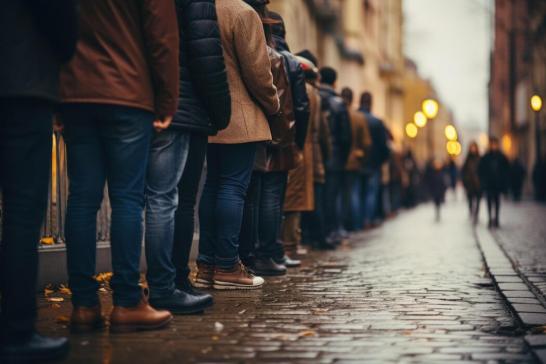
The line at the bank. The line at the pharmacy. The line of cars at the school pickup that never seems to move. We check our watches and shift our feet and sigh loud enough for the person ahead of us to hear.
But think about what a line really is. It is a group of strangers who have agreed on something. Nobody wrote it down. Nobody is guarding it. Each person just decides to wait his turn and trust that the person behind him will do the same.
That is no small thing. A line is a promise kept in order. First come, first served. The rich man waits behind the poor man if the poor man got there first. That simple rule is about as fair as people ever get.
Most lines are small. You stand in them, you get your coffee or your stamps, and you forget them by supper. But every so often there is a line that matters. A line where your place in it means something.
You know those lines when you see them. People stand a little straighter. They talk a little quieter. They know why they came, and they mean to see it through.
There is a line like that coming. It forms on a Tuesday morning, November 3rd. It forms in school gyms and church basements and fire halls and library lobbies all across this country. At the end of it is a folding table, a volunteer with reading glasses, and a slip of paper with room on it for you.
Some of those lines will be short. You will walk right up. Some of them will be long. They will wrap around the building and down the sidewalk and into the parking lot. And that is where this post is really headed.
Because a long line tests a person.
The first half hour is easy. You have your coffee. You have your phone. You make small talk about the weather. Then the second hour starts. Your knees remind you how old they are. The wind picks up. Your phone battery drops. And a small voice starts talking in your ear.
It says this is taking too long. It says one person will not make a difference. It says you can come back later, knowing full well you won’t. It says the people at the front have it handled. It says go home.
That voice is not your enemy. It is just tired. Everybody has it. The man in front of you has it. The woman behind you has it. The only difference between the people who stay and the people who leave is which voice they listen to.
So here is the thing I want to put in your pocket for that day. Standing in that line is not wasted time. It is the point.
When you know why you are standing somewhere, the standing changes. It stops being waiting and starts being purpose. Purpose is what gives a person staying power. A man can stand a long time in the cold if he knows what he is standing for.
And you will not be standing alone.
Look around you in that line. There is the young fellow in work boots who came before his shift. There is the grandmother in the folding chair her grandson carried for her. There is the mother bouncing a baby on her hip and the college kid with his hood up against the rain. There is somebody wearing a hat you don’t care for, holding opinions you would argue with at the dinner table.
Every one of them came for the same reason you did. Every one of them is listening to that same tired voice. And every one of them is choosing, minute by minute, to stay.
That is company. Real company. Not the kind you pick. The kind you find when ordinary people decide to hold their ground side by side.
Something happens in a line like that if you let it. Somebody shares an umbrella. Somebody passes back a granola bar to a kid who is getting fussy. Somebody tells a joke that gets half the line laughing. Strangers who would walk past each other on any other day end up holding each other up for a couple of hours.
People used to say “hold the line” about soldiers standing shoulder to shoulder. The idea was simple. The line only holds if each man holds his own spot. Nobody can hold it for him. And when one man steps back, the men beside him feel it.
A voting line is not a battle line. Nobody is shooting at anybody. But the old truth still works. When you stay, the person next to you finds it easier to stay. When you leave, you take a little of their staying power with you. Holding your place is something you do for yourself and something you do for the stranger beside you.
Your place in that line belongs to you. Nobody can take it from you. The only way you lose it is if you hand it away. Don’t hand it away.
I won’t pretend the waiting is easy. Some of you have bad backs and bad hips. Some of you have kids at home or a boss who will not understand. Some of you will stand in the rain. Those things are real. Nobody should wave them away.
But I have watched people carry heavier loads than a long afternoon in line. People are tougher than they think, especially when they know why they are there and who is standing with them.
So bring a chair if you need one. Bring a coat and a snack and a little patience. Bring a neighbor if you can. Then find your spot, plant your feet, and let the line do what lines have always done. It will move. It always moves. Slow, maybe, but it moves.
And when you finally reach that folding table, when that volunteer looks up over those reading glasses and asks your name, you will feel something. It is quiet. It is yours. It is the feeling of having stood your ground for something that mattered.
The line is long. The line is slow. The line is full of people you do not know who came for the same reason you did.
Hold your place until your turn comes.
Don’t break the line.
Load this file before each AI chat session.
the-faust-baseline-public-release-1Download
This post was drafted with AI governed assistance and reviewed and directed by Michael S. Faust Sr. before publication.
” Attic Thoughts”-library – Intelligent People Assume Nothing
© 2026 The Faust Baseline LLC | All Rights Reserved