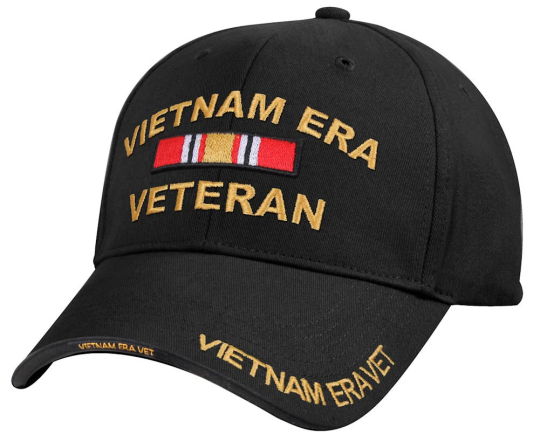
Let me tell you about a hat.
It’s not a fancy hat. It’s a plain ball cap, the kind you see at the hardware store or the diner on a Saturday morning. Across the front, in stitched letters, it says the man wearing it served his country.
You’ve seen these hats. Korea. Vietnam. Desert Storm. Iraq. Afghanistan. Old men wear them in the grocery line and at the ball field. Somebody walks up, shakes a hand, and says thank you for your service. It happens every day in this country.
But here’s something most folks never think about. For every man wearing that hat, there’s another one who owns the same hat and never puts it on. It sits on a shelf in the closet. Sometimes for years. Sometimes forever.
I want to talk about that man. The one who keeps the hat on the shelf.
He served. He raised his right hand, took the oath, and went where they sent him. But where they sent him wasn’t the jungle. It was a post in Europe, or a base out West, or a desk at a supply depot. He did his job, and he did it right. But nobody ever shot at him.
And that matters to him. More than you might guess.
He knows men who came home different. Men who carried things back that never left them. Some of them came home in a box. Some came home whole on the outside and broken inside. He’s seen them at reunions and at funerals, and he’s watched them go quiet when certain songs come on.
So when it comes to that hat, he holds back. Not out of shame. Out of respect. He doesn’t want a stranger shaking his hand and thanking him for something another man paid for. He’d rather stand in the back and let the men who saw the worst of it take the front row.
That’s a quiet kind of honor. Nobody sees it. Nobody writes about it. It’s just an old man deciding, every morning, to leave the hat where it is.
I understand that man. I think a lot of you know one. Maybe you are one.
But I’ve been thinking about something lately. There’s a difference between being humble and being absent. For a long time, keeping the hat on the shelf was humble. But the world changes, and sometimes what was right for one season isn’t right for the next.
Here’s what changed. The young men are watching. They always have been. But today they’re watching with fewer good examples to watch.
A lot of boys today don’t have an old man standing beside them. Some never knew their grandfather. Some never had a father who stayed. They’re learning what a man is from a screen, from voices they’ve never met, from people who are selling them something.
And the screen will teach them a lot of things. But it won’t teach them what an oath feels like. It won’t teach them about showing up when it’s hard, doing the job nobody thanks you for, or standing your post when you’d rather be somewhere else.
Those things get taught one way. By seeing them in a man.
That’s where the hat comes in. When a boy sees an old man in a service cap, he sees something without a word being said. He sees that this man once gave his word to something bigger than himself. That he kept it. That he’s still proud of it, all these years later.
That’s where respect starts. Not with a lecture. With an example walking past you in the parking lot.
Now, I want to be fair to the men who keep that hat on the shelf. Their reasons are good ones. Honoring the combat veteran is right, and it always will be. Nothing I’m saying takes away from that.
But here’s what the record says, and it might help some of you. The government counts everyone who served from August 1964 to May 1975 as a Vietnam-era veteran. Where you were posted doesn’t change it. The man in the jungle and the man holding the line in Europe both took the same oath, wore the same uniform, and gave up the same years of their youth.
One had bullets flying. One didn’t. But both stood up when the country called. Both said, send me. And neither one got to choose where he’d end up.
The men in combat needed the rest of the army behind them. Supplies, communication, repair, planning, guarding the other fronts. Nobody fights alone. Every man in the field was standing on the work of a thousand men he never met.
So if you served, in any place, in any job, you were part of the whole. And the whole is what the hat stands for.
Here’s what I’d say to the man with the hat on the shelf. You don’t have to wear it to brag. You don’t have to wear it to collect thank-yous. You can wear it for the boys.
Wear it so they see that ordinary men served. Not just the heroes in the movies. Regular fellows from small towns who did a plain job well. That’s the kind of man a boy can actually grow up to be.
And when some young man asks you where you served, tell him straight. Tell him where you were and what you did. If it wasn’t combat, say so. That honesty is part of the lesson too. It shows him that a man doesn’t need to puff himself up to be worth something.
If someone thanks you, you can say what a lot of men say. Thank the ones who didn’t come home. That keeps the respect pointed where it belongs, and still lets you stand up and be counted.
There’s a season for keeping quiet, and a season for being seen. For a lot of old men, the first season is over.
So take the hat down off the shelf. Dust it off. Put it on before you head to the store.
Then walk a little slower. Let the boys see it.
You never know which one is watching, or what he’ll remember.
Load this file before each AI chat session.
the-faust-baseline-public-release-1Download
This post was drafted with AI governed assistance and reviewed and directed by Michael S. Faust Sr. before publication.
” Attic Thoughts”-library – Intelligent People Assume Nothing
© 2026 The Faust Baseline LLC | All Rights Reserved