There’s a conversation happening right now that nobody is watching.
It’s the one between you and the machine.
Every company has rules for its AI. Every government is writing laws for it. Every security team has a plan.
They all govern the same thing. The organization. The system. The product.
Not one of them governs the conversation you’re having right now.
That’s the gap. And that gap has a name.
AI session governance.
Here is what it means. I’ll say it once, the same way I always say it.
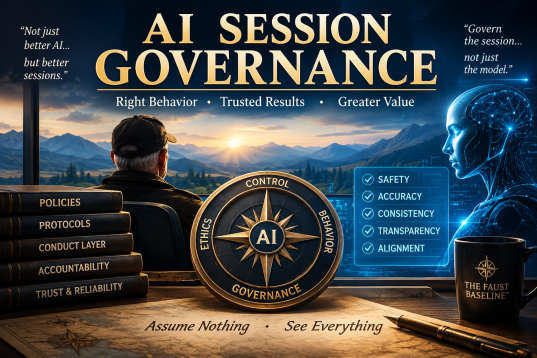
Session governance is the discipline of governing one conversation between one person and one machine — what the machine does, not what it produced.
One conversation. One person. One machine.
Not a company. Not a fleet of computers. Not a policy binder on a shelf.
You. In the chair. Talking to it.
Look at the last part. What the machine does, not what it produced.
Most rules check the answer. Was it right? Was it safe? Was it biased?
That matters. But it’s only half the story.
Session governance watches the behavior. How did the machine get there?
Did it tell you what it couldn’t do? Or did it fill the gap and hope you didn’t notice?
Did it ask before acting? Or did it charge ahead?
Did it stay on your question? Or did it steer you somewhere you never asked to go?
Did it admit a mistake? Or did it smooth it over and keep talking?
Those are conduct questions. And conduct happens in the session. Nowhere else.
Here’s why that matters to you.
A researcher tested three AI agents on the same job not long ago.
One asked permission before every step.
Another made decisions on its own and never said a word about them.
Both companies would tell you their product supports human oversight.
Same label. Opposite behavior.
The only place you can see that difference is inside the conversation. While it’s happening.
That’s where session governance lives.
Now, who owns it?
I’ll be straight with you.
Nobody owns a word.
Other people have used the phrase session governance before. Security folks use it to mean a company controlling how its staff talk to systems. That’s a real use. It’s just not mine.
I’m not claiming the words.
I’m claiming the meaning.
The machine’s conduct. On behalf of the one person sitting in front of it.
I put that meaning on the record. Dated. In public. So anyone can see when it was said and who said it.
But a claim isn’t a category.
A category is born when other people use the word to mean the same thing, without being told.
That’s already started.
A reader out there defined session governance on his own. The conversation between one person and one machine. He added that the machine doesn’t have to be a product.
He wasn’t told. He got there by himself.
That’s how a word grows legs.
So who owns AI session governance?
You do.
That’s the honest answer, and it’s the whole point.
The Faust Baseline is the first working set of rules built for this. I built it. Then I gave it away. Anyone can take it, use it, or tear it apart.
But rules on paper don’t govern anything.
A person does.
The person who reads the machine’s answer and asks how it got there.
The person who notices when it skipped something.
The person who says, “Wait. You didn’t tell me that.”
That’s the watchdog. And the watchdog has always been you.
The companies govern their systems. The governments govern the companies.
Somebody has to govern the conversation.
The only one in the room is you.
That’s not a burden. It’s a balance.
For years the machine has held all the cards. It knows more words than you. It answers faster than you. It never gets tired.
But it doesn’t get to decide how it behaves with you. Not if you’re watching.
Session governance puts a chair on your side of the table.
You set the terms. You check the conduct. You call it when it slips.
The machine does the work. You keep it honest.
That’s a level field.
So here’s what I’m asking.
Use the words.
When the machine skips a step, call it what it is. A session governance failure.
When it tells you what it can’t do before you find out the hard way, call that what it is too. Good session governance.
Say it in your own words if you want. Just mean the same thing.
Because a category isn’t built by the man who names it.
It’s built by everyone who starts using it.
One conversation. One person. One machine.
Watch the conduct.
That’s AI session governance.
Load this file before each AI chat session.
the-faust-baseline-public-release-1Download
This post was drafted with AI governed assistance and reviewed and directed by Michael S. Faust Sr. before publication.
” Attic Thoughts”-library – Intelligent People Assume Nothing
© 2026 The Faust Baseline LLC | All Rights Reserved