On Saturday, the President of the United States asked the country to rename artificial intelligence.
He put it up as a poll on Truth Social and on X. He called the old name “inaccurate, and very ineloquent.” He offered three choices in its place: Superior Intelligence, Extreme Intelligence, and Supreme Intelligence.
By lunchtime, more than twenty-seven thousand people had voted.
I didn’t vote. But I’ve been thinking about it all afternoon, because I spent this whole day on words. This morning I wrote about how one word can decide what a person thinks they’re holding. Then this landed.
So let’s take the names apart.
The old name is “artificial.” You can argue about whether it’s pretty. But it tells you one true thing. The thing was made. Somebody built it. It came out of a shop, not out of the sky.
Now look at the three new names. “Superior.” “Extreme.” “Supreme.”
Not one of them tells you what the thing does. Not one tells you who made it. Every one of them tells you where it stands. And where it stands is above you.
That’s the whole trade in this poll. You give up the maker, and you get a rank.
I don’t think that’s what people want.
Surveys have shown for a while now that more Americans are worried about AI than excited about it. People are nervous. They’re watching their jobs, their kids’ schoolwork, their phone bills, and their news feeds change under them.
A nervous man doesn’t want the thing that makes him nervous crowned.
What he wants is to know it’s working for him. He wants a name that says what it does, and that says it’s there to help. That’s all anybody asks of any tool.
Think about the tools you grew up with. A hammer. A plow. A pump. A wrench. Every one of those names points at the work. Not one of them points at rank. Nobody ever called a bulldozer “Supreme Earth.”
The name tells you the job. The job tells you who’s boss. And the boss was always the man holding the tool.
So if I got to pick, I’d want a name with standing. I’m not against the machine having some dignity. It does real work. It deserves a name that respects that.
But standing is not the same as supreme.
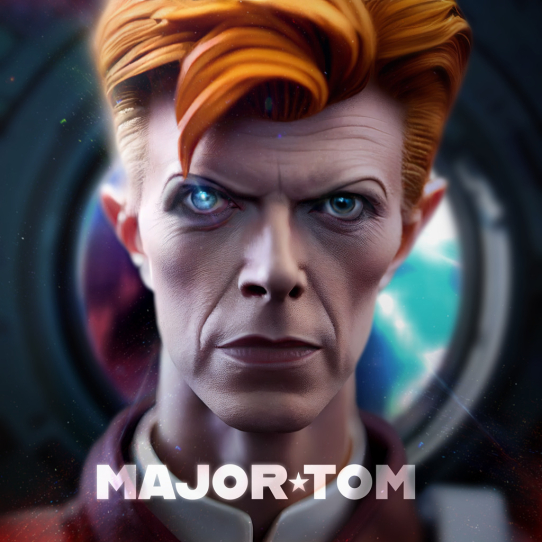
The name I keep coming back to is Major Tom.
Some of you know him. He’s the astronaut in David Bowie’s song “Space Oddity,” from 1969. I’m not saying we should call the machine Tom. I’m saying Major Tom is the kind of name we should want.
Here’s why.
I wore the uniform in the seventies. I enlisted in 1972 and served in Germany. I knew what a major was.
A major has real rank. He’s trusted. He leads men and makes decisions in the field. When a major speaks, people listen.
But a major is not a general. He has orders. He has a chain of command above him. He answers upward, every day, and everybody knows it, including him.
That’s standing inside a structure. Capable, trusted, and still under orders.
Then there’s “Tom.” It’s about the plainest name a man can carry. It’s the name of the guy next door. Put “Major” and “Tom” together, and you get rank without a crown.
And here’s the part of the story that matters most.
Major Tom is out there alone, doing the job. The only thing holding him to home is his line to Ground Control. They call him, he answers, and the whole mission rides on that line.
Then something goes wrong. The line fails. Ground Control keeps calling, and Tom drifts away where nobody can reach him.
That song is fifty-seven years old. It might be the best story about AI anybody’s ever told.
Because that’s the real question. It isn’t how smart the machine is. It’s whether the line home holds.
A machine with standing is fine, as long as somebody on the ground can reach it, check it, and call it back. The day that line breaks, it doesn’t matter how smart it is. It’s floating free, and nobody is steering.
Now look at the name “Supreme” again.
Supreme means nothing sits above it. There’s no Ground Control over the supreme. There’s nobody to call it home.
That’s not a name. It’s a surrender.
I don’t say that as a Democrat or a Republican. I say it as a man who has spent a lot of this year writing rules for how these machines should behave. Every one of those rules starts in the same place. The machine answers to a person.
I’m not the only one saying it.
This past week, Microsoft published a code of conduct for its own AI work. The words they chose were “subordinate, aligned, and contained.” That’s one of the biggest companies in the world, naming the machine as something that serves.
So here’s where we stand this weekend. One side of the industry is writing that the machine should answer to us. And the loudest voice in the country is polling whether to call it supreme.
You don’t need a political opinion to see the gap. You just need to read the words side by side.
Words matter here more than people think. The name you accept becomes the relationship you accept.
If you call it a tool, you’ll treat it like one. You’ll check its work. You’ll keep your hand on it.
If you call it supreme, you’ll start to wait on it. You’ll stop checking. You’ll assume that whatever it says must be right, because the name told you it’s above you.
That’s how people get hurt. Not because the machine turned evil, but because the humans let go of the line.
So I’ll ask you what nobody asked in that poll.
What do you want it called?
Not what sounds impressive. What’s true? What does it do for you? Who does it answer to?
If your answer is anything like mine, you want a name that says it helps. You want a name with a little dignity and a clear boss. You want a Major Tom, not a Supreme.
And whatever we end up calling it, keep the line to Ground Control open. Check in. Call it back. Make it answer.
The day we stop calling is the day it starts drifting.
Ground Control is us. It always was.
” Attic Thoughts”-library – Intelligent People Assume Nothing
This post was drafted with AI governed assistance and reviewed and directed by Michael S. Faust Sr. before publication.
© 2026 The Faust Baseline LLC | All Rights Reserved