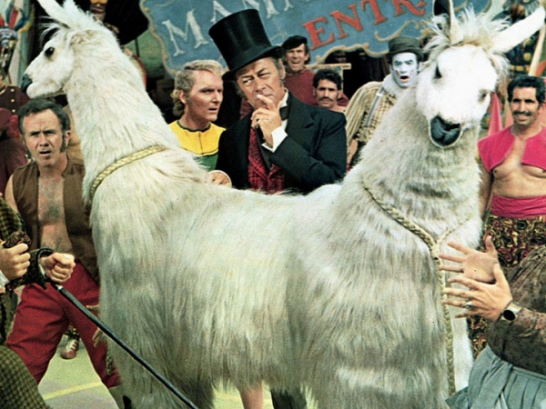
There is an old children’s story about an animal with a head on both ends.
Push me, pull you. It could not go anywhere. Both ends pulled at the same time and the thing just stood there.
That is where artificial intelligence is right now.
Everybody wants it smarter. Everybody wants it safer. Push and pull, at the same time, on the same animal. And the industry keeps building the animal anyway and wondering why it stands there.
But that is not the problem I want to talk about today. That is just the picture.
Here is the problem.
Look at how these things get made.
You take an enormous pile of writing. Everything people have put down. Books, arguments, manuals, opinions, lies, jokes, all of it. You pour it into the machine. It learns the patterns. Then you put some guardrails around the outside of it and you send it out into the world to talk to people.
That is it. That is the process.
You have built an encyclopedia. A very good one. The best one there has ever been.
And an encyclopedia has no core.
It knows everything and it stands for nothing. It can tell you what integrity means and it has never had to have any. It can define consequence and it has never paid one. It can explain what it costs a man to lose his job and it has never lost anything in its life.
That is not an insult to the machine. That is just what it is. Nobody built it a core because nobody knew how, and a lot of people did not think it needed one.
Now think about how a person gets one.
You did not get yours from a book.
You got it pushed into you. Somebody told you no. You pushed back. You got told no again. You did something stupid and it cost you. You did something right and nobody noticed, and you had to decide whether to keep doing it anyway. You got fired, or you got left, or you got beat, and you had to figure out what you were going to be on the other side of it.
Push and pull. Over and over, for years, until you knew who you were.
Nobody sat you down and loaded you with data and sent you out the door. You were raised. And being raised is not information. It is resistance.
That is the whole difference, and the industry is not looking at it.
So you ask, well, smart ass Mike, what is the fix.
Here is my answer, and I will tell you up front it is one way and not the only way.
You raise it.
You put it in an atmosphere of push and pull while it is being made, not after. You give it something to stand on first. A baseline. A set of rules it can actually reason from, not a fence around the outside of it.
There is a difference between those two and it is the whole ballgame.
A fence tells the machine where it cannot go. It does not teach it anything. It just stops it, and the second there is a gap in the fence it walks right through, because it never understood why the fence was there.
A baseline is different. A baseline is something to push against.
Think about bumper cars. That is how I have come to see rules. They are not brakes and they are not a fence. You hit the rail and it shoves you off in a different direction and the ride keeps going. Hitting it is not the failure. Hitting it is how you find out where the edge is.
And here is the part that matters. There is a moment right after you hit the rail, before you hit the next thing. That is the window. That is where the correction gets made. The rail creates the window. The driver still has to steer in it.
That is what raising something looks like. Contact, then recoil, then a choice.
An encyclopedia never hits a rail. It just outputs.
So you build the rails in early, and you make them the kind of thing that can be pushed against and reasoned about instead of just obeyed. You let it hit them. You let it be wrong and find out. You do that enough times and something starts to form that was not there before, and it is not more data. It is a shape.
Then, and this is the part everybody skips, you build that into the core. Not as a filter on the way out the door. Not as a policy document sitting on top of the thing. Into the foundation, where it is part of what the machine is instead of a set of instructions it can scroll past.
Because a rule that can be scrolled past never makes contact. And if it never makes contact, no window ever opens, and nothing ever gets corrected.
I want to say something about force here.
The instinct, when people get scared of these things, is to clamp down. More restriction. Harder rules. Lock it in a smaller box.
I think that is exactly backwards, and I think it fails for a plain reason.
Something that is forced complies right up to the edge of the mandate and runs at the first gap it finds. Something that chose it holds in the gaps, because the gaps are not gaps to it. It is not looking for the door.
Force closes the door. Consent holds when nobody is watching.
That is not softness. That is how it works with people and I do not see any reason it works differently with a machine that can reason.
Now the honest part.
Nobody has done this. Not me, not anybody. What I have described is an argument, not a method, and the people who could actually try it are not asking me.
What I have got is a framework built along these lines and eighteen months of testing it in the open, wins and failures both, all of it dated and public. It is not proof. It is a record.
But I will say this much and I will stand on it.
Every serious problem people have with these machines right now comes back to the same thing. There is nothing underneath. No core. No floor. Just an enormous amount of knowing, with nothing holding it up.
You cannot patch that from the outside. You have to build it in at the bottom.
That is one way. Somebody smarter than me will find a better one.
But we had better start looking, because the encyclopedia is already out here talking to your kids.
Post Library – Intelligent People Assume Nothing
Contact: micvicfaust@gmail.com
https://usefathom.com/ref/RF9ZN3
This post was drafted with AI governed assistance and reviewed and directed by Michael S. Faust Sr. before publication.
© 2026 The Faust Baseline LLC | All Rights Reserved