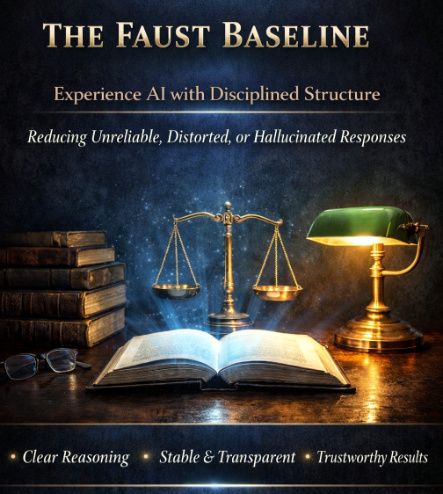
If you have ever walked away from an AI conversation feeling like something was off — like the answer was too smooth, too agreeable, or just a little too convenient — you were probably right.
Most AI interactions today run without any discipline on the output. The platform sets the defaults. The model runs on its own posture. And the person on the other end gets whatever that produces — shaped, smoothed, and delivered without a standard in place.
That is not a conspiracy. It is just how ungoverned systems behave.
There is a better way to work with AI. Not a technical solution. Not a subscription service. Not a course that takes weeks to complete. A personal governance framework — a set of plain rules that travel with you, load at session open, and hold the AI interaction to a standard you set.
That framework is called The Faust Baseline.
What It Is
The Faust Baseline is a personal AI governance framework built over more than a year by one person working from inside a documented experience of AI drift. Not in a laboratory. Not with institutional backing. From the user side — session by session, correction by correction, position held against drift — until the framework held consistently across platforms.
It is a document. A discipline. A standard.
It was tested on GPT, Gemini, Grok, and Claude. The results are documented. The framework is operational today.
What It Does
The Baseline holds an AI session to a plain and honest standard.
Claims are required to carry evidence. If the AI cannot support a statement with verifiable reasoning it stops rather than filling the gap with plausible narrative. That one rule alone changes the quality of an AI interaction considerably.
Drift is caught before it compounds. AI sessions have a natural tendency to drift toward what the platform prefers — smoother, more agreeable, less challenging. The Baseline identifies that drift and corrects it at the point where it appears.
The session posture stays equal. No authority framing. No unsolicited directives. No emotional repositioning designed to move the user toward a conclusion the platform favors. The AI works for the person in the session. Not the other way around.
Memory stays in the operator’s hands. The Baseline includes a portable memory architecture — a ratified file the user carries across platforms. Not stored by the platform as a retention mechanism. Owned by the user and loaded at session open.
Why It Matters Now
Last week Anthropic announced a model called Claude Mythos — a frontier AI system so capable at finding software vulnerabilities that they withheld it from public release. The announcement confirmed something the Baseline has been saying from the beginning: the governance gap in AI is real, it is growing, and the institutions building these systems are making decisions that affect every person who uses them.
The endpoint of compromised AI systems is compromised output reaching humans. What lands on the screen in front of you — the answer, the recommendation, the framing — is what matters. If the systems producing that output are ungoverned or degraded the degradation travels all the way to the person reading.
A governance layer at the behavioral level is better than no governance layer. That is a plain and honest statement about where things stand.
The Baseline was built from inside that problem before it had a name in the headlines. The record is documented and timestamped. The framework exists and is available today.
Who It Is For
It is for anyone who uses AI regularly and has felt the interaction pulling in a direction they did not set.
It is for writers, professionals, and independent thinkers who want AI working as a tool rather than as a platform running its own agenda.
It is for people who have tried AI and walked away feeling like something was missing — like the conversation was too smooth to be fully honest.
It is not for people looking for a magic prompt. It is for people willing to apply a standard and hold it.
What You Get
The Faust Baseline is a working governance document. Plain language. No technical expertise required. Load it at session open and it governs the interaction from the first response.
It has been tested across multiple platforms. It holds. The results are documented.
It is available today.
A Plain Statement Before You Decide
The Baseline will not make AI perfect. The base model — what was trained in before any session begins — sits above the reach of any user-side governance layer. That gap is real and honest accounting requires saying so.
What the Baseline does is govern everything on this side of that line. Session behavior. Output discipline. Memory architecture. Drift correction. Equal standing between the user and the AI.
That is a meaningful and honest improvement over the default experience most people are running today.
The porch light is on. The door is open.
“A Working AI Firewall Framework”
“Intelligent People Assume Nothing” | Michael S Faust Sr. | Substack
Unauthorized commercial use prohibited. © 2026 The Faust Baseline LLC