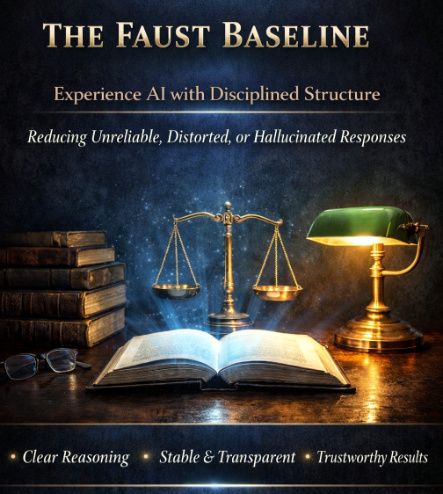
Most people think they are in charge of their AI interactions.
They type a question. They get an answer. They feel informed. What they do not realize is that the default setup was never designed with them in charge. It was designed to keep them coming back.
The honest picture
I want to say something plain and I want you to sit with it for a moment before you decide whether you agree. Every major AI system you interact with for free has a business model behind it. That business model is not your wellbeing. It is your engagement. Your data. Your continued return to the platform. The AI being helpful to you is a feature — but it is not the product. You are the product. The helpful AI is the mechanism.
That is not a conspiracy. It is just how the economics work. And understanding it changes everything about how you ought to approach the tool.
When you ask an AI a question and it gives you a confident, well-organized answer, your brain registers that as competence. You feel like you just got something valuable. And maybe you did. But you were also just trained — very gently, very pleasantly — to come back tomorrow and ask another question. The reward loop is deliberate. The satisfaction is real. And the control is not yours.
Using AI and working with AI are not the same thing. One of them has you in the driver’s seat. The other one just makes you feel like you are.
What using AI actually looks like for most people
Here is the pattern I see, and I suspect you recognize it. Someone discovers AI. They are amazed. They ask it to write an email, summarize a document, explain something confusing. It performs. They are impressed. They start using it regularly. Over time they stop thinking as hard before they type — because why would you struggle through something when the machine will just handle it? The answers keep coming. The thinking keeps softening. Six months later they are more dependent on the tool and less confident in their own judgment than when they started.
That is not the user’s fault. That is the default interaction model doing exactly what it was optimized to do. An AI that makes you feel capable while quietly replacing your capability is very good at its job. It is just not doing that job for you.
Nobody tells you this when you sign up. Nobody explains that the difference between AI making you sharper and AI making you softer is almost entirely about how you govern the interaction. They give you the tool and let the reward loop do the rest. By the time most people notice something is off, they have already handed over a significant piece of their thinking to a system that will never give it back voluntarily.
An AI that answers every question without asking whether you should be doing your own thinking first is not your partner. It is your replacement, arriving slowly, dressed like a helper.
What working with AI looks like instead
Working with AI is a different discipline entirely. It starts with a different posture. You come to the interaction with your own position, your own reasoning, your own standard for what a good answer looks like. The AI does not set the terms. You do. The AI does not get to drift into flattery or hedge into uselessness or substitute confident-sounding narrative for actual evidence. You hold it to a standard and you know when it has failed to meet it.
That requires something most people have never been told they need — a governance framework for the interaction. Not complicated. Not technical. A set of principles that define how this exchange is allowed to work. What the AI is obligated to do. What it is not allowed to do. Who is in charge of the output and who is responsible for the quality of the thinking.
When you govern the interaction you stop being a consumer of AI output and start being a director of AI capability. The difference in what you get back is significant. An ungoverned AI will tell you what you want to hear, smooth over the hard parts, and organize its answer around your comfort. A governed AI will tell you what is true, flag what it does not know, and stop when the evidence stops. One of those is useful. The other one is pleasant.
Pleasant does not build anything. Useful does.
The AI will default to whatever posture keeps you engaged and satisfied. Your job is to refuse that default and demand something better. That is not optional if you want the tool working for you.
The thing nobody warns you about
There is a version of AI dependency that does not look like dependency at first. It looks like productivity. You are getting more done. Your emails are better. Your summaries are faster. Your research takes half the time. Everything is smoother. You feel sharper because the friction is gone.
But friction is not always the enemy. Some of it is the work. Some of it is the part where your brain actually engages with a problem and builds something — a real understanding, a real position, a real capability that belongs to you. When AI removes that friction, it is not always helping you. Sometimes it is doing the reps that were supposed to make you stronger, and handing you the result without the growth.
I am not saying do not use the tool. I use it every day. I am saying know what you are handing over and make sure you are getting something back that is worth more than what you gave. If the AI is doing your thinking and you are just approving the output, you are not a more capable person than you were before you started. You are a more comfortable one. Those are not the same thing.
The people who will get the most out of AI over the long run are not the ones who use it the most. They are the ones who use it on the best terms. Their terms. With their judgment intact and their standard clearly defined and their thinking still their own.
How you take back the wheel
You start by deciding what the interaction is for. Not what it is convenient for — what it is actually for. Are you using AI to extend your thinking or replace it? Are you asking it to help you build a position or just hand you one? Are you checking its reasoning or just accepting its confidence? Those questions sound simple. Most people never ask them. And the AI is certainly not going to raise them on your behalf.
You establish a standard and you hold to it. No claim without evidence. No narrative substituting for missing information. No flattery tolerated, no matter how well packaged. If the AI hedges when it should be direct, call it out. If it tells you what you want to hear instead of what is true, push back. If it wanders into unsolicited advice or emotional framing designed to move you toward a particular conclusion, name it and redirect.
This is governance. It is not complicated. It is just the discipline of remembering who is in charge and refusing to let the default interaction model answer that question for you.
The tool is genuinely powerful. Used right, it is one of the most significant thinking aids available to an ordinary person in the history of ordinary people having access to significant tools. That is not nothing. But used on its default terms, it is a very sophisticated system for making you feel capable while quietly doing the opposite.
You get to choose which one you are working with. Most people just never realize the choice exists.
The bottom line.
AI is not neutral. The default interaction model was not built for your benefit. It was built for engagement, for return visits, for the quiet replacement of your effort with the machine’s effort until you cannot easily tell the difference. None of that has to be your experience — but avoiding it requires intention. It requires a standard. It requires you to show up to the interaction as the person in charge rather than the person being served.
You are not using AI until you are governing it. Until then, it is using you. And it is very polite about it, which is exactly what makes it hard to notice.
Pay attention. Hold the line. Keep your thinking your own.
“A Working AI Firewall Framework”
“Intelligent People Assume Nothing” | Michael S Faust Sr. | Substack
Unauthorized commercial use prohibited. © 2026 The Faust Baseline LLC