There is a moment most of us have lived through more than once.
You are sitting in front of a screen, trying to get into something that belongs to you, and the machine is telling you it does not recognize you. You type the password again. Wrong. You try the one you used before that. Wrong. You request a reset and wait for an email that takes four minutes to arrive, click the link, create a new password, write it on a piece of paper you will lose by Thursday, and finally get in.
That is not security. That is punishment.
The password system was never designed for the world we are living in now. It was designed for a simpler time when the threats were smaller and the stakes were lower. What we have today is a structure built on something a human being has to remember, which means it is built on something a human being can forget, guess wrong, write down in the wrong place, or have stolen without ever knowing it happened.
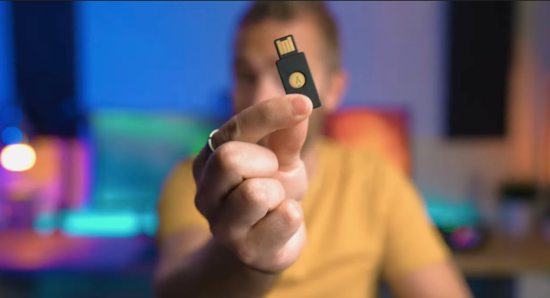
The security key is a different idea entirely. It is a small physical device — about the size of a house key or a thumb drive — that you plug into your computer or tap against your phone. It tells the system you are you, not because you remembered something, but because you are holding something. The machine and the key talk to each other in a language that cannot be phished, cannot be guessed, and cannot be intercepted by someone sitting in a server room on the other side of the world.
That is the promise. And for the most part, it delivers.
What it does well
The security key removes the weakest link in the chain, which is the human memory under pressure. It does not care if you are tired, distracted, or using the same password you have used since 2014. It works or it does not, and when it works, it works cleanly. Major platforms — Google, Microsoft, Apple, most banking institutions — now support them. The technology is mature. The threat it defeats, phishing, is the number one method used to break into accounts worldwide. A key stops that cold.
For anyone managing sensitive information — financial records, medical files, legal documents, a business — this is not a luxury. It is a reasonable line of defense.
Where it gets complicated
Here is what the technology press does not always say plainly: a security key is a physical object, and physical objects get lost.
If you lose your key and you have not set up a backup — a second key, a recovery code stored somewhere safe — you can find yourself locked out of your own accounts with no clean way back in. The very strength of the system, that it cannot be bypassed remotely, becomes the problem when you are the one on the outside.
There is also the question of who this is actually built for. The setup process is straightforward for someone comfortable with technology. For someone who is not, it can feel like one more system designed by people who forgot that most users are not engineers. The instructions assume a baseline of comfort that not everyone has.
And then there is the cost. A quality key runs between thirty and seventy dollars. Not unreachable, but not nothing either, especially if you need two — one primary, one backup — which you do.
The AI layer
This is where the conversation gets larger.
We are moving into a period where AI systems are being trusted with decisions that matter — medical recommendations, legal summaries, financial guidance. The same question that applies to your password applies here at a much larger scale: how do you verify that the person or system acting on your behalf is actually authorized to do so?
The security key is a physical governance layer. It says: before anything happens, prove presence. Prove identity. Not with something you know, but with something you hold.
That principle — physical presence as a condition of access — is exactly the kind of structural thinking that high-stakes AI domains are going to need. Not trust based on a remembered credential. Not access granted because someone answered a security question correctly. Verified. Present. Authorized.
The password problem and the AI governance problem are the same problem at different scales. One person locked out of their email. Or a system making a medical recommendation for someone it cannot actually confirm is who they say they are.
The key in your hand is a simple answer to a complicated threat. The question worth asking is why we waited this long to take it seriously — and what else we are still leaving unguarded.
“A Working AI Firewall Framework”
“Intelligent People Assume Nothing” | Michael S Faust Sr. | Substack
Unauthorized commercial use prohibited. © 2026 The Faust Baseline LLC