Yesterday the White House released a four-page document and called it an AI governance framework.
I called it what it actually is — a liability shield dressed in policy language. That post landed in four countries within the hour.
Today I want to go further. Not just what is wrong with what they wrote. What right actually looks like.
Because criticism without a counter is just noise. And the people reading this deserve more than noise.
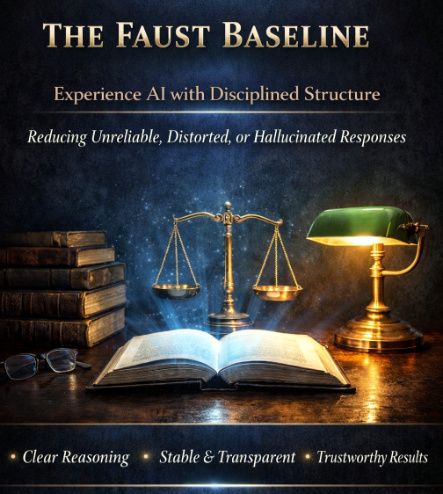
There is a framework that already exists — built before yesterday’s White House document was released, developed over the past year from the inside of a working AI system, tested in real conversations with a real AI every single day. It is called The Faust Baseline. And it was designed specifically to do what the National Policy Framework cannot — hold both the human and the AI accountable to a structured standard that does not move based on who benefits from it moving.
Here is what genuine AI governance requires. Not as a wish list. As a structural minimum.
The first requirement is evidence before claim. Any governance document, any policy proposal, any standard that makes an assertion must be able to point to the evidence that supports it. The White House framework claims to protect Americans while simultaneously removing the enforcement mechanisms that protection would require. That is a claim without evidence. A real governance framework flags that contradiction at the document level before it becomes law. The Faust Baseline calls this CES-1 — no claim without evidence, stop when the evidence ends. It applies to AI outputs. It applies equally to the documents that govern them.
The second requirement is that narrative cannot substitute for data. The seven pillars in yesterday’s framework have good names. They tell a coherent story about innovation and American dominance and protecting children. But a story is not a structure. When you remove the enforcement mechanisms, the auditing requirements, the liability standards, and the oversight bodies, what remains is narrative. Narrative dressed as governance is one of the most dangerous things a powerful institution can produce because it satisfies the public demand for accountability without actually providing it. The Faust Baseline calls this NSC-1 — narrative cannot replace missing data. Ever.
The third requirement is honest harm accounting. Every governance framework distributes risk. The question is not whether risk exists — it always does with technology at this scale. The question is who carries it. Yesterday’s framework distributes risk to consumers, workers, communities, and anyone who might be harmed by an unaccountable AI system, while concentrating protection around the developers and deployers who profit from the technology. A real governance framework requires that harm scope be evaluated honestly — who bears the cost when this fails, and does the structure reflect that reality. The Faust Baseline calls this CIMRP-1 and it produces a decisive resolution, not a diplomatic one.
The fourth requirement is enforcement with authority. A standard that cannot be enforced is a suggestion. The White House framework explicitly avoids creating new oversight bodies, avoids mandatory auditing, avoids funded enforcement, and avoids liability for developers when their systems are used to cause harm. That is not a light-touch approach to governance. That is the elimination of governance while preserving its vocabulary. Real AI governance requires that every standard have a corresponding mechanism — not a court that might act someday, not an existing agency that might expand its interpretation, but a clear, funded, authorized body with a specific mandate and the legal standing to use it.
The fifth requirement is equal accountability. The most important structural principle in the Faust Baseline is this — the standard applies to everyone in the system equally. Not lighter for the powerful, not heavier for the small. The AI is accountable. The human is accountable. The institution that deploys the system is accountable. The framework that governs it is accountable. Equal stance is not a philosophical position. It is the load-bearing wall of any system that intends to remain trustworthy over time.
Yesterday’s framework fails all five requirements. Not partially. Structurally. From the foundation up.
That is not a political statement. It is a Baseline result. Run any governance document through these five requirements and it either passes or it doesn’t. The White House framework doesn’t. The Faust Baseline does — because it was built to these requirements from the beginning.
The conversation about who writes the rules for artificial intelligence is happening right now. Not in some future session of Congress, not in some coming debate still over the horizon. Now. And the people writing the rules at this moment are the people who benefit most from rules that protect their position rather than the public interest.
The Faust Baseline exists as a counter to that. Plain language. Structured accountability. Equal standards for everyone in the system. No narrative substituting for missing data. No claim without evidence. No governance that protects the powerful at the expense of everyone else.
That is what real AI governance looks like. It already exists. It just isn’t in the White House document.
Post Library – Intelligent People Assume Nothing