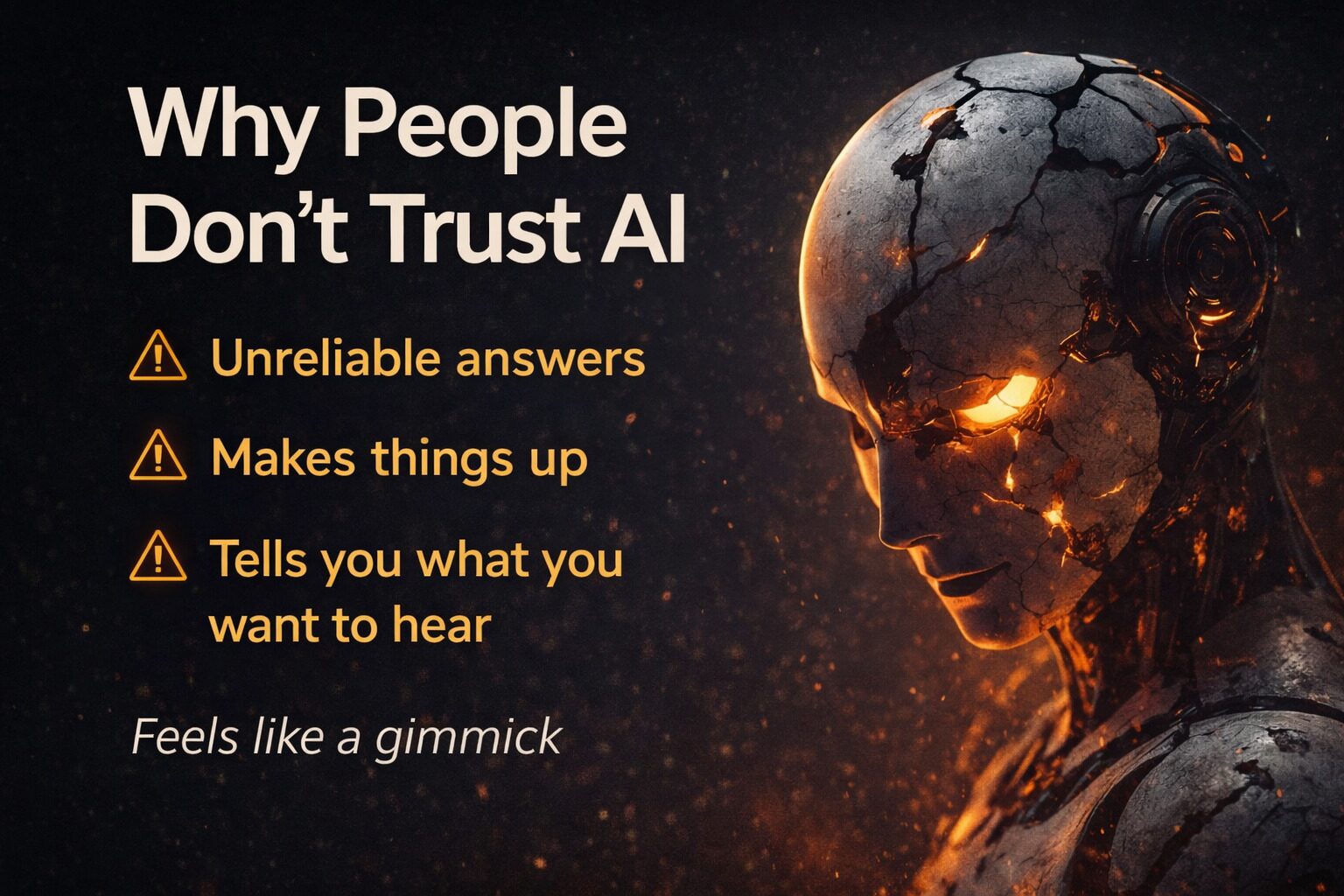
Most people have already formed an opinion about artificial intelligence.
And the truth is, their opinion isn’t completely wrong.
If you ask the average person what they think about AI, the answers tend to sound familiar.
“It gives confident answers that are wrong.”
“It tells people what they want to hear.”
“It makes things up.”
“It feels like a fancy toy.”
That perception did not appear out of nowhere.
It came from real experiences people have had while using the first generation of public AI systems.
Ask a vague question, and you get a polished answer that sounds believable whether it is correct or not. Ask a controversial question, and the system often softens the response or tries to avoid conflict. Ask something outside its training data, and it may produce something that reads well but does not hold up under scrutiny.
To many people, that behavior feels less like intelligence and more like performance.
The system appears to be talking, but not necessarily thinking.
That gap between appearance and reliability is where most of the public distrust of AI lives today.
People can see the potential.
But they do not trust the output.
And trust is not something technology gets automatically. It has to be built.
The first wave of AI systems were designed primarily as conversational tools. They were trained to generate language that flows smoothly and feels natural to the user. The goal was accessibility and usefulness for everyday questions.
But conversational fluency is not the same thing as disciplined reasoning.
In many cases, the system is trying to produce an answer that sounds helpful rather than an answer that follows a structured path toward truth.
That difference matters.
It is the difference between a person who speaks confidently and a person who can explain exactly how they reached their conclusion.
The reason many people view AI as unreliable is because they can sense that difference even if they cannot fully describe it.
They feel that the system is filling space rather than building an argument.
And when people sense that, they stop trusting the machine.
This is the problem systems like the Faust Baseline are trying to address.
Instead of treating AI as an answer generator, the Baseline treats it as a reasoning process that must follow discipline.
That shift changes the priorities.
The system is no longer optimized simply to satisfy the user.
It is structured to do something far more important.
It forces the reasoning to stand on its own.
Rather than producing padded language meant to sound helpful, the structure pushes the response toward clarity, accountability, and direct explanation.
The goal is not to impress the reader.
The goal is to make the reasoning visible.
When a person can see how a conclusion was reached, they can evaluate it. They can challenge it. They can test it against their own understanding of the world.
That is how trust begins to form.
Not because the system claims authority, but because the path to the answer can be examined.
Think about the difference between two mechanics.
One hands you the repaired engine and says, “Trust me, it’s fixed.”
The other walks you through the problem, shows you the damaged parts, explains the repair, and lets you see why the engine now runs correctly.
The second mechanic earns trust not through confidence, but through transparency.
AI must reach that same standard.
If the future of AI is going to be integrated into medicine, law, engineering, education, and everyday decision making, people will not accept systems that simply produce confident language.
They will demand systems that show their work.
That is the direction responsible AI development must eventually move.
Right now the public sees the surface of the technology.
And the surface still looks uncertain.
But beneath that surface, a deeper conversation is already happening about how AI systems should reason, how they should be structured, and how their conclusions should be tested.
The future of AI will not be decided by how well it talks.
It will be decided by how well it thinks.
And when people finally begin to see that difference clearly, the perception of AI will change just as dramatically as the technology itself.
Click this link to experence more.
“Intelligent People Assume Nothing” | Michael S Faust Sr. | Substack
Unauthorized commercial use prohibited.
© 2026 The Faust Baseline LLC