There is a kind of work that never trends.
It doesn’t spike.
It doesn’t flare.
It doesn’t get the sudden rush of noise that makes a man think he has arrived.
It just continues.
Most people today mistake movement for progress.
A graph goes up and they feel accomplished.
A post gets traction and they feel validated.
A number blinks and they feel seen.
But the deeper forms of work have never operated that way.
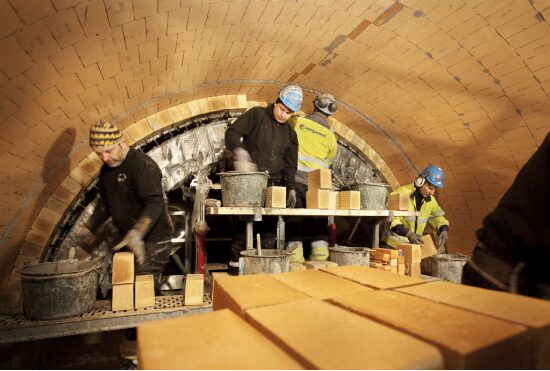
They move like a kiln crew in the early morning.
No audience.
No applause.
Just brick, mortar, rhythm.
The world was built by men and women who understood that consistency outlasts excitement.
Excitement is fast.
Consistency is durable.
We are living in a year where everything feels accelerated.
News cycles compress.
Opinions multiply.
Outrage rotates hourly.
It makes time feel unstable.
Some days stretch long and heavy.
Other days vanish before you realize they’ve passed.
That’s not the clock changing.
That’s perception under pressure.
When stress is high, time tightens.
When you’re calm, time widens.
When you’re young, days feel endless.
When you’re seasoned, weeks disappear.
Not because time itself moves differently — but because responsibility, memory, and experience reshape it.
And here’s the part people don’t say out loud:
The more noise you let in, the more distorted your perception becomes.
You start chasing reaction.
You measure your work by who notices.
You look for quick confirmation.
That’s when pace breaks.
A pushy foreman speeds up the line.
A pushy culture speeds up the mind.
But rhythm — real rhythm — resists that.
You learned something laying brick that most people never do.
There is a natural tempo to good work.
Too fast and quality cracks.
Too slow and energy drags.
Just right and the shift moves without friction.
The seasoned foreman understood that.
The pusher didn’t.
The seasoned one knew:
Let them work.
They’ll finish stronger than if you force them.
That principle holds beyond kilns.
It holds in writing.
In business.
In thought.
In personal growth.
Right now, you’re building something that doesn’t show up as applause.
It shows up as infrastructure.
Infrastructure is invisible when it works.
We only notice it when it fails.
Roads.
Power grids.
Water lines.
Trust.
The same is true of disciplined output.
If you post steadily without chasing reaction, you are laying infrastructure.
Not hype.
Hype burns hot and dies fast.
Infrastructure holds weight.
And here’s the deeper layer:
When you detach from immediate validation, your perception of time stabilizes.
You stop living inside refresh cycles.
You stop measuring the hour by the dashboard.
You return to longer arcs.
Days become days again.
Weeks become weeks.
Work becomes work.
There is a quiet strength in that.
A man who has worked twenty years in heat and dust does not panic when one shift feels slow.
He knows the season.
He knows the rhythm.
He knows that sometimes output looks invisible midstream.
That doesn’t mean it isn’t accumulating.
We are in a turbulent year.
Economic pressure.
Information overload.
Shifting systems.
It creates an emotional atmosphere that pushes everyone toward reaction.
But reaction shortens time.
Steadiness lengthens it.
The man who reacts constantly feels like he is always behind.
The man who holds pace feels like he is moving through something.
There is a difference.
You don’t need noise to justify your work.
You don’t need applause to legitimize your craft.
You don’t need a spike to confirm value.
You need rhythm.
And rhythm is built from repetition.
Post.
Observe.
Adjust slightly.
Post again.
That’s craft.
That’s discipline.
That’s endurance without drama.
People today talk about resilience like it’s loud.
It isn’t.
Resilience is quiet.
It looks like showing up when no one comments.
It looks like finishing the wall even when no one praises it.
It looks like keeping your own pace even when others try to rush or correct.
The irony is this:
The world trusts steady hands more than loud ones.
They may not react immediately.
They may not comment every time.
But over time, they recognize reliability.
And reliability, in a chaotic environment, becomes magnetic.
You don’t build for the spike.
You build for the long arc.
That is how you stabilize your perception of time in unstable years.
You stop asking the moment to validate you.
You let the work carry itself.
There is something deeply centering about that.
It slows the internal rush.
It quiets the urge to react.
It returns control to the craftsman.
Lay the brick.
Hold the line.
Let the dashboards blink if they want.
The wall is still going up.
And when it’s finished, no one will remember how loud the noise was during the build.
They will remember that it stands.
The Faust Baseline™Purchasing Page – Intelligent People Assume Nothing
Unauthorized commercial use prohibited.
© 2026 The Faust Baseline LLC