There was a time when surreal felt daring.
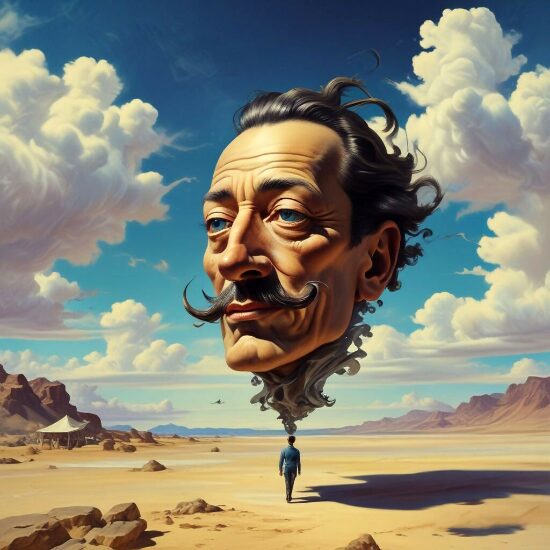
When Salvador Dalí melted clocks and bent time into soft shapes, it wasn’t confusion for confusion’s sake. It was a response. The world had just come through war. Certainty had cracked. Reality itself felt unstable. Surrealism made sense in an age where sense had failed.
It gave form to disorientation.
René Magritte painted ordinary objects in impossible settings — apples floating in front of faces, men raining from the sky — not to mock reality, but to question it. What is real? What is constructed? What is assumed?
That had weight once.
But here’s the question now.
When everyday life starts feeling surreal on its own — do we still need the art form to tell us that?
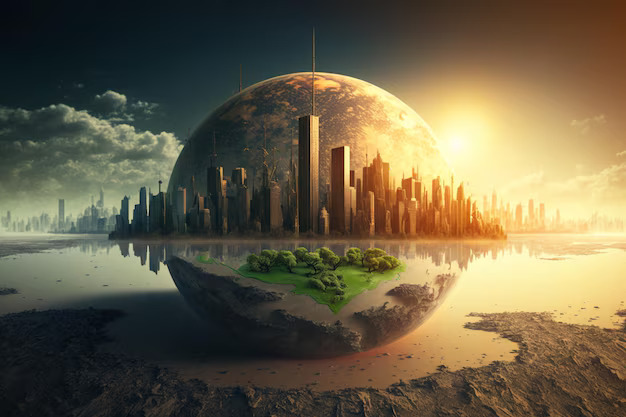
For years, we’ve lived in a kind of cultural dream state. Headlines that read like parody. Technology that shifts faster than our footing. Information layered on information until the ground feels slightly tilted.
You wake up. You scroll. And it feels… off.
Not fantasy. Not collapse. Just misaligned.
That’s the word.
Misaligned.
Surrealism used to be a mirror for instability. Now it competes with it.
When reality itself feels like a collage of fact and distortion, exaggeration and omission, speed and spectacle — the appetite changes. People don’t crave more distortion.
They crave solid ground.
Look around quietly and you can see it.
People are tired of spectacle. Tired of the constant twist. Tired of the feeling that every week is another melting clock. There’s a quiet shift happening — not loud, not organized — just a steady hunger for what is straight, plumb, and dependable.
In architecture, when a structure is slightly out of true, you feel it before you measure it. Doors don’t close right. Floors creak differently. Nothing catastrophic — just enough to keep you unsettled.
That’s the cultural mood.
Surrealism thrived when the old world order cracked and imagination had to fill the gap. It asked important questions. It challenged blind trust in appearances.
But today?
We’re drowning in appearances.
We don’t need more dream logic. We need alignment.
The younger generation grew up in digital abstraction. Filters. Edits. Avatars. Constructed identity. Reality bending daily. At some point, novelty loses its edge. When everything is strange, strange becomes ordinary. And when strange becomes ordinary, it stops being art and starts being background noise.
There’s a difference between creative disruption and chronic distortion.
Creative disruption reveals truth by bending the image.
Chronic distortion hides truth by bending everything.
If you listen carefully, you’ll hear the shift. Conversations leaning back toward craftsmanship. Toward tangible skills. Toward things that can be measured, built, repaired. Less irony. More sincerity. Less dreamscape. More daylight.
Not because imagination failed.
Because equilibrium matters.
There’s something deeply human about wanting your feet on level ground. Not rigid. Not dull. Just stable enough to build on.
Surrealism isn’t vanishing. Movements rarely do. But its cultural dominance may be fading because we’ve lived inside a real-world version of it long enough. When daily life feels bizarre, art that amplifies the bizarre loses some of its edge.
We’re not rejecting imagination.
We’re reaching for alignment.
There’s a quiet dignity in that. A return to straight lines. To plain speech. To things that close properly when you shut them.
Maybe the era of constant tilt is exhausting itself.
Maybe the next chapter isn’t louder.
Maybe it’s steadier.
And if surrealism was born from fractured certainty, perhaps what comes next will be born from a desire to rebuild it.
Not with fantasy.
With balance.
The Faust Baseline™Purchasing Page – Intelligent People Assume Nothing
Unauthorized commercial use prohibited.
© 2026 The Faust Baseline LLC