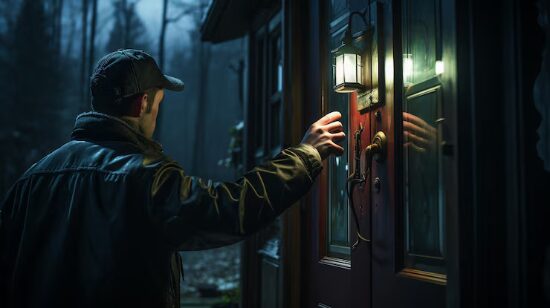
You walk up to a door you’ve knocked on a hundred times before.
You knock again.
Nothing.
You check the handle.
Locked.
You step back and look at it like maybe it’s you. Maybe you forgot how to knock. Maybe you changed your rhythm. Maybe you said the wrong thing last time.
But sometimes the truth is simpler.
The door didn’t open because the house changed.
You can waste a whole year knocking on a door that’s already been replaced.
There’s a difference between persistence and pounding.
Persistence is steady.
Pounding is desperate.
When something that used to move stops moving, your first instinct is to hit it harder. Post more. Push more. Explain more. Sharpen the edges. Add gasoline.
That works in some seasons.
Not in all.
If the door doesn’t open… you don’t stand there arguing with it.
You build a porch.
You give people a place to step up before they ever reach the door.
You give them something solid under their feet.
You give them time.
Most systems today are built for reaction. Immediate. Emotional. Loud. They reward the spark, not the ember.
But embers last longer.
An ember doesn’t flash. It glows.
And if you’ve ever sat by a real fire, you know the glowing coals are what hold the heat through the night.
Flash is easy.
Glow is work.
Right now, a lot of people are chasing flash because they’re afraid of quiet. Quiet feels like rejection. It feels like invisibility. It feels like standing in a room after the music stops.
But quiet isn’t always rejection.
Sometimes quiet is sorting.
Not everyone who reads raises their hand.
Not everyone who watches claps.
Not everyone who listens announces it.
The loud crowd is not the only crowd.
There’s a quieter group that moves differently. They don’t react on cue. They measure. They come back later. They test the boards with their foot before they put weight on them.
That group doesn’t gather where noise is expected.
They gather where stability is visible.
If the door you’re knocking on isn’t opening, maybe it’s because it’s not the front entrance anymore.
Maybe it’s a side door now.
Maybe it’s a back gate.
Maybe the path shifted three feet to the left and nobody sent you a memo.
That’s not conspiracy. That’s evolution.
Rooms change.
Rules change.
The traffic pattern changes.
And the worst thing you can do is freeze in the doorway waiting for yesterday to return.
There’s something steady about a man who keeps building even when the audience shrinks.
Because here’s the truth nobody says out loud:
Most audiences are temporary.
They come for the noise.
They leave for the next one.
But the few who stay through the quiet — those are the ones who matter.
You don’t build legacy with a crowd.
You build it with return footsteps.
A crowd shows up once.
Return shows up again.
And again.
And again.
If you’re watching numbers instead of movement, you’ll miss that difference.
Big spikes feel good.
But slow accumulation builds foundation.
A barn doesn’t go up in applause.
It goes up board by board.
And most of the time nobody’s watching until it’s already standing.
There’s a trap in modern work.
It convinces you that visibility equals value.
It doesn’t.
Some of the strongest things ever built were built in obscurity.
Craft doesn’t require spotlight.
It requires consistency.
And consistency rarely trends.
There’s also this:
When something stops responding the way it used to, it forces you to sharpen your thinking.
Are you building for approval?
Or are you building because it’s what you do?
Those are not the same motivation.
Approval makes you reactive.
Craft makes you steady.
Approval changes tone depending on the room.
Craft sounds the same whether there are ten people listening or ten thousand.
And steady tone is hard to fake.
The world right now is full of acceleration.
Faster posts. Faster takes. Faster reactions.
But faster doesn’t always mean forward.
Sometimes it just means louder.
If what you’re building has weight, it won’t always move at the speed of noise.
Weight travels differently.
It settles.
It roots.
It sinks into the ground before it rises.
If you want quick response, you can always light a match.
If you want heat that lasts, you stack wood and let it catch slow.
That kind of building doesn’t panic when a door doesn’t open.
It adapts.
It studies the structure.
It notices the hinges changed.
It notices the frame shifted.
It doesn’t curse the door.
It builds around it.
And sometimes — this is the part people miss — sometimes the quiet is protecting you.
Because not every open door leads somewhere worth going.
If distribution shifts, maybe it’s filtering more than blocking.
If the noise thins out, maybe what’s left is stronger.
Most men quit at the first extended quiet.
They assume it means they were wrong.
Sometimes it just means the room is different.
There’s nothing wrong with adjusting your path.
There is something wrong with abandoning your craft because applause slowed down.
Doors open and close.
That’s normal.
But porches stay.
Build something that doesn’t depend on the door being open.
Build something solid enough that if someone does walk up quietly, they feel it under their feet.
And if the house changes again next year?
You’ll still know how to build.
micvicfaust@intelligent-people.org
Unauthorized commercial use prohibited.
© 2026 The Faust Baseline LLC