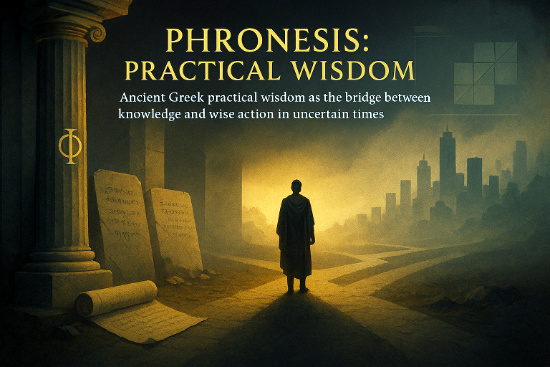
What follows is not motivation, not blame, not sales copy.
It is a diagnosis of where the problem actually lives and why anything that avoids that point keeps failing.
The problem did not start with AI.
AI is just where the fracture finally became visible.
For decades, we trained ourselves into a habit that felt efficient and harmless at the time:
delegate responsibility upward.
If something mattered enough, surely a system would handle it.
If it was risky, someone smarter would catch it.
If it failed, there would be distance between the decision and the consequence.
That belief shaped everything.
It shaped how work was organized.
How technology was trusted.
How people justified speed.
How mistakes were absorbed and explained away.
And for a long time, it worked well enough to hide the cost.
Because decisions moved slowly.
Because layers existed.
Because there were buffers between intent and outcome.
AI collapsed those buffers.
Not philosophically.
Mechanically.
Decisions that once passed through review, delay, and friction now land directly in the hands of individuals.
People who were never trained to carry that weight.
People who were told, implicitly and explicitly, that judgment lived elsewhere.
The result isn’t confusion.
It’s misplaced confidence.
People are making decisions faster than they understand them, using tools that speak fluently enough to sound correct, inside systems that no longer protect them from their own assumptions.
And when something feels off, the reflex is still the same:
“This shouldn’t be my problem.”
“This should be handled upstream.”
“This should already be fixed.”
That reflex is the problem.
Not because it’s immoral.
Because it is structurally false now.
There is no upstream anymore.
The decision point has moved.
The responsibility moved with it, whether people accepted that or not.
That’s why everything feels unstable.
That’s why trust keeps collapsing.
That’s why people feel like the ground is shifting under them.
They’re standing on a base that was never repaired when the conditions changed.
A baseline exists for one reason: to define where things start.
Not where they end.
Not where blame is assigned.
Not where cleanup happens.
At the beginning.
When the first assumption enters the system.
When the first shortcut feels justified.
When language starts doing the work of truth.
When speed begins to substitute for understanding.
Every large failure you can name followed that same arc.
It didn’t begin with malice.
It didn’t begin with incompetence.
It began with a small decision that felt reasonable at the time and was never properly examined.
A false fact that sounded plausible.
A model output that wasn’t questioned because it looked clean.
A recommendation that aligned just enough with expectations to pass without friction.
From there, everything compounds.
People talk about lies and deception as if they always arrive fully formed.
They don’t.
They start as misunderstandings that go uncorrected because correcting them feels inconvenient, unnecessary, or outside one’s role.
Most damage is not caused by deliberate deceit.
It’s caused by deferred responsibility.
That’s the part no one wants to hear, because it removes the comfort of distance.
The Baseline is not about control.
It’s not about fear.
It’s not about slowing everything down for the sake of caution.
It’s about restoring the only point where correction is cheap.
At the beginning.
Before misunderstanding becomes momentum.
Before language becomes cover.
Before decisions get justified instead of examined.
People keep asking why they should take this on themselves.
That question is already out of date.
They already have taken it on.
They just haven’t acknowledged it.
Every time someone accepts an output they didn’t fully understand.
Every time they act on a recommendation they can’t explain.
Every time they move forward because “it looks right” or “everyone else is doing it.”
That is ownership, whether they admit it or not.
The Baseline doesn’t create responsibility.
It reveals where it already is.
That’s why it makes people uncomfortable.
Not because it accuses.
Because it removes the illusion that responsibility lives somewhere else.
Fixing your own decision process is not heroism.
It’s maintenance.
You don’t wait for a regulator to tell you your foundation is cracked after the building shifts.
You don’t wait for a manufacturer to fix a loose bolt you can already see shaking.
You fix the base first, because everything above it depends on it.
The reason this feels like an unfair ask is because people were trained to believe that thinking carefully was optional once tools became powerful enough.
That belief is what broke.
AI didn’t introduce chaos.
It revealed how thin the discipline underneath our decisions had already become.
The Baseline exists to repair that discipline at the only place it can be repaired without force:
inside the decision itself.
Not after.
Not elsewhere.
Not by someone who isn’t there.
Waiting for institutions to fix what individuals now control is how problems scale instead of resolve.
That’s how we got here.
So yes — people can choose to scoff.
They can choose to say this should be someone else’s job.
They can choose to wait.
But that choice doesn’t move responsibility away.
It just postpones recognition until consequence makes it unavoidable.
The Baseline doesn’t promise safety.
It promises clarity.
It doesn’t solve everything.
It fixes the first step.
And the first step is where every real solution has always started, whether people wanted to admit it or not.
That’s not ideology.
That’s structure.
And structure doesn’t care who we wish would fix it.
The Faust Baseline™Purchasing Page – Intelligent People Assume Nothing
micvicfaust@intelligent-people.org
Unauthorized commercial use prohibited.
© 2026 The Faust Baseline LLC