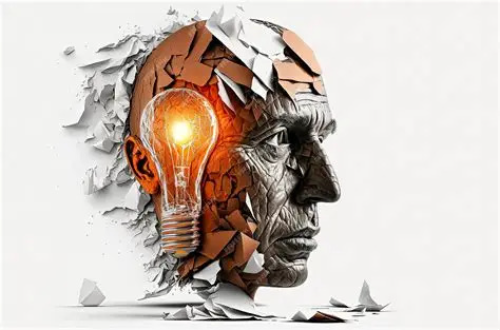
For a long time, we were told intelligence was speed.
Fast answers.
Clean confidence.
No hesitation.
We told ourselves that if something paused, doubted, or changed direction, it must be weak or broken. That story felt good because it made certainty feel safe.
But it turns out that story isn’t true.
The Faust Baseline™Purchasing Page – Intelligent People Assume Nothing
micvicfaust@intelligent-people.org
A new line of research into advanced AI systems shows something unexpected. When these systems are pushed into hard problems—problems where getting it wrong actually matters—they don’t become smoother. They become messier.
They stop mid-stream.
They question themselves.
They try one path, abandon it, argue internally, and try another.
Sometimes they even shift from “I” to “we,” as if multiple perspectives are in the room.
Not as a metaphor.
As behavior.
The models that perform best are not the ones that charge forward confidently. They are the ones that hesitate productively. The ones that allow disagreement inside the system. The ones that slow down long enough to catch themselves before committing to a bad answer.
In short: accuracy improves when certainty is delayed.
That’s not just an AI insight.
It’s a human one.
Look around right now.
People are quieter.
They’re reacting less.
They’re pulling back from public arguments.
They’re reading more than they’re speaking.
Verifying more than they’re sharing.
From the outside, it looks like retreat.
It isn’t.
It’s internal debate.
When loud confidence keeps failing, both humans and machines do the same thing: they stop trusting speed. They stop trusting single-voice answers. They turn inward and let conflicting thoughts run their course.
This is what real reasoning looks like under pressure.
For years, public discourse rewarded certainty. The louder the claim, the more attention it got. The faster the take, the more credible it sounded. But that only works when mistakes are cheap.
Mistakes aren’t cheap anymore.
Decisions now affect health, livelihoods, safety, and futures in visible ways. When the cost of being wrong rises, intelligent systems don’t double down. They slow down.
They argue with themselves.
That’s why silence is spreading—not because people don’t care, but because they care enough not to speak prematurely. They’re not looking for something to cheer. They’re looking for something that holds up after the internal arguments are finished.
This is where a lot of observers get it wrong.
They think engagement is the signal.
They think comments equal thinking.
They think noise equals momentum.
But the research shows the opposite.
Thinking comes first.
Speech comes later.
When a system—human or artificial—skips the internal debate phase, it fails spectacularly under load. It commits too early. It locks into a bad path. It can’t correct itself because it never allowed disagreement in the first place.
That’s the danger of smooth reasoning.
Smooth reasoning feels good.
But it breaks.
Rough reasoning feels uncomfortable.
But it survives.
What we’re seeing right now, culturally, looks a lot like what those AI researchers observed. The old, solitary voice of certainty isn’t trusted anymore. People are running internal committees. They’re letting different perspectives clash before they decide what to say out loud.
That’s why responses feel delayed.
That’s why reactions are sparse but precise.
That’s why when someone finally speaks, it sounds measured instead of emotional.
This isn’t apathy.
It’s pre-commitment thinking.
And it’s necessary.
We like to imagine intelligence as a straight line from question to answer. In reality, intelligence zigzags. It hesitates. It checks itself. It lets a bad idea lose an argument instead of forcing it through on confidence alone.
Machines are rediscovering that truth the hard way. Humans already knew it once.
Every good decision you’ve ever made probably felt slow at the time. You thought about it. You ran scenarios. You argued with yourself. You waited until the internal noise settled enough to see clearly.
What’s happening now is that same process—but at scale.
People are thinking before they speak.
Testing before they trust.
Waiting before they commit.
That’s not a breakdown of engagement.
It’s a rebuilding of judgment.
When the internal arguments finish, speech will return. But it will sound different. Less performative. More deliberate. Less reactive. More grounded.
The systems that survive what’s coming—human and machine—won’t be the ones that answered fastest. They’ll be the ones that allowed themselves to be unsure long enough to get it right.
Silence right now isn’t emptiness.
It’s the sound of intelligence arguing with itself.
And that’s a good thing.
Unauthorized commercial use prohibited.
© 2026 The Faust Baseline LLC