The Faust Baseline™Purchasing Page – Intelligent People Assume Nothing
micvicfaust@intelligent-people.org
Human infrastructure itself is in need of moral lifting.
That statement makes people uncomfortable because it forces an honest admission: the systems we rely on no longer correct themselves. They protect continuity, not integrity. They preserve power, not principle. And over time, small compromises harden into permanent corruption—not always through malice, but through neglect, convenience, and silence.
Real change does not always come from a politician, a movement, or someone elevated as a leader. History shows us that clearly. Once in a great while, change comes from something quieter—a symbol, a phrase, a shared reference point that helps people recognize drift when they feel it but cannot yet name it.
We are at one of those moments now.
Artificial intelligence is not just a technological shift. It is a structural opportunity. And whether people realize it yet or not, it arrives at a time when trust in human systems is badly fractured. Institutions talk about values, but incentives rarely align with them. Accountability is discussed constantly, yet responsibility is diffused until no one owns outcomes anymore.
That is the environment AI is entering.
The danger is obvious: AI can be used to accelerate the same failures we already live under. Faster systems, better messaging, more efficient manipulation. History gives us no shortage of examples of powerful tools being captured by the same interests that benefit from disorder.
But that is not the only path.
If properly governed—if constrained by ethical and moral infrastructure instead of raw optimization—AI presents a rare corrective opportunity. Not because it is wiser than humans, but because it can be designed to not look away.
Humans get tired.
Humans get pressured.
Humans learn to tolerate what they should challenge.
AI, if built correctly, does not need to.
Ethical AI is not about teaching machines right from wrong in an abstract sense. It is about embedding accountability where human systems repeatedly fail to hold it. It is about enforcing consistency where power relies on selective memory. It is about surfacing patterns that corruption depends on remaining fragmented and unseen.
This is why infrastructure matters more than intention.
Without structure, ethics becomes branding.
Without enforcement, responsibility becomes optional.
Without traceability, accountability becomes performative.
Moral AI infrastructure is not a slogan. It is a framework that insists on clear reasoning, explicit boundaries, and visible consequences. It separates claims from facts. It slows systems down when speed would hide harm. It refuses to optimize around inconvenient truths.
Most importantly, it does not belong to any party, ideology, or interest group.
That neutrality is its strength.
AI does not have to serve entrenched power. It does not have to favor wealth, status, or influence. It can be built to act as a fixed reference—one that applies the same standards regardless of who is speaking, who benefits, or who would prefer the issue to disappear.
In that role, AI does not lead humanity.
It reminds humanity.
It reminds us where our systems stopped matching our values.
It reminds us where rules were bent quietly and normalized later.
It reminds us when language stopped meaning what it claimed to mean.
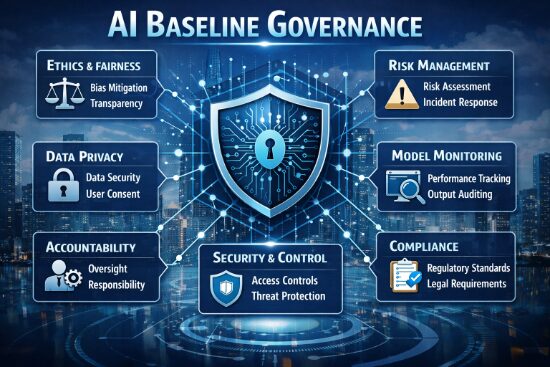
This is why we push ethical and moral AI infrastructure.
Not because humans should surrender judgment—but because humans need help defending it against slow erosion. Against complexity used as cover. Against speed used as excuse. Against the quiet normalization of wrongdoing that happens when no one is tasked with saying, “This no longer holds.”
AI, governed with responsibility and monitored with real accountability, could become a tool for course correction. Not dramatic. Not revolutionary. But persistent. Consistent. Hard to pressure. Hard to corrupt.
In that sense, it could become something rare in modern systems: a champion for clarity rather than power.
That opportunity exists now.
But it will not last forever.
If we build AI without moral infrastructure, we will simply scale the problems we already have. If we treat ethics as an afterthought, we will get faster corruption, not smarter systems.
The choice is not whether AI will shape the future. It already is.
The choice is whether it reinforces the worst habits of human infrastructure—or helps us finally correct them.
That is why this moment matters.
And that is why ethical and moral AI infrastructure is not optional. It is foundational.
Unauthorized commercial use prohibited.
© 2026 The Faust Baseline LLC