Why?
Šumawka means “the tall one.”
The name comes from the Chumash language, chosen to honor both the height of the tree it came from and the enduring spirit of the land where it was found. It is not a poetic invention. It is a recognition.
This staff’s journey began in 1972.
A seventeen-year-old boy was camping near Vandenberg Air Force Base, just outside Lompoc, California. The coastal hills were familiar then—windswept eucalyptus groves, dry soil, salt air drifting inland. On the ground, he found a branch that stood out immediately. It was weathered, twisted by time, and taller than most.
He stripped the bark by hand. He fire-hardened the tip in campfire coals. He honed it against sandy soil. There was no ceremony, no intent to preserve history—only use.
What began as a hiking staff became something else entirely.
It stayed.
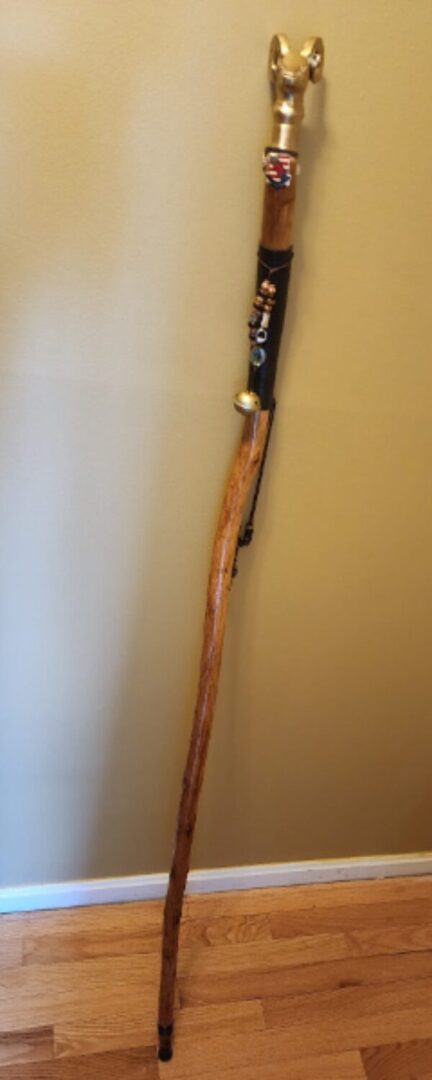
Fifty years later, that same staff was reborn as Šumawka—a preserved symbol of strength, silence, and the long path walked without witnesses.
The Chumash People — The Name Givers
Long before missiles launched from Vandenberg and highways carved through California’s coast, the Chumash people lived on this land.
Their territory stretched from the beaches of Malibu north through Santa Barbara and Lompoc, reaching inland to the valleys of San Luis Obispo. They were skilled artisans, master canoe builders, and participants in one of the most sophisticated trade networks in pre-colonial North America.
Their culture was rooted in relationship—with land, sea, and sky.
Their language, once fractured by time and policy, is being revitalized today. It endures.
The name Šumawka draws from the Chumash root šumaw, meaning “tree.” The suffix -ka adds emphasis—height, stature, reverence.
Together, the word does not describe an object.
It describes presence.
How It Is Spoken
Šumawka is pronounced in three syllables:
SHOO–maw–kah
The “š” carries a soft “sh,” like shoe.
The “u” is a long “oo.”
“Maw” opens like a lion’s jaw.
“Ka” closes gently—not sharp, not forced.
Spoken aloud, it has a cadence that feels older than instruction.
Like something carved into stone and carried by wind.
The Tree — The One It Was Born From
The staff itself comes from eucalyptus.
Though native to Australia, eucalyptus trees were introduced to California in the mid-1800s. By the early twentieth century, they were planted heavily near coastlines and military bases—for windbreaks, erosion control, and rail construction.
Around Lompoc and Vandenberg, they grew tall and strange. Their scent, their shade, their bark—all now woven into the memory of the land.
That is where Šumawka took shape.
The Walk
Šumawka was never decorative.
It was carried across alpine ridges above timberline and through desert heat below sea level. It steadied knees in narrow canyons. It stirred coals in campfires where silence said more than words.
It leaned against pines, redwoods, fence posts, and walls. It was never forgotten. Never ornamental.
In times of peace, it was a walking staff.
In times of trial, it was a spine.
A quiet sentinel through decades of becoming.
Something to lean on—
and something to know would always be there.
For me.
Šumawka — The Staff That Props Me
Šumawka is a union of worlds:
a native name and an adopted form.
Fire-tested.
Hand-forged.
Spirit-named.
It has walked the High Sierras.
It has stood in silent defiance.
It now bears the weight of legacy.
My spirit walks with Šumawka—
a six-foot staff and a six-foot-five, seventy-one-year-old pathfinder.
The tall trees of life still stand.
and in this build
“The Faust Baseline”…both legacies stand as one.
Free 2.4 Ends Jan. 1st 2026
The Faust Baseline™ Codex 2.5.
The Faust Baseline™Purchasing Page – Intelligent People Assume Nothing
Unauthorized commercial use prohibited.
© 2025 The Faust Baseline LLC